CRIME & COURTS

‘Stand Your Ground’ Showdown: Key Witness Accounts Shift

As lawyers do battle, conflicting witness accounts take center stage.

Getting your Trinity Audio player ready...

by JENN WOOD

***

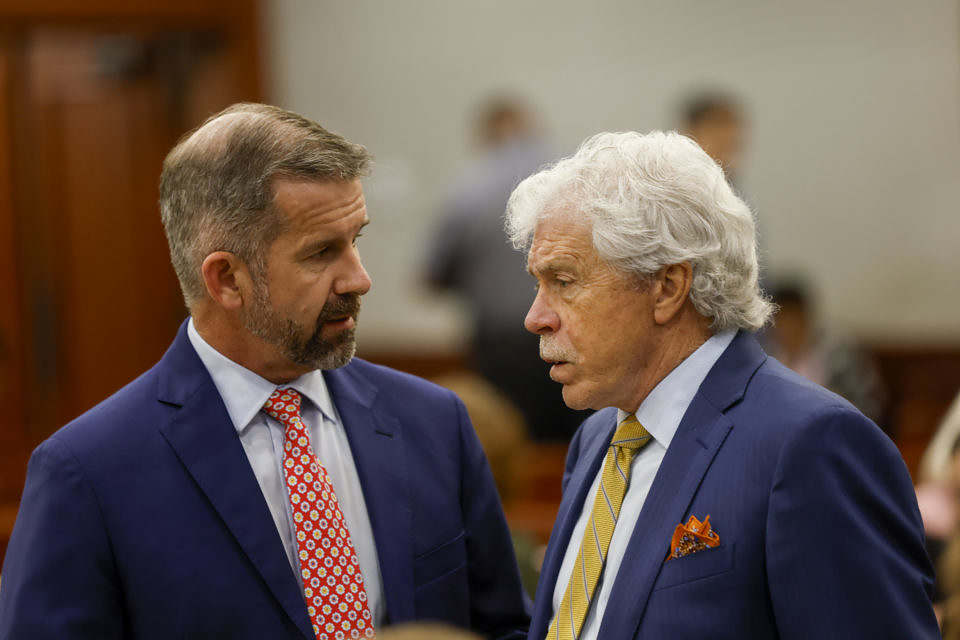
Two days into a high-stakes, high-profile South Carolina ‘Stand Your Ground‘ immunity hearing, the courtroom narrative has taken a sharp turn — not because of new forensic evidence, but because of how two central witnesses now describe what they saw.

The hearing stems from the fatal roadside shooting of 33-year-old North Carolina insurance adjuster Scott Spivey on Camp Swamp Road in rural Horry County in September 2023. Defendants Charles Weldon Boyd and Kenneth Bradley Williams — who admitted to shooting Spivey – were not criminally charged after prosecutors concluded they acted within South Carolina’s Protection of Persons and Property Act, a.k.a. its ‘Stand Your Ground’ law.

Now staring down a wrongful death lawsuit, Boyd and Williams are asking a Palmetto State court to find they are likewise immune from civil liability in the action filed by Spivey’s estate.

Under South Carolina law, immunity is unavailable if a defendant was determined to be the aggressor or to have engaged in unlawful conduct at the time deadly force was used. That means the court must closely examine who initiated the confrontation, whether there was a sustained pursuit – and how the final exchange unfolded.

Support FITSNews … SUBSCRIBE!

***

The testimony of eyewitness Blaiz Ward and witness Frank McMurrough — both positioned along the Highway 9 corridor during the escalating roadway encounter — goes directly to those questions. Their observations have been cited by both sides in support of competing narratives: the defense portraying Spivey as the aggressor, the plaintiff arguing Boyd pursued and escalated the encounter.

But as deposition transcripts and prior statements are compared side by side, their accounts have evolved in notable ways from earlier recorded and sworn statements.

Those changes now sit squarely before S.C. Circuit Court judge Eugene C. Griffith, Jr., who will determine whether Boyd and Williams are to be shielded from civil liability.

In an immunity hearing decided by a preponderance of the evidence standard, credibility is everything – and shifts in testimony matter.

***

RELATED | ‘STAND YOUR GROUND’ SHOWDOWN UNDERWAY

***

BLAIZ WARD’S SHIFTING STORY

On the night of the shooting, Blaiz Ward provided a handwritten voluntary statement (.pdf) to the Horry County Police Department (HCPD). In that statement, she described the black truck driven by Spivey as driving “reckless,” moving in and out of lanes and pointing a gun out of the driver’s window. She also wrote that the black truck “ran the white truck off the road because of his driving.”

Her early description aligned closely with the defense theory that Spivey was the aggressor.

But in her February 13, 2026 sworn deposition (.pdf), Ward’s testimony became more measured — and in some respects, more qualified.

Under questioning, Ward acknowledged that parts of her 911 call were confusing and that she was “frantic” after seeing a gun. She agreed that some assumptions she formed at the scene — including her early impressions about who fired first — were made in the moment and without full visibility of every movement.

Perhaps most notably, when asked whether she believed Boyd was pursuing Spivey, Ward testified that at the time of the incident she did not think so — but today, she believes that is what was happening.

Her deposition also placed those changes in context.

Ward confirmed that her original 911 call and written statement were given before she had heard any outside commentary about the case — including podcasts or online discussions. By the time of her deposition, however, she acknowledged awareness of public debate surrounding her 911 call and her presence at the scene.

That timeline — immediate statements made within hours of the shooting, followed by later sworn testimony after months of intense public scrutiny — is now part of the evidentiary record.

She also confirmed she did not see Spivey exit his vehicle and did not directly observe him fire a weapon during the final moments on Camp Swamp Road.

In effect, Ward’s early statements conveyed greater immediacy and certainty about Spivey’s conduct. Her deposition reflects narrower claims — clearer about what she did not see and more cautious about sequence.

Defense attorneys have emphasized her contemporaneous statement. Plaintiff’s counsel has underscored her later sworn clarifications.

Judge Griffith must now decide which version carries greater weight.

***

FRANK MCMURROUGH’S SHIFTING CERTAINTY

The deposition of Frank McMurrough, a witness in the ‘Stand Your Ground’ shooting case involving Scott Spivey, is shown in court on the second day of proceedings. (Jason Lee/Pool)

***

On Wednesday, McMurrough’s deposition (.pdf) became a critical record in the immunity dispute, particularly when defense attorneys pressed him on what he personally saw versus what he inferred during the chaos of the moment.

During plaintiffs’ attorney Mark Tinsley’s direct questioning, McMurrough initially stated he did not recall certain details from that day, including specifics from his 911 call. But when shown prior statements — including his recorded interview and handwritten statement — he acknowledged key points: he saw the driver of the black truck exit with a pistol drawn, observed what appeared to be a two-handed grip, and described gunfire erupting almost immediately thereafter.

On cross-examination, however, defense counsel Kenneth Moss walked carefully through McMurrough’s 911 call and written statement, parsing out what he directly observed versus what he relayed from others at the scene.

Under questioning, McMurrough clarified several critical points:

  • He did not know who fired first.
  • He did not see Spivey re-enter the truck.
  • He did not see muzzle flash from Boyd’s weapon — only heard gunshots.
  • He acknowledged that portions of his 911 call included information he learned from speaking to others after the shooting began.

He confirmed that during the 911 call he was “trying to relay everything that [he] perceived” in a fast-moving, traumatic moment — including fears there might be children in the black truck. He agreed the transcript would accurately reflect what he said that day.

Defense counsel emphasized that distinction — between immediate perception and confirmed observation — particularly as it relates to whether McMurrough actually saw a shot fired or simply saw a gun present before “all hell broke out,” as he described it.

At the same time, McMurrough did not retreat from key aspects of his account: he maintained that he saw the black truck’s driver exit with a firearm and that he perceived gunfire coming from the white truck’s direction as the confrontation escalated.

In an immunity hearing where judge Griffith must determine who escalated the encounter — and whether the defendants reasonably feared imminent deadly harm — the nuances of McMurrough’s vantage point, perception and certainty now sit squarely in the court’s hands.

***

WHY IT COULD DECIDE THE CASE

S.C. Circuit Court Judge Eugene Griffith Jr. listens intently to testimony from Kerry Higgs, an Horry County Police Officer, during a high-profile ‘Stand Your Ground’ hearing in Conway, S.C. on February 18, 2026. (Jason Lee/Pool)

***

This is not a jury trial…

There will be no deliberations and no verdict form. The judge alone must decide whether the defendants have proven — by a preponderance of the evidence — that they acted in lawful self-defense.

“Preponderance” is the civil standard of proof. It means the judge must find it is more likely than not — even slightly more than 50 percent — that Boyd and Williams were justified and were not the aggressors.

If they meet that burden, immunity applies and the plaintiffs would be enjoined from pursuing their civil case against the two men. If the evidence leaves the judge unconvinced — or meaningfully uncertain about who escalated the confrontation — immunity is denied and the case moves toward trial.

That makes credibility central.

Two days in, the hearing has shifted from physical evidence to perception, memory and consistency. Judge Griffith must weigh contemporaneous 911 calls against later sworn depositions. He must decide whether shifts in testimony reflect natural clarification — or create doubt about the defense’s version of events.

Keep it tuned to FITSNews as we continue to provide coverage of these ongoing proceedings… and await judge Griffith’s determination.

***

ABOUT THE AUTHOR …

Jenn Wood (Provided)

As a private investigator turned journalist, Jenn Wood brings a unique skill set to FITSNews as its research director. Known for her meticulous sourcing and victim-centered approach, she helps shape the newsroom’s most complex investigative stories while producing the FITSFiles and Cheer Incorporated podcasts. Jenn lives in South Carolina with her family, where her work continues to spotlight truth, accountability, and justice.

***

WANNA SOUND OFF?

Got something you’d like to say in response to one of our articles? Or an issue you’d like to address proactively? We have an open microphone policy! Submit your letter to the editor (or guest column) via email HERE. Got a tip for a story? CLICK HERE. Got a technical question or a glitch to report? CLICK HERE.

***

Subscribe to our newsletter by clicking here…

*****

Related posts

CRIME & COURTS

South Carolina Man Gets 125 Counts In ‘VINsanity’ Fraud Probe

Erin Parrott
CRIME & COURTS

Columbia Woman Admits To Stealing Dead Relative’s Pension Payments

Erin Parrott
CRIME & COURTS

SCDNR Officer Fired After Making False Statements, Records Show

Andrew Fancher

Leave a Comment