
by JENN WOOD
***
Last week, FITSNews reported extensively on Clemson University’s worsening financial condition — a deepening crisis marked by rising debt, internal pressure for sweeping budget cuts, and growing frustration among the school’s board of trustees.
Now, newly obtained internal communications have revealed yet another layer of that financial turmoil…
A behind-the-scenes legal battle is raging over whether Clemson’s leadership improperly restricted funds tied to the university’s Public Service Activities (PSA) division — funds some officials argued were protected by state law and could not legally be withheld to stabilize the university’s broader finances.
This dispute has escalated all the way to the South Carolina attorney general’s office, where Clemson regulatory officials sought guidance as to whether university leadership was interfering with their ability to perform legally mandated duties.

***
WHY PSA MATTERS…
To understand the significance of the dispute, it is important to understand what Clemson’s Public Service Activities division actually is.
PSA is not a traditional academic department. It is the operational arm of Clemson’s land-grant mission — overseeing programs tied directly to agriculture, public health, research, and statewide regulatory enforcement.
Those programs include:
- Clemson Cooperative Extension Service
- Agricultural Experiment Station
- Livestock and Poultry Health (LPH)
- Regulatory and Public Service Programs
Together, those divisions oversee everything from pesticide regulation and invasive species control to livestock disease response, agricultural outreach, and environmental compliance. And unlike traditional university operating funds, portions of PSA funding are tied to specific statutory mandates.
That distinction sits at the center of the current dispute.
Acording to internal emails and audit materials (.pdf) reviewed by FITSNews, PSA officials believed Clemson leadership was treating restricted regulatory funds as part of a broader institutional budget crisis — potentially limiting access to money they argued was legally earmarked for specific public service functions.
Those concerns aligned with language lawmakers recently inserted into the proposed 2026-2027 state budget.
As previously reported by FITSNews, a proviso inserted into the upcoming 2026-2027 state budget would require PSA funds to be “maintained, budgeted and accounted for in a separate and distinct fund.” The same proviso would explicitly prohibit money from being “transferred, loaned or otherwise moved” between accounts.
That language did not emerge in a vacuum. Documents suggest lawmakers may have been responding to a growing internal conflict over whether Clemson was attempting to consolidate or suppress PSA funds amid mounting financial pressure elsewhere within the university.
***
‘NO SPENDING APPROVALS…’
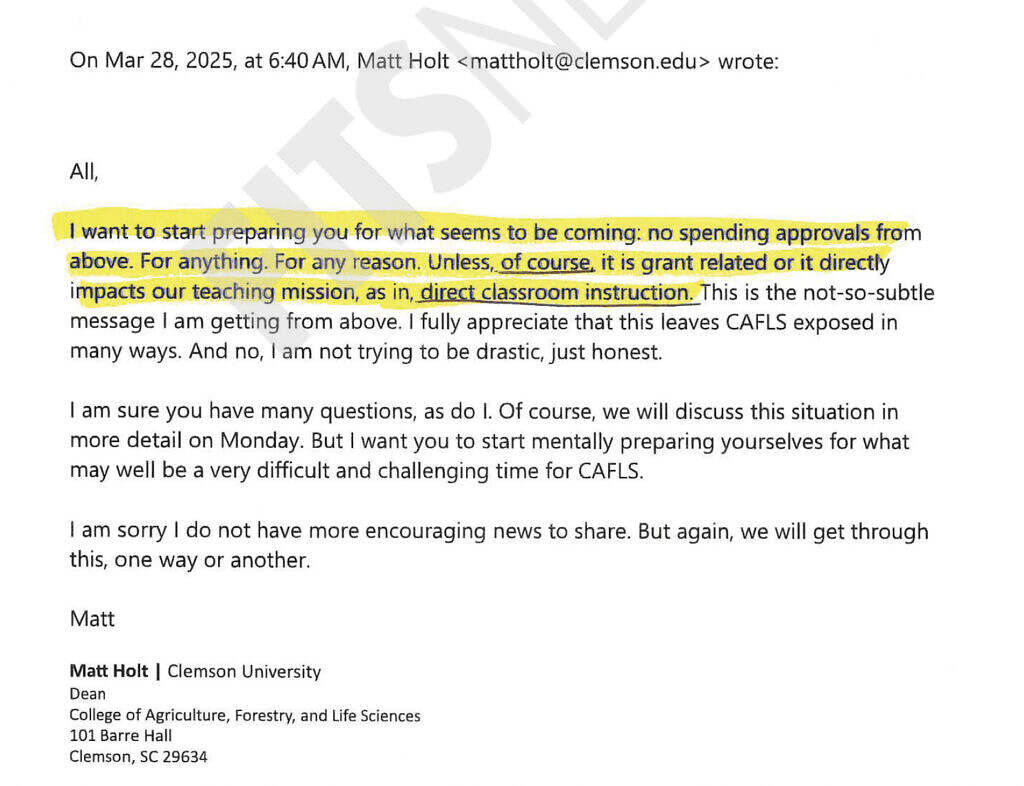
The conflict intensified in March 2025 with an email circulated to leadership at Clemson’s College of Agriculture, Forestry and Life Sciences (CAFLS) leadership. In that message, dean Matthew Holt warned that broad spending restrictions were imminent.
“I want to start preparing you for what seems to be coming,” Holt wrote. “No spending approvals from above. For anything. For any reason.”
The directive included limited exceptions for grant-funded activity and direct classroom instruction — but for PSA officials responsible for carrying out statutory regulatory duties, the implications were immediate. Internal communications show PSA leadership believed the restrictions could place them “in direct conflict with the law.”
***
***
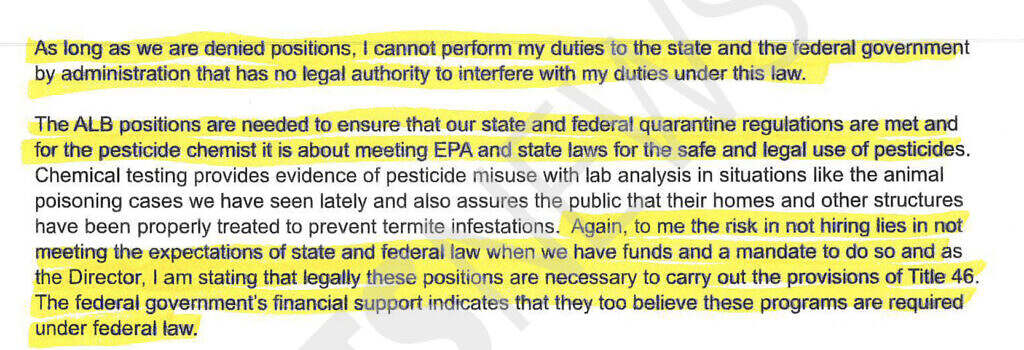
Specifically, officials questioned whether limiting spending and denying hiring requests could interfere with regulatory operations the state has legally assigned to Clemson under Title 46 of the South Carolina Code of Laws — including inspection, enforcement, and public protection responsibilities tied to agriculture and animal health.
The concern, according to the emails, was not simply that budgets were tight – it was that financial restrictions imposed by university leadership could impair programs the state legally requires Clemson to operate.
***
***
RAISING THE STAKES…
By March 31, 2025, the issue had reached attorney general Alan Wilson‘s office. Emails obtained by FITSNews (.pdf) showed Clemson regulatory officials formally sought guidance regarding whether restrictions placed on PSA funds and operations constituted unlawful “interference” under state law.
One statute cited repeatedly in the communications — S.C. Code of Laws § 46-9-80 — makes it a misdemeanor to interfere with officials carrying out duties assigned under Title 46.
PSA officials argued that sweeping spending freezes and denied hiring requests could prevent inspections, enforcement actions, and other required regulatory functions.
“This is a fairly cut and dry matter,” one Clemson official wrote in an email to state attorneys.
The official argued PSA funds were derived from state appropriations, federal grants, and generated revenue “mandated through statute to be used solely for their regulatory programs.”
The same communication claimed restrictions imposed by Clemson leadership were making it “impossible to protect industry, the citizens of SC, agriculture, forestry and other stakeholders.”
The internal record confirms those concerns were not merely hypothetical.
In communications with assistant attorney general Matthew Houck, Clemson associate general counsel Robert Wilkins acknowledged that PSA officials had raised concerns that “funds were being frozen by the University” and that hiring requests were being denied.
Houck stopped short of endorsing criminal liability, but his response introduced a significant legal distinction.
“If there was a willful withholding of funds that are earmarked for a specific purpose,” Houck wrote, “a court may order those funds to be released as directed by statute.”
That statement appears to have become a key focal point in the dispute — because it framed the issue not simply as an administrative budgeting disagreement, but as a question involving statutorily restricted public funds.
***

RELATED | CLEMSON’S FINANCIAL CRISIS DEEPENS
***
A GROWING FINANCIAL CRISIS…
The legal concerns surrounding PSA funding emerged against the backdrop of Clemson University’s increasingly strained financial condition — a crisis that has placed mounting pressure on administrators to cut costs and reduce spending across the institution.
As previously reported by FITSNews, Clemson’s debt has climbed to approximately $1.15 billion while long-term liabilities have surged to roughly $2.65 billion. At recent board meetings, trustees openly criticized university leadership for failing to bring expenses under control, with some pushing for aggressive cuts while others warned the university lacked a coherent long-term reform strategy.
It was during that period of financial pressure that internal audit findings raised additional concerns about Clemson’s handling of PSA budgets.
Documents reviewed by FITSNews indicate auditors warned of a “potential conflict” involving consolidated spending targets between PSA and CAFLS due to statutory restrictions tied to certain PSA funding sources. The same materials stated PSA funding “should support all PSA functions” and warned PSA budgets “should not be suppressed to meet consolidated spending targets.”
Those findings closely mirrored concerns raised internally by PSA officials, who feared regulatory and public service operations were being caught in the middle of Clemson’s broader budget crisis.
According to emails and audit materials reviewed by FITSNews, some Clemson personnel believed funds tied to legally mandated PSA operations were effectively being treated as part of a larger institutional balancing strategy — despite statutory restrictions governing how portions of that money could be used.
***
A DISPUTE THAT DIDN’T GO AWAY…
Despite the seriousness of the concerns raised by PSA officials, Wilson’s office never issued a formal opinion on the matter. Internal correspondence instead shows officials advising that the office could not act without a formal request from an authorized entity and suggesting the concerns could potentially be referred to the South Carolina Office of Inspector General (SCOIG).
But the issue did not disappear.
By February 2026, Clemson regulatory officials were again contacting the attorney general’s Office alleging continued interference and ongoing restrictions tied to PSA funding — nearly a year after the initial concerns were raised.
That timeline suggests this was not a temporary budget disagreement or short-term cost-cutting measure. It was a sustained internal conflict over whether Clemson’s response to mounting financial pressure collided with statutory obligations governing PSA programs and regulatory enforcement.
At this stage, the documents reviewed by FITSNews establish several things clearly: Clemson leadership implemented broad spending restrictions amid escalating financial pressure; PSA officials believed those restrictions interfered with duties mandated under Title 46 of the South Carolina Code; concerns over frozen funds and denied hiring requests were escalated to the Attorney General’s Office; Clemson’s own legal counsel acknowledged those concerns internally; and internal audit materials warned against suppressing PSA budgets to meet consolidated financial targets.
What remains unresolved is the central question underlying the dispute:
Whether Clemson’s actions amounted to ordinary financial management during a budget crisis — or crossed into the unlawful withholding of funds earmarked by statute for specific public service functions.
The answer to that question may ultimately depend on financial records, audit workpapers, and internal legal analyses that have not yet been publicly released.
But one thing now appears unmistakably clear — the fight over Clemson’s finances is no longer just about debt. It is about whether the university’s response to that debt collided with the law.
***
ABOUT THE AUTHOR …
As a private investigator turned journalist, Jenn Wood brings a unique skill set to FITSNews as its research director. Known for her meticulous sourcing and victim-centered approach, she helps shape the newsroom’s most complex investigative stories while producing the FITSFiles and Cheer Incorporated podcasts. Jenn lives in South Carolina with her family, where her work continues to spotlight truth, accountability, and justice.
***
SOUND OFF…
Got something you’d like to say in response to one of our articles? Or an issue you’d like to address proactively? We have an open microphone policy! Submit your letter to the editor (or guest column) via email HERE. Got a tip for a story? CLICK HERE. Got a technical question or a glitch to report? CLICK HERE.

1 comment
Very well written article! Thanks for keeping us informed. I wonder what ever happened to that lawsuit about the lifetime trustees on the Clemson board…..