
|
Getting your Trinity Audio player ready...
|
by JENN WOOD
***
By now, most people know the headline: South Carolina’s supreme court unanimously – and emphatically – overturned the murder convictions of Alex Murdaugh.
What many people still do not understand, though, is why.
The ruling was not based on new DNA evidence. It was not because the justices concluded Murdaugh was innocent. And it was not because prosecutors failed to present evidence tying him to the savage killings of his wife, 52-year-old Maggie Murdaugh, and younger son – 22-year-old Paul Murdaugh – on the evening of June 7, 2021.
Instead, the case turned on something less intuitive — but constitutionally fundamental. In its blistering per curiam opinion, the court concluded the integrity of the jury process itself had been compromised.
To many outside the legal world, that may sound technical or procedural. But in the American justice system, the right to an impartial jury is not a side issue – it is the foundation of a criminal trial. And according to the state’s highest court, former Colleton County clerk of court Rebecca “Becky” Hill crossed a line that made it impossible for the justices to confidently say Murdaugh received the fair trial he is guaranteed under our Constitution.
The court’s decision carries enormous implications — not just for Murdaugh, but for how courts across South Carolina handle allegations of jury tampering, courtroom misconduct and outside influence going forward.

***
THE CORE ISSUE
At the heart of Alex Murdaugh’s appeal of his double homicide convictions was the allegation that Hill improperly communicated with jurors during his six-week trial – held from January 23 through March 2, 2023 at the Colleton County courthouse in Walterboro, S.C.
Months after the trial concluded, jurors alleged Hill made comments that appeared to steer them toward a guilty verdict – warning them not to be “fooled” by Murdaugh’s testimony and encouraging them to closely watch his behavior on the witness stand.
Those accusations became especially explosive after Hill published a book and embarked on a media tour following the trial — creating what Murdaugh’s attorneys argued was a personal and financial motive to influence the proceedings.
For many people outside the legal system, one of the hardest concepts to understand is how courts can overturn convictions even when the evidence against a defendant appears overwhelming. But appellate courts are not designed to simply determine whether someone was “probably guilty.” Their role is to determine whether constitutional protections were followed.
The Sixth Amendment to the U.S. Constitution guarantees criminal defendants the right to a fair trial before an impartial jury. That means jurors must decide a case based solely on evidence presented in court — not pressure, outside commentary or influence from court officials.
Importantly, the South Carolina Supreme Court was not asked to decide whether Hill successfully forced a guilty verdict. Instead, the legal question was narrower — and far more consequential.
Did her conduct create an improper outside influence on the jury?
And if so, did the state prove that influence was harmless?
The justices ultimately concluded Hill’s actions threatened the constitutional guarantee of a fair and impartial jury trial. And once that threshold was crossed, the legal burden shifted dramatically.
***

***
THE LEGAL DOCTRINE THAT CHANGED THE CASE
One of the most important — and least understood — aspects of the supreme court’s ruling involves a legal framework known as the Remmer presumption.
The doctrine comes from a landmark 1954 U.S. Supreme Court decision, Remmer v. United States.
That case involved a federal tax fraud prosecution in which someone allegedly approached a juror during the trial and suggested he could profit by delivering a favorable outcome for the defendant. Rather than immediately informing defense attorneys, the trial judge quietly asked the Federal Bureau of Investigation (FBI) to investigate the incident while the trial was still underway. The defendant was ultimately convicted without knowing the contact had occurred.
When the issue later surfaced, the U.S. supreme court concluded the handling of the situation posed a serious threat to the defendant’s constitutional right to an impartial jury.
The court recognized something fundamental about the jury system: outside influence on jurors is extraordinarily dangerous because courts can rarely measure its true impact after the fact.
Jurors may not even fully understand how subtle pressure, commentary or perceived authority influenced their thinking.
***
***
As a result, the supreme court established a powerful legal safeguard. In simple terms, the Remmer rule says this: when jurors are exposed to improper outside influence during a trial, courts must presume prejudice occurred unless the government proves otherwise. That is a major shift from the normal burden of proof. Usually, defendants must prove they were harmed by misconduct.
Under the Remmer framework, once improper influence is shown to be “more than innocuous,” the burden flips to the prosecution. The state must then prove the misconduct did not affect the verdict.
That burden-shifting framework was decisive in Murdaugh’s case. In its unanimous ruling, the supreme court concluded its erstwhile leader – former chief justice Jean Toal – applied the wrong legal standard during the original evidentiary hearing on the jury tampering allegations.
Toal had largely focused on whether jurors themselves claimed they were influenced — but the supreme court said that was legally insufficient under Remmer.
Why? Because jurors are often poor judges of whether subtle influence affected their decision-making.
The justices ultimately concluded Hill’s alleged comments and conduct were significant enough to trigger the Remmer presumption — meaning the burden shifted to prosecutors to prove the jury remained untainted.
And according to the court, the state failed to meet that burden…
***

***
“THE APPEARANCE OF FAIRNESS”
The supreme court’s ruling also leaned heavily on longstanding legal principles holding that courts must guard not only against actual prejudice, but against conduct creating the appearance of unfairness.
In citing prior South Carolina precedent — including State v. Green — the justices emphasized that public confidence in the judicial system depends on the belief that verdicts are reached by impartial jurors free from outside influence.
The Green case itself involved concerns about whether outside conduct and improper courtroom interactions had compromised the integrity of the trial process. In that decision, the court stressed that the justice system must avoid not only actual bias, but situations that create reasonable doubt about the fairness and neutrality of judicial proceedings.
That principle reflects a broader reality underlying the American legal system: courts derive their legitimacy from public trust. If citizens begin to believe verdicts are influenced by courtroom officials, political pressure, personal interests or improper communications with jurors, confidence in the entire judicial process begins to erode.
That principle became especially important in the Murdaugh case because the alleged misconduct came not from a stranger, spectator or anonymous third party — but from the elected clerk of court overseeing the trial itself. According to the supreme court, that distinction mattered enormously.
Jurors naturally view court officials as authoritative figures connected to the judicial process. Comments from someone in that position can carry far greater weight than ordinary outside commentary.
The court ultimately concluded Hill’s conduct created precisely the kind of appearance of impropriety the judicial system cannot tolerate — particularly in a case drawing intense national scrutiny. In other words, the ruling was not simply about whether jurors changed their votes because of Hill’s comments – it was about whether the public can trust the verdict was reached fairly, independently and free from improper influence.
***
***
RULE 606(B)
Another key legal concept cited by the court in its decision was Rule 606(b), a South Carolina court rule which governs what jurors are allowed to say after a verdict (or indictment).
This rule severely limits what jurors can discuss, preventing them from testifying about:
- their mental processes,
- internal deliberations,
- emotional reactions,
- how evidence influenced them
Courts imposed this rule to protect the secrecy and independence of jury deliberations. Otherwise, every controversial verdict could devolve into endless post-trial interrogations of jurors.
However, there is an important exception: jurors can testify about outside influence or improper external conduct, a distinction that mattered enormously in the Murdaugh appeal.
In their decision, justices concluded Toal improperly relied on jurors saying things like “we were not influenced,” or “the comments did not affect our verdict.”
Under Rule 606(b), the justices said those statements should not have carried substantial legal weight.
The issue was not whether jurors believed they remained impartial – the issue was whether improper outside influence occurred in the first place.
***
***
LANGUAGE THAT MATTERS
Appellate courts are typically careful and restrained in their wording. This opinion was anything but…
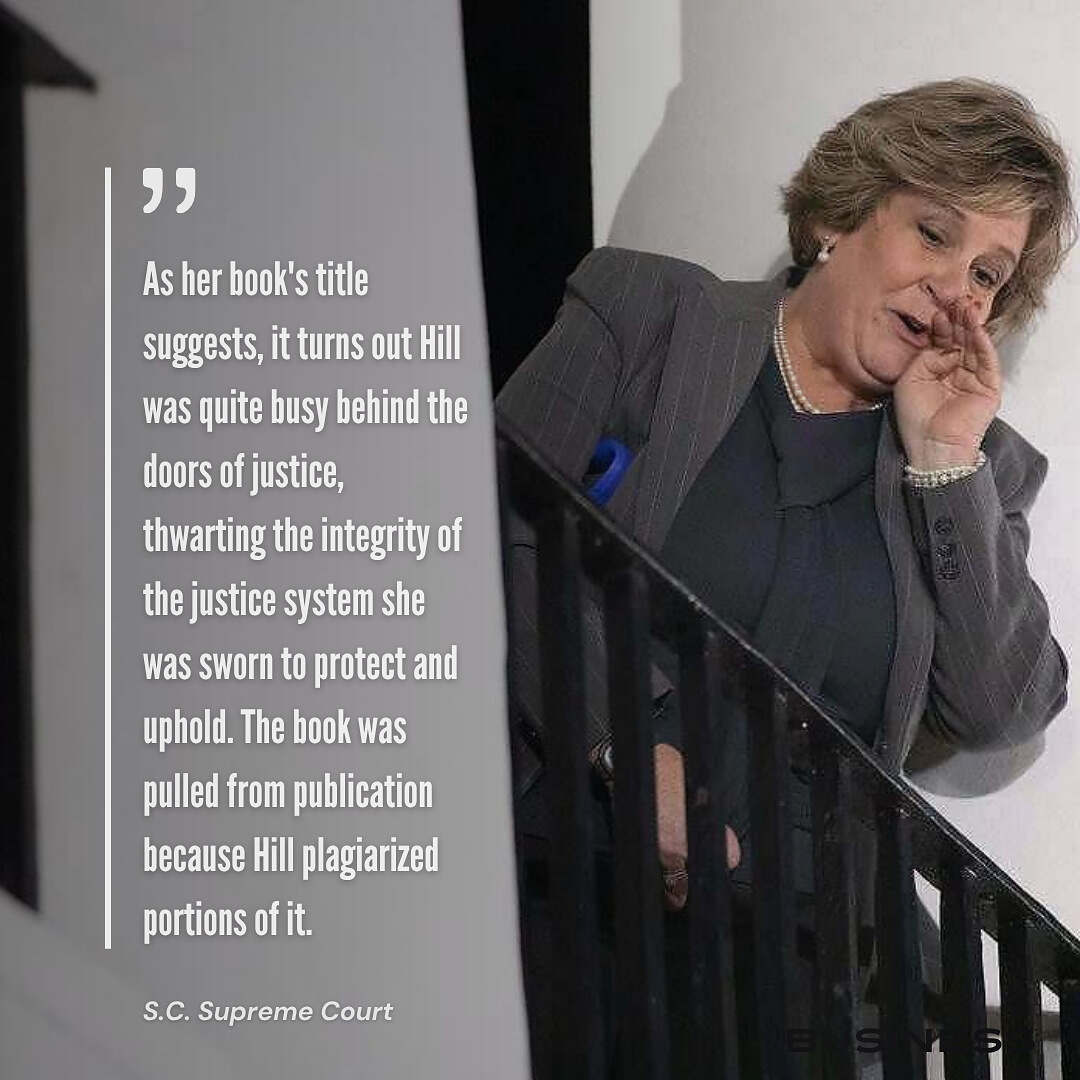
The supreme court sharply criticized former Colleton County clerk of court Becky Hill, writing she had “betrayed her oath of office for money and fame” and “placed her fingers on the scales of justice.”
That language matters because appellate courts rarely use such pointed rhetoric unless they believe misconduct seriously undermined public confidence in the judicial process.
The wording also reflected the justices’ view that Hill’s conduct was not an isolated mistake or minor procedural lapse. According to the opinion, Hill occupied a uniquely sensitive position within the courtroom itself. As clerk of court, she was not merely an observer or administrative employee. Jurors interacted with her daily throughout one of the most high-profile murder trials in modern American history.
That institutional authority became central to the court’s analysis.
Jurors are naturally inclined to view court officials as trusted extensions of the judicial process. Even subtle comments from someone in that role can carry enormous influence — particularly during a lengthy, emotionally charged trial in which jurors are heavily dependent on court personnel.
The justices also appeared deeply troubled by the perception that Hill may have personally benefited from the trial’s outcome through media attention, public appearances and book sales following the verdict.
That combination — alleged improper juror communications coupled with apparent personal gain — appears to have fundamentally shaped the tone of the ruling. The court repeatedly framed Hill’s conduct not simply as inappropriate, but as corrosive to the legitimacy of the judicial system itself.
In many ways, the opinion reads less like a routine appellate ruling and more like a warning about the importance of preserving public trust in the integrity and neutrality of criminal trials.
The ruling effectively transformed Hill from a peripheral courthouse figure into the central reason one of the most notorious murder convictions in modern South Carolina history no longer exists.
***

***
THE FINANCIAL CRIMES
Although the reversal ultimately centered on jury tampering, the court also delivered another major ruling with potentially enormous implications for any future retrial – criticizing the sheer scope of financial crimes evidence introduced during the original murder trial.
Over the course of several days, prosecutors walked jurors through a sprawling web of alleged thefts, fraud schemes, missing client money, fake accounts, unpaid debts and financial deception tied to Alex Murdaugh.
Much of the state’s original theory of motive rested on the idea that Murdaugh was facing mounting financial pressure and feared his various fraud schemes were on the verge of collapse. Prosecutors argued the murders bought him time, distracted scrutiny and generated sympathy at a moment when his financial crimes were beginning to unravel publicly.
The court agreed that at least some financial evidence was relevant to establishing motive, but the justices concluded prosecutors went well beyond what was necessary to make that point. In one of the most consequential portions of the opinion, the court wrote the state went “far too long and far too deep” into Murdaugh’s financial misconduct.
***
***
That criticism matters because appellate courts typically give prosecutors broad discretion in presenting motive evidence — especially in circumstantial murder cases. The fact that the justices concluded the evidence became excessive signals significant concern about how much unrelated misconduct jurors were exposed to during the six-week trial.
For non-lawyers, the concern centers on something courts call “unfair prejudice.”
Under the rules of evidence, prosecutors generally cannot introduce large amounts of unrelated bad acts simply to convince jurors a defendant is a bad person who likely committed the charged crime.
Courts try to balance two competing concerns:
- whether evidence legitimately helps explain the alleged motive or context of a crime,
- versus whether the evidence risks inflaming jurors emotionally or encouraging conviction based on character rather than proof.
The court concluded portions of the financial crimes presentation crossed that line.
That does not mean financial evidence will disappear entirely from a retrial. Far from it. Prosecutors will almost certainly still attempt to show Murdaugh faced growing financial exposure and personal pressure in the weeks leading up to the murders. But the ruling gives the defense far stronger grounds to challenge the breadth and detail of that evidence before a second trial begins.
The practical effect of these guardrails could be substantial.
The original trial often resembled two cases unfolding simultaneously – a double murder prosecution and a sweeping financial crimes exposé. In a retrial, jurors may hear a far narrower and more tightly controlled version of Murdaugh’s alleged financial misconduct.
That could significantly alter the pacing, tone and strategic focus of the state’s presentation — potentially forcing prosecutors to rely more heavily on forensic evidence, witness testimony and the timeline surrounding the killings themselves.
***

***
WHAT HAPPENS NEXT…
Legally, the South Carolina supreme court’s decision does not mean Alex Murdaugh walks free. It simply means his murder convictions are vacated and the case is sent back — or remitted — to the lower court for further proceedings consistent with the high court’s ruling.
That remittitur process is a routine but important procedural step in appellate law. Under South Carolina appellate rules, the remittitur ordinarily is not issued until the 15-day window for filing a petition for rehearing expires. If prosecutors seek rehearing of the court’s decision, the remittitur would be delayed pending resolution of that request. Once the remittitur is formally issued, jurisdiction transfers back to the Colleton County trial court, where prosecutors and defense attorneys begin litigating what happens next.
South Carolina attorney general Alan Wilson has already indicated prosecutors plan to pursue a new murder trial – in Colleton – with all options (including the death penalty) on the table. Meanwhile, defense attorneys will likely seek a change of venue as one of their pretrial motions.
Clearly, Murdaugh’s retrial will look significantly different from the original proceedings. The court’s opinion imposed major new guardrails on the prosecution — particularly regarding the scope of financial crimes evidence that can be introduced and the handling of jury-related issues moving forward.
The ruling also creates practical challenges. Defense attorneys will almost certainly file extensive pretrial motions seeking to narrow evidence, revisit procedural questions and potentially challenge aspects of the original investigation.
***
***
Questions surrounding jury selection could become even more complicated given the extraordinary publicity surrounding the case and the Supreme Court’s findings regarding former clerk of court Becky Hill.
But for many legal observers, the broader significance of the ruling extends far beyond one defendant or one murder trial. The decision strengthens protections against jury interference statewide and establishes clearer guidance for how South Carolina courts must handle allegations of outside influence on jurors in future cases.
It also sends a powerful message that courtroom officials — including elected clerks of court — are not immune from scrutiny when their conduct threatens judicial neutrality.
More fundamentally, the ruling reinforces a constitutional principle many people find uncomfortable but essential to the American legal system:
Constitutional rights apply equally to everyone.
Even deeply unpopular defendants.
Even defendants many people believe are guilty.
The justice system is designed not merely to secure convictions, but to ensure convictions are obtained fairly, impartially and in a manner the public can trust.
The South Carolina Supreme Court ultimately concluded that standard was not met in the Murdaugh trial. And because of that conclusion, one of the most closely watched murder convictions in modern American history no longer stands.
***
ABOUT THE AUTHOR …

As a private investigator turned journalist, Jenn Wood brings a unique skill set to FITSNews as its research director. Known for her meticulous sourcing and victim-centered approach, she helps shape the newsroom’s most complex investigative stories while producing the FITSFiles and Cheer Incorporated podcasts. Jenn lives in South Carolina with her family, where her work continues to spotlight truth, accountability, and justice.
***
SOUND OFF…
Got something you’d like to say in response to one of our articles? Or an issue you’d like to address proactively? We have an open microphone policy! Submit your letter to the editor (or guest column) via email HERE. Got a tip for a story? CLICK HERE. Got a technical question or a glitch to report? CLICK HERE.

3 comments
My compliments to you, Jenn Wood, are subsumed in my care to make one correction and several necessary, but succent and useful additions to this excellent article of yours.
The corrections is that NOTHING limits what jurors can say about their verdict or anything else after the verdict or indictment of their own volition OUTSIDE OF JUDICIAL PROCEEDINGS.
The limitations are on their being REQUIRED to testify in court in post-verdict or post-indictment proceedings about their mental processes in reaching their verdict or indictment.
The rest of your article is more precise; but your choice of the word “say” on reference to Rule 606(b) is too broad and may give some a false impression that those jurors who CHOSE to speak to Richard Alexander Murdaugh’s (“RAM”) defense team after Becky Hill’s book came out did something improper.
Now to the additions:
The right to impartiality of a representative jury, when trial by jury is timely and clearly demanded, is guaranteed by the 6th Amendment in criminal cases, AND BY THE SEVENTH IN CIVIL CASES when the value in controversy exceeds $20.
So, meddling with a civil jury is as offensive to the Constitutions of the U.S. and of South Carolina as meddling with a jury hearing a criminal case. No one should have different ideas.
Next, a person may not be imprisoned in his/her rights. Though the right to counsel and to jury trial are constitutionally guaranteed, a person is equally constitutionally protected in choosing to represent him/herself and/or in opting for a bench trial instead of a jury trial.
And in bench trials, civil or criminal, the Constitution guarantees a judge who is not only impartial in fact but also meets the appearance of impartiality.
Nor is the Constitution limited to the 6th and 7th amendments; before them are the 4th and 5th Amendments, the latter crucial in preventing coerced confessions, true or false.
And DUE PROCESS is not merely procedural; it is substantive, too, though there is debate about the origins and scope of substantive due process. To my mind, it is in the Preamble to the Constitution, in the preceding Declaration of Independence, and in the Social Contract principles which motivated the common signatories to both documents.
Back to RAM’s case, I reiterate that due process guarantees him and all criminal defendants a pre-indictment/pre-presentation/pre-probable-cause-application unbiased and thorough investigation ACCORDING TO THE EVOLVING SCIENTIFIC KNOWLEDGE just as the 8th Amendment understanding of “cruel and unusual” punishment evolves with the evolving standards of decency of modern societies.
Finally, the whole purpose of all these constitutional safeguards is to ensure that no one gets convicted of a crime of which (s)he is in fact innocent; and if in fact guilty, not punished in excess of what contemporary decency allows.
I am disturbed by those who accept the retrial only because they are confident RAM will be prosecuted again and convicted again.
No, no, NO! The Constitution is not a museum piece or a silly dysfunctional ritual like the British judges’ and lawyers’ antique wigs.
Belief in the Constitution means open-mindedness to the premise that convictions obtained through constitutional violations may well have been convictions of the innocent.
Belief in the
Restoring appreciation of the Constitution requires restoration of common sense among other things.
Because Creighton Waters and his “number 2” former-CACA Fernandez succeeded in getting the public to buy an insane motive theory and an insane idea of death by phone-battery-death, the public is now making its own insane ideas that Becky Hill was really out to help Alex because they were kin and secret lovers.
Here again is my latest brilliant reply which deserves to be read and re-read until people come to their senses:
? @MickeeAdams , if Becky Hill had been out to do Alex Murdaugh a favor, she would have pushed the jury to return a NOT GUILTY verdict and been done with it.
How many times do I have to try to counter the insane idea that Becky Hill was out to help Alex Murdaugh?
More insane ideas about “justice” keep popping up.
“Justice,” according to Alan Wilson, for Paul and Maggie Murdaugh is spending “whatever it takes” for a SECOND WRONGFUL conviction of the man who loved them most, while the real shooter(s) roam free and perhaps are plotting to kill Alex Murdaugh himself in prison to end the inquiry.
Not one word from Alan Wilson about re-investigating the matter with an open mind.
We already know, from Becky Hill’s now-withdrawn book, that some spent thousands of dollars to keep a conviction-prone juror on the jury instead of his having to return to work and earn money to pay his baby-mama overdue child support.
Isn’t funneling money to sitting juror a very serious crime?
Why isn’t Alan Wilson investigating that?
Perhaps the source of that money to that juror is also a campaign contributor to Alan Wilson.
Isn’t that the REAL reason Alan Wilson never investigated Hatchet-for-Hire Heather’s (Sarah Heather Savitz Weiss) crimes of fabrication and subornation of perjury in a failed scheme to frame Dr. Marie Faltas for supposed “harassment in the first degree”?
Didn’t Alan Wilson rescue Hatchet-for-Hire Heather from the tumult of her then-colleagues at the Fifth Circuit’s solicitor’s office by hiring her (and later hiring John Meadors, too) after John Meadors lost his campaign for solicitor but Stephen Savitz, Heather’s father had made sizeable contributions to both the John Meadors and Alan Wilson 2010 campaigns?
Doesn’t Alan Wilson continue to promote Hatchet-for-Hire Heather within his office even though her reputation among lawyers is so bad that she withdrew her second candidacy for a judgeship after the secret bar surveys came back heavily negatively against her?
Heck! The woman even had her own son cheat on his Bar Mitzvah exam instead of doing the necessary work to learn Hebrew and become a true-before-God eligible for a Minyan!
And let’s talk about two other people, a wife and a son, each shot in the head by the gun of one man, in his sole presence, in his home, and to his ultimate financial gain.
Two difference, though: (1) that man’s second wife was shot in May 1993 and his first-bort son was shot in April 2016; (2) that man, Larry Wayne Mason, passed his shooting of Ella Faye Kaizer Mason and of Richard Wayne Mason off as suicides, even though the ballistics were against that and even though Richard Wayne Mason was hastily cremated WITHOUT an autopsy on this highly suspicious death.
And one more suspicious detail: Larry Wayne Mason’s second son, Ella’s only son, got reported dead in the middle of civil lawsuits and criminal drug and other charges against him, all without a death certificate for Christopher James Mason appearing anywhere.
Was it a fake death? Who knows other than Larry Wayne Mason, who remains able to blackmail officers and officials alike?
Where is Alan Wilson’s pursuit of Justice for Ella and Richard? Heck! Where is the concern for Christopher James’ children who are either lied to about their father’s fake death or are know the truth but are forced to join, and grow up in, lies?
Where is the justice for Dr. Marie Faltas’ family who got bankrupted financially supporting her through years of her 24/7 necessary and able pro se work to exonerate herself from the Larry-Wayne-Mason-ordered and Hatchet-for-Hire-Heather- executed, but thank God failed, scheme to railroad Dr. Marie Faltas into a false 36-year (yes, thirty-six years) incarceration for that Larry Wayne Mason could overtake Dr. Faltas’ tiny lot of land which Larry coveted just as Mark coveted Moselle?
I want Alan Wilson to answer to his own conscience before trying to answer to the voters.
Some day or another, we all have to answer to God; and if you don’t believe in God, at least believe in History coming back to interrogate you when you are no longer in power.