
|
Getting your Trinity Audio player ready...
|
by JENN WOOD
***
Nearly five years after the murders of 52-year-old Maggie Murdaugh and her son, 22-year-old Paul Murdaugh — and more than three years after Alex Murdaugh‘s attorneys accused prosecutors and investigators of fabricating blood spatter evidence against him — one of the most explosive motions filed before the original trial remains unresolved.
No hearing was ever held on the motion – and no ruling was ever handed down by the court.
It’s just another loose end in a saga increasingly defined by them… although the motion could wind up being one of the first orders of business in Murdaugh’s second trial, just as soon as the S.C. supreme court (which emphatically reversed Murdaugh’s double homicide convictions last week) picks a judge to preside over those proceedings.
At issue is a January 18, 2023 motion for sanctions (.pdf) filed by Murdaugh attorneys Dick Harpootlian, Jim Griffin and Phil Barber seeking to exclude all testimony tied to controversial Oklahoma bloodstain analyst Tom Bevel — along with any testimony derived from Bevel’s work product.
While never introduced during Murdaugh’s first trial, Bevel’s work product was the evidence that buried the disgraced attorney and confessed fraudster in the court of public opinion – solidifying his guilt in the hearts and minds of many tracking the case.

***
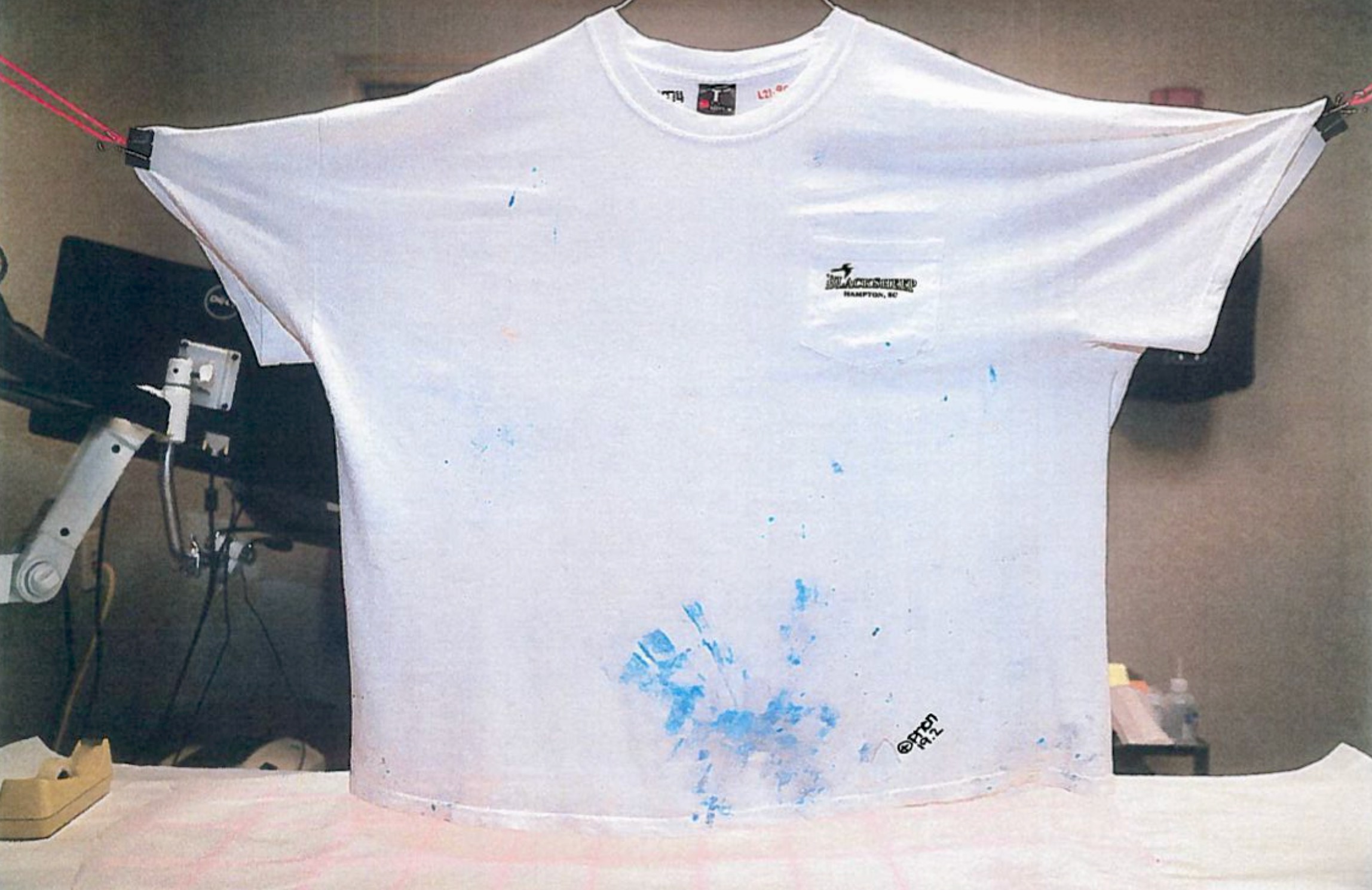
The filing in question accused agents of the S.C. State Law Enforcement Division (SLED) of “badgering” Bevel into changing his original conclusion that blood samples obtained from Murdaugh’s white T-shirt were “consistent with transfers and not back spatter from a bullet wound.”
According to the defense, Bevel’s original report was buried inside a massive discovery dump – mislabeled and misplaced – and was only uncovered thanks to the amazing digital sleuthing of Harpootlian’s paralegal, Holli Miller.
The discovery prompted Murdaugh’s attorneys to accuse SLED and Bevel of attempting to “fabricate evidence” against their client through Photoshop-enhanced imagery of the bloody shirt. They further accused the state of refusing to comply with judge Clifton Newman‘s December 2022 discovery order compelling the production of communications, Photoshop files and other underlying forensic materials.
Despite the severity of these allegations, the sanctions motion was never formally decided prior to Murdaugh’s six-week murder trial – which began on January 25, 2023. Nor was it ever revisited afterward.
***
KEY EVIDENCE — UNTIL IT WASN’T
***
The blood spatter issue occupied a strange — and increasingly controversial — place in the Murdaugh prosecution from almost the very beginning of the investigation.
Long before Alex Murdaugh was formally charged with murder in July 2022, rumors swirled throughout South Carolina’s legal community that investigators believed they had uncovered powerful forensic evidence tying him directly to the killings of his wife and son at Moselle.
In April 2022, FITSNews reported sources familiar with the investigation believed high-velocity impact spatter on Murdaugh’s clothing directly tied him to the killings.
At the time, the evidence appeared devastating.
“The presence of this forensic evidence on his clothing ‘could have only come from one thing,’” sources told this outlet.
The implication was unmistakable: investigators believed Murdaugh had been standing close enough to one or both victims to be sprayed during the shootings.
That allegation carried enormous weight because bloodstain pattern analysis — particularly high-velocity impact spatter associated with gunshots — has historically been viewed by jurors as highly persuasive forensic evidence. In theory, tiny mist-like droplets can reveal positioning, proximity and movement during a shooting.
And prosecutors badly needed something physical connecting Murdaugh to the actual murders.
At the time of the leak, public discussion surrounding the case was increasingly dominated by circumstantial evidence: financial crimes, shifting timelines, missing weapons, cellphone data and Murdaugh’s own inconsistent statements to investigators. The alleged blood spatter evidence appeared different. It appeared tangible. Scientific. Direct.
The problem? Behind the scenes, the forensic picture was far less settled than the public understood.
***

***
By late 2022, the foundation supporting the blood spatter narrative began to fracture — dramatically. According to defense filings, SLED retained Bevel to evaluate the white T-shirt Murdaugh wore on the night of the killings.
Bevel was not an obscure figure in forensic circles. He was nationally known in bloodstain pattern analysis and had testified in numerous high-profile cases around the country. But he was also controversial — particularly among innocence advocates who sharply criticized aspects of his testimony in the David Camm case in Indiana, where disputed bloodstain evidence contributed to years of wrongful prosecution before Camm was ultimately acquitted.
Initially, however, the defense alleged Bevel’s conclusions did not support SLED’s theory at all.
According to motions later filed by Murdaugh’s defense team, Bevel’s original February 2022 report (.pdf) concluded the stains on the shirt were “consistent with transfers and not back spatter from a bullet wound.”
In other words, the stains were supposedly more consistent with Murdaugh touching the bodies of Maggie and Paul after discovering them — something he openly admitted doing during the 911 call — than with him being sprayed while firing the weapons.
The defense further alleged SLED already knew by that point that confirmatory HemaTrace testing performed on the shirt had returned negative results for human blood in the very areas where Bevel would later claim high-velocity spatter existed.
That allegation became central to the controversy…
***
***
Presumptive blood tests like Leuco-Crystal Violet (LCV) can indicate the possible presence of blood, but they are not definitive because other substances can trigger reactions. HemaTrace testing, meanwhile, is designed to confirm the presence of human blood specifically.
According to the defense, every relevant cutting from the shirt tested negative.
At the same time, another issue emerged — one that would later become a cornerstone of the sanctions motion. The shirt itself had been subjected to LCV testing by SLED. Over time, according to defense attorneys, that process caused the shirt to darken dramatically until critical details were effectively obscured forever. Defense attorneys accused SLED of destroying the evidentiary value of the garment before independent experts could meaningfully analyze it.
Then came the most explosive allegation of all: that SLED agents pressured Bevel into changing his conclusions.
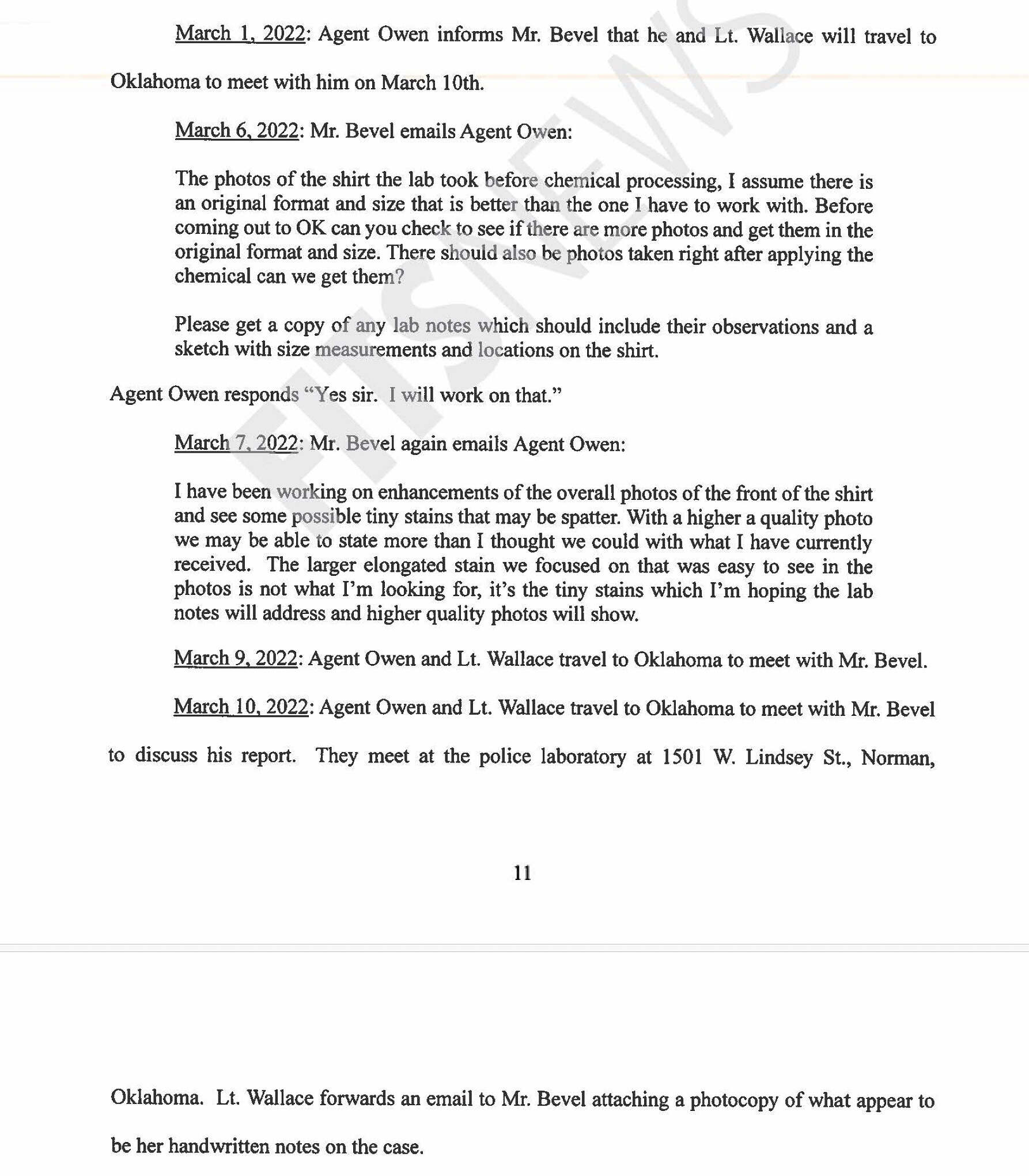
Defense filings laid out an extraordinary timeline in which investigators allegedly met repeatedly with Bevel after his initial report failed to support the prosecution’s theory. According to those filings, SLED agents traveled to Oklahoma in March 2022 to meet with Bevel in person after discussing concerns regarding his original conclusions.
***
***
Shortly afterward, the defense alleged, Bevel informed investigators he had used Photoshop-enhanced imagery to isolate color patterns on the shirt and now believed he could identify “over one hundred stains consistent with spatter.”
“Bottom line I don’t see any other mechanism to get so many misting stains onto his shirt other than the spatter created from the shotgun wounding,” Bevel wrote in one email cited by the defense.
That reversal transformed the shirt from a potentially exculpatory piece of evidence into one of the prosecution’s most publicly discussed forensic claims.
It also triggered one of the nastiest discovery fights in the entire case. Beginning in November 2022, Harpootlian and Griffin filed a series of increasingly aggressive motions accusing SLED and prosecutors of withholding evidence, concealing Bevel’s initial report, destroying evidence and presenting “manipulated opinion testimony contradicted by exculpatory evidence.”
Judge Newman eventually ordered prosecutors to turn over communications, draft reports, Photoshop files and other underlying forensic materials tied to Bevel’s work. The defense later argued those materials were never fully produced.
The allegations culminated in a sprawling sanctions motion filed just days before trial began in January 2023 — a motion asking Newman to prohibit not only Bevel’s testimony, but any testimony derived from his work product. And then — almost abruptly — the entire issue began fading from the courtroom.
By the time jurors were seated in Walterboro, the blood spatter evidence that once appeared poised to become a centerpiece of the state’s forensic case had largely evaporated – and Bevel was never called to testify.
***

RELATED | ‘FINGERS ON THE SCALES OF JUSTICE‘
***
Instead, prosecutors pivoted to Orangeburg County deputy and former SLED agent Kenny Kinsey, who testified broadly about crime scene reconstruction and back spatter concepts. But even Kinsey ultimately stopped short of definitively concluding the stains on Murdaugh’s shirt were gunshot blood spatter.
The prosecution’s theory of guilt ultimately leaned far more heavily on cellphone evidence, Murdaugh’s own testimony, kennel video footage placing him at the scene moments before the murders and the mountain of financial crimes evidence admitted by judge Newman.
The once-ballyhooed blood spatter evidence — the same evidence publicly described as potentially direct forensic proof of Murdaugh’s guilt — vanished. And because prosecutors chose not to fully introduce the disputed Bevel testimony during trial, the sanctions motion itself drifted into procedural limbo.
That meant the court never formally resolved whether:
- the shirt was improperly destroyed,
- exculpatory forensic evidence was withheld,
- Bevel was improperly influenced,
- or whether the Photoshop-enhanced analysis was scientifically reliable.
More than three years later, those questions remain unanswered — another unresolved thread in a saga increasingly defined by unresolved threads.
***
DAVID OWEN’S LONG SHADOW

***
Another reason the unresolved sanctions motion remains significant? Ongoing scrutiny surrounding the conduct of former lead SLED agent David Owen.
Owen was deeply involved in the blood spatter saga outlined by the defense — including direct communications with Bevel and participation in the controversial Oklahoma trip defense attorneys claimed was designed to pressure the expert into changing his conclusions.
Since the Murdaugh trial, Owen’s credibility and investigative conduct have repeatedly resurfaced in other major South Carolina cases.
Most notably, Owen recently became a central figure in the Michael Colucci murder prosecution — a case which collapsed spectacularly last year after judge Roger Young quashed Colucci’s indictment due to Brady violations tied to undisclosed evidence. In that case, Colucci’s attorneys accused Owen of suppressing exculpatory evidence for years — including statements suggesting the alleged victim had threatened suicide prior to her death.
Judge Young ultimately ruled the state failed to meet its obligations and ordered prosecutors to start over from square one.
Owen also drew intense scrutiny during Murdaugh’s murder trial after cross-examination by Griffin revealed misleading or inaccurate statements made to the grand jury that indicted him for murder.
Those issues — viewed together — have caused defense attorneys in multiple cases to increasingly frame Owen not as an isolated problem, but as part of a larger pattern involving investigative shortcuts, discovery disputes and credibility concerns.
That backdrop makes the unresolved Bevel sanctions motion more difficult to dismiss as ancient procedural history.
***
THE TOM BEVEL PROBLEM
***
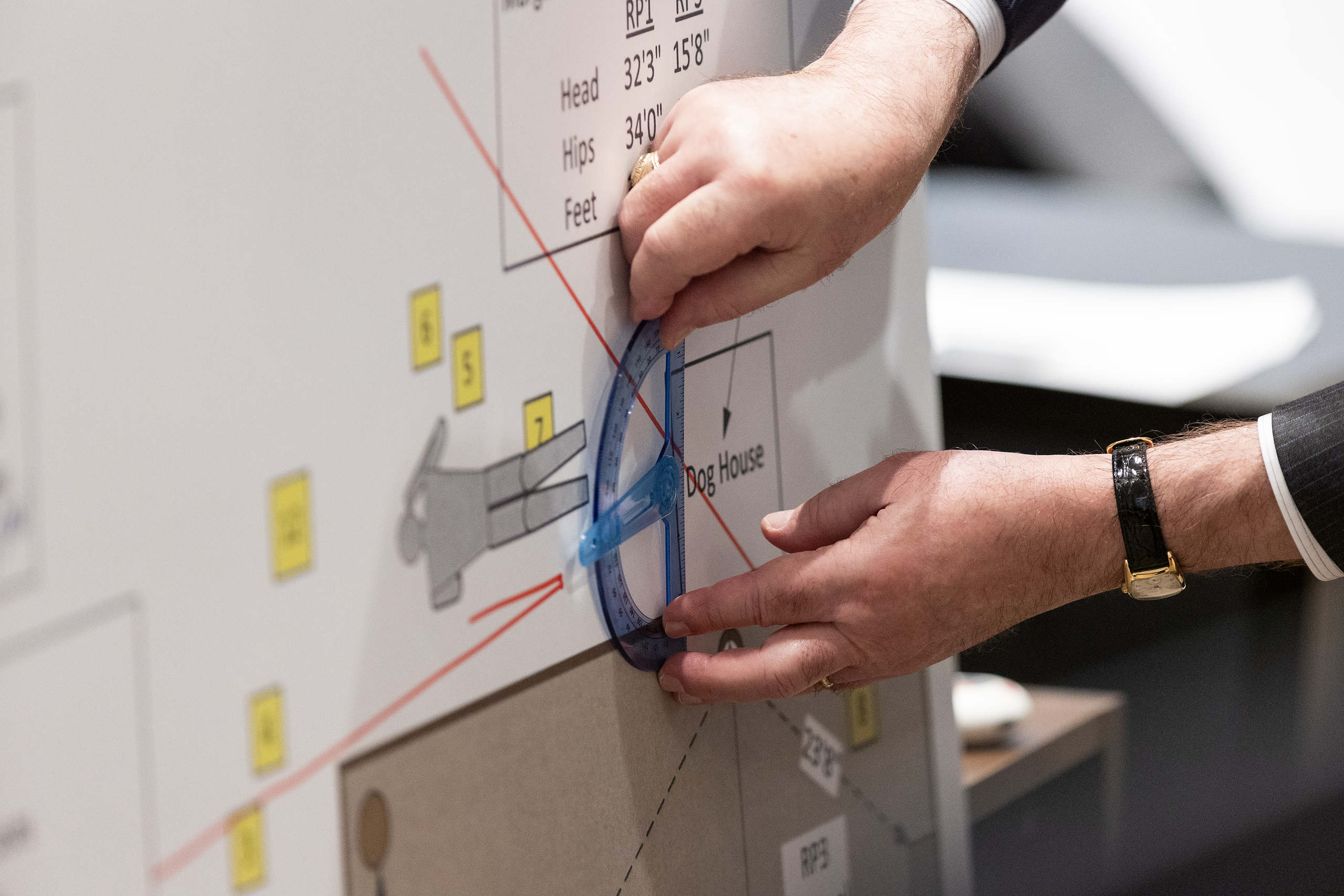
Then there is Bevel himself. Outside South Carolina, Bevel’s name is already associated with another controversial wrongful conviction saga: the prosecution of former Indiana state trooper David Camm.
Camm was accused of murdering his wife and two children in 2000 — a case that largely turned on bloodstain pattern analysis. Bevel testified that tiny stains on Camm’s shirt were high-velocity impact spatter generated by the shootings, a conclusion prosecutors used to argue Camm had been standing close to the victims when they were killed.
But the case against Camm steadily unraveled.
His convictions were overturned twice, and after more than a decade fighting the charges, Camm was acquitted in 2013. Another man tied to the crime scene through DNA evidence was ultimately prosecuted in connection with the murders.
In the years that followed, Bevel’s testimony in the case became a flashpoint in broader debates over the reliability of bloodstain pattern analysis — a forensic discipline that has faced increasing scrutiny nationwide for its subjectivity and lack of standardized scientific validation.
Critics of the Camm prosecution argued Bevel’s conclusions were overstated and helped drive a wrongful prosecution narrative.
That history matters because many of the same themes surfaced again in the Murdaugh case:
- disputed interpretation of tiny stains,
- evolving forensic conclusions,
- and aggressive reliance on blood pattern analysis as a centerpiece of a murder prosecution.
Defense attorneys in the Murdaugh case repeatedly highlighted those parallels as they challenged Bevel’s changing opinions regarding the white T-shirt worn by Alex Murdaugh the night of the murders.
But because prosecutors ultimately chose not to call Bevel as a witness, the court never fully examined those issues in open court. As a result, one of the most controversial forensic fights in the entire Murdaugh saga was never conclusively resolved.
***

RELATED | THE MURDAUGH SAGA: LOOSE ENDS
***
ANOTHER LOOSE END
In July 2024, FITSNews published an expansive review of the many “loose ends” still hanging over the sprawling Murdaugh saga.
At the time, that list included unresolved questions surrounding Curtis “Eddie” Smith – Murdaugh’s check casher and alleged drug runner – missing millions, alleged drug trafficking ties and the broader web of corruption orbiting the once-powerful Murdaugh dynasty.
The unresolved blood spatter sanctions motion belongs on that list too – not because it necessarily proves misconduct occurred. And not because it somehow erases the substantial body of evidence prosecutors ultimately used to convict Murdaugh at trial.
It belongs on that list because some of the most serious allegations ever made regarding the integrity of the investigation were never actually adjudicated.
Those questions were effectively frozen in time once prosecutors pivoted away from Bevel and chose not to make the disputed blood spatter evidence a centerpiece of the trial. For years, that left the issue lingering in a strange legal gray area — significant enough to spark explosive motions and intense public debate, but never formally resolved because the jury convicted Murdaugh without it.
Now, however, the legal landscape surrounding the case has fundamentally changed.
With the South Carolina supreme court reversing Murdaugh’s murder convictions, the possibility of a retrial suddenly transforms old unresolved fights into potentially active issues again.
If prosecutors elect to retry Murdaugh, they will face strategic decisions about what evidence to present the second time around — especially after the supreme court sharply criticized the scope of financial crimes evidence admitted during the original trial.
That matters because the blood spatter evidence was initially viewed as one of the few pieces of purportedly direct forensic evidence tying Murdaugh physically to the shootings themselves. In a retrial where prosecutors may seek a more streamlined presentation focused more tightly on the murders, the temptation to revisit stronger forensic arguments could increase.
But doing so could also reopen the entire Bevel controversy. Defense attorneys would almost certainly renew attacks on:
- the HemaTrace results,
- the destruction of the shirt,
- the Photoshop-enhanced imagery,
- Bevel’s changing conclusions,
- the conduct of investigators during the forensic review process.
They would also likely argue that the unresolved sanctions issues deserve full litigation before any such testimony could be presented to a second jury.
At the same time, prosecutors may conclude the controversy surrounding the evidence outweighs its value entirely — particularly given how successfully they secured convictions the first time without Bevel ever testifying.
Either way, the unresolved motion is no longer merely historical background.
The reversal of Murdaugh’s convictions means dormant issues once left behind in Walterboro could suddenly regain legal significance. And in the endlessly unfolding Murdaugh saga, unresolved questions have a habit of refusing to stay buried.
***
ABOUT THE AUTHOR …

As a private investigator turned journalist, Jenn Wood brings a unique skill set to FITSNews as its research director. Known for her meticulous sourcing and victim-centered approach, she helps shape the newsroom’s most complex investigative stories while producing the FITSFiles and Cheer Incorporated podcasts. Jenn lives in South Carolina with her family, where her work continues to spotlight truth, accountability, and justice.
***
SOUND OFF…
Got something you’d like to say in response to one of our articles? Or an issue you’d like to address proactively? We have an open microphone policy! Submit your letter to the editor (or guest column) via email HERE. Got a tip for a story? CLICK HERE. Got a technical question or a glitch to report? CLICK HERE.

13 comments
At the time of the leaks about “high velocity impact blood spatter”, all the stories about it appeared in Fitsnews and were written by Mandy Matney. (Matney later left Fitsnews.) Question: Why did David Owen, the SLED agent obviously doing the leaking, choose Mandy Matney as his accomplice in the leaks?
I explained it before but will do a quick re-fresher here and pray to God that some people, specially lawyers and judges, begin to understand REAL science or at least give more than lip service to its importance.
Mature human red blood cells are non-nucleated.
Avian red blood cells are nucleated.
A hemoglobin unit consists of four spiral-like peptide chains which carry a heme molecule which carries an iron atom.
It is the iron atom which takes the oxygen up, carries it, and releases it, by changing from a ferric atom to a ferrous atom and vice versa.
The Leuco Crystal Violet (“LCV”) test takes advantage of the heme molecule’s ability to release oxygen, that is “oxidize” the LCV molecule and turn it from colorless to violet. Since basically all vertebrate species’ blood have the same iron atom on the heme molecule, the PRELIMINARY LCV test will turn violet with ANY vertebrate blood. And if left too long in the light, a specimen with or without blood on it but treated with LCV will also turn violet by having been oxidized by the oxygen in the air.
The HemaTrace reacts with the peptide chain of the hemoglobin molecule with is more specific to higher primates and humans, although it also cross-reacts with the blood of ferrets and weasels.
Because all vertebrate blood also has white blood cells which are nucleated, it is possible to DNA test a specimen which tested positive for vertebrate blood by LCV but negative for human blood by HemaTrace.
Should that have been done PROMPTLY in this case to find out what vertebrate species caused the positive LCV test? ABSOLUTELY!
WHY? Because there was a freshly dead chicken in the vicinity of the kennels where Paul and Maggie’s bodies were found; and that freshly dead chicken had caught the attention of the first responders.
What would it have proven conclusively? If the blood spatter stains on the white T-shirt DNA-matched the dead chicken, it would have been near-conclusive proof that this is the T-shirt Richard Alexander Murdaugh (“RAM”) wore to the kennels and thence to his mother’s home at Almeda and back and gave to the first-responders on demand.
Should properly-trained first-responders have taken that freshly-dead chicken for testing even without knowing the Bubba story? ABSOLUTELY!
WHY? Because it would have told them, for example, if gases had been sprayed in the enclosed spaces before the shootings; that is, again just for example, to subdue the victims.
Since that shirt later DNA-tested negative for spatter from Paul’s blood, it all but conclusively exonerates RAM of the shooting of at least Paul, assuming that is the T-shirt RAM wore to the kennels.
Again, it could have been CONCLUSIVELY proven that this is the T-shirt RAM wore to the kennels had the dead chicken been collected for evidence and its DNA tested against the blood spatter stains which reacted positively to the LCV.
DUE PROCESS, I repeat, includes the right to a competent, scientific, examination of the crime scene by properly-trained and committed law enforcement officers. That is the responsibility of THE STATE and all its prosecutorial apparatus.
Instead, what RAM and basically most other criminal defendants in South Carolina and Massachusetts (Karen Read), get is incompetent, intellectually-lazy, if not corrupt, self-congratulatory supposed law enforcement who substitute their own speculation for science.
God willing and FITS permitting, I shall in a forth-coming comment re-iterate the timing of death by stomach contents at autopsy when the time and contents of the victim’s last meal are known with certainty.
I explained it before but will do a quick re-fresher here and pray to God that some people, specially lawyers and judges, begin to understand REAL science or at least give more than lip service to its importance.
Mature human red blood cells are non-nucleated.
Avian red blood cells are nucleated.
A hemoglobin unit consists of four spiral-like peptide chains which carry a heme molecule which carries an iron atom.
It is the iron atom which takes the oxygen up, carries it, and releases it, by changing from a ferric atom to a ferrous atom and vice versa.
The Leuco Crystal Violet (“LCV”) test takes advantage of the heme molecule’s ability to release oxygen, that is “oxidize” the LCV molecule and turn it from colorless to violet. Since basically all vertebrate species’ blood have the same iron atom on the heme molecule, the PRELIMINARY LCV test will turn violet with ANY vertebrate blood. And if left too long in the light, a specimen with or without blood on it but treated with LCV will also turn violet by having been oxidized by the oxygen in the air.
The HemaTrace reacts with the peptide chain of the hemoglobin molecule with is more specific to higher primates and humans, although it also cross-reacts with the blood of ferrets and weasels.
Because all vertebrate blood also has white blood cells which are nucleated, it is possible to DNA test a specimen which tested positive for vertebrate blood by LCV but negative for human blood by HemaTrace.
Should that have been done PROMPTLY in this case to find out what vertebrate species caused the positive LCV test? ABSOLUTELY!
WHY? Because there was a freshly dead chicken in the vicinity of the kennels where Paul and Maggie’s bodies were found; and that freshly dead chicken had caught the attention of the first responders.
What would it have proven conclusively? If the blood spatter stains on the white T-shirt DNA-matched the dead chicken, it would have been near-conclusive proof that this is the T-shirt Richard Alexander Murdaugh (“RAM”) wore to the kennels and thence to his mother’s home at Almeda and back and gave to the first-responders on demand.
Should properly-trained first-responders have taken that freshly-dead chicken for testing even without knowing the Bubba story? ABSOLUTELY!
WHY? Because it would have told them, for example, if gases had been sprayed in the enclosed spaces before the shootings; that is, again just for example, to subdue the victims.
Since that shirt later DNA-tested negative for spatter from Paul’s blood, it all but conclusively exonerates RAM of the shooting of at least Paul, assuming that is the T-shirt RAM wore to the kennels.
Again, it could have been CONCLUSIVELY proven that this is the T-shirt RAM wore to the kennels had the dead chicken been collected for evidence and its DNA tested against the blood spatter stains which reacted positively to the LCV.
DUE PROCESS, I repeat, includes the right to a competent, scientific, examination of the crime scene by properly-trained and committed law enforcement officers. That is the responsibility of THE STATE and all its prosecutorial apparatus.
Instead, what RAM and basically most other criminal defendants in South Carolina and Massachusetts (Karen Read), get is incompetent, intellectually-lazy, if not corrupt, self-congratulatory supposed law enforcement who substitute their own speculation for science.
God willing and FITS permitting, I shall in a forth-coming comment re-iterate the timing of death by stomach contents at autopsy when the time and contents of the victim’s last meal are known with certainty.
A penny of prevention is worth a pound of cure.
Those who pinch the penny of prevention want to cash in on the pound of cure.
That goes for the penny to properly train law enforcement and crime scene investigators compared to the pound of high-salaried prosecutors and defense attorneys and prosecutors-turned-defense-attorneys all in a case bound to ultimately fail due to investigatory failures from the start.
Ever heard the expression “like a chicken with its head cut off”? I means furiously flapping around.
Ever heard the expression “a stick-to-your-ribs mean”? It means fatty meals are emptied from the stomach much later than light ones.
Now, you might say human observation is that one has a bowel movement almost immediately after a large and fatty meal.
True; but that movement is NOT the meal you just ate. It is the prior meal(s) that got SLOWLY moved down the digestive tact, broken down, and absorbed with ONLY the indigestible residue passing down to the terminal part of the digestive tract and waiting there.
Waiting there for what?
For one of both of two things: enough volume to open the anal sphincter and/or signals from the very upper digestive tract that “more food is coming so you, distal colon and anus, better get empty and ready for it because you do not know how much it will be.”
How do the terminal colon and anus get those signals? The reflexes of the autonomic nervous system.
They start with the dento-colonic reflex. You are more likely to have a bowel movement after brushing your teeth in the morning.
Next is the gastro-colonic reflex. Even babies have bowel movements right after every feed. If that were the milk they just received, they would starve to death. It is the residue of the milk from the prior feeds.
The reflexes go the other way, too. Adults and babies feel hungrier after a bowel movement because the terminal colon tells the stomach “I’m good and empty and ready for the residue of the next meal to come down my way.”
That is why babies have more bowel movements a day because they need more feeds a day at the stage of fastest growth. As the growth curve slows, the number of bowel movements decreases until one bowel movement a day becomes the norm for adults.
These are, of course, the physiological, not pathological, sequences.
What does this have to do with Paul and Maggie?
We know FOR SURE that their last meal started after 8:00 pm on 7 June 2021 and ended at 8:30 pm that day.
We also know with relative certainty what they had because Blanca testified what she had cooked and left on the stove for them.
It would have been MANDATORY for properly-trained first investigators on the scene to collect that/those pots left on the stove and precisely measured how much, if any, food was left and precisely subtracted that from the total capacity of the pot(s) left on the stove and the dirty dishes, if any, around.
Of course, with three people sharing the same dinner from the same pots, it would have been an educated guess to apportion how much each of the three ate and drank.
But the bottom line is the Prosecution’s FALSE time of death at 8:49 or 8:52 pm, is ONLY 19 to 22 minutes after the last meal. THAT SOON after the last meal, the stomach contents should look almost exactly as they looked on the dinner plates.
THEY DID NOT.
They were too digested into “tan material” for the pathologist to tell exactly was they were and she “did not see any corn or beans or anything like that.” That pretty much rules out death 19 to 22 minutes after the last meal.
And it puts the most likely time of death around 9:30 pm.
Why did Maggie’s phone have some activity around 8:52 pm but not thereafter? EASY? She had laid it on the side-by-side or somewhere to have both hands free to handle the dogs; and one member of the shooting cabal got hold of it to prevent her from using it to record the events or to summon help. Once they realized someone was calling Maggie, they had to discard it far away to prevent her from reaching for it but not too far away for that member to return to the shooting cabal.
And the Defense team fell into the Prosecution’s trap and spent a lot of money proving that Alex would not have heard the shots fired at the kennels when he was at the house for some acoustic reason or another.
The real reason Alex could not hear the shots is that they were fired by the real shooter AFTER Alex had left for Almeda. And, no, he would not have seen, much less suspected a pedestrian disposing of Maggie’s phone on the side of the road.
All that stuff about the phone lighting or not lighting when thrown assumes it was thrown from a moving car.
It need not have been. It could have been placed by a pedestrian.
Tell me, if you can, where I am wrong.
Some AI-hallucination-infected sites claim the dento-colonic reflex does not exist.
It does and has been known or hinted-at since the days of Banting Best, of Sampson Wright, and even of Pavlov.
Don’t expect me to spend time telling you who these founders of physiology are because I have something else to tell you, God so willing and FITS permitting.
For all your claims to be asking the hard questions, FITS, you omit a bombshell revelation in a deposition of your former employee, Callie Lyons, recently and curiously filed by another former employee of yours, Malicious Mandy Matney (“MMM”) in supposed defense against MMM’s contempt-of-court exposure.
That bombshell revelation, among many others obtained by Greg Parker’s civil defense because MMM’s text messages showed up on Callie Lyons’ i-phone is (drum rolls): the leak of the FALSE blood spatter was by former Alan Wilson employee Megan Burchstead to MMM.
I challenge you to delete this comment of mine, because your deleting is will prove you are an agent of Alan Wilson, too.
And I can, God willing, post it elsewhere, too, assuming the other outlets are not agents of Alan Wilson, too.
And here is a related reply of mine to a comment on YouTube:?
@janmcrae8358 , you asked me who do I think did it and I told you. It is nothing sexist. It is because I have several women/young women in mind who had motive and opportunity to do this AND were incited to do it by Malicious Mandy Matney (“MMM”) who very conveniently arranged for herself to be off shore (but with her podcast equipment) on a supposed vacation that day.
I earned the right to figuratively toot my own horn.
Look at what I wrote two years ago, and of which I was just reminded by another commenter’s question to me yesterday:
“@marieassaad-faltas1299
2 years ago
In reference to pages 59-60 of Becky Hill’s book, am I the ONLY one left in this world with any sense of decency?
FIRST, this means THAT MALE JUROR (not the female egg juror) was discussing the case with at least three friends and talking about how long the case will take.
SECOND, nothing BUT NOTHING compelled that juror to stay on the case and make just $20/day (NOT $10 because I read Becky Hill’s ENTIRE book VERY CAREFULLY). All that juror had to do is tell the judge about the work needs. The judge would have replaced that juror with an alternate (remember? six alternates had been chosen) and no outside money would have changed hands.
THIRD, how do we know there was no explicit or tacit understanding about what that juror was to do in return for those “thousands of dollars” from his three friends? After all, that jury, ACCORDING TO BECKY HILL, communicated with their eyes. Perhaps those friends winked and nodded as the money changed hands.
FOURTH AND FOREMOST, we need to know IMMEDIATELY if that money was the three friends’ own money or whether they were funneling it from someone else.
There may have been money laundering going on if the amount exceeded $10K. Banks are supposed to report those AND it is, according to MY understanding (and I am NOT a lawyer), money laundering to break a $10K transaction into smaller ones to evade the bank’s reporting requirement.
Frankly, I think Dick and Jim are not that brilliant after all. They don’t know where it is REALLY at.
It is no longer “the trial of the century” but “the mistrial of the decade.””
And then tell me why that male, guilty-voting, juror’s receipt of outside money is as ignored as Cousin Eddie Smith’s indicted alleged crimes.
Heck, FITS, run this comment here, too, because I earned the right to figuratively toot my own horn everywhere.
Look at what I wrote two years ago, and of which I was just reminded by another commenter’s question to me yesterday:
“@marieassaad-faltas1299
2 years ago
In reference to pages 59-60 of Becky Hill’s book, am I the ONLY one left in this world with any sense of decency?
FIRST, this means THAT MALE JUROR (not the female egg juror) was discussing the case with at least three friends and talking about how long the case will take.
SECOND, nothing BUT NOTHING compelled that juror to stay on the case and make just $20/day (NOT $10 because I read Becky Hill’s ENTIRE book VERY CAREFULLY). All that juror had to do is tell the judge about the work needs. The judge would have replaced that juror with an alternate (remember? six alternates had been chosen) and no outside money would have changed hands.
THIRD, how do we know there was no explicit or tacit understanding about what that juror was to do in return for those “thousands of dollars” from his three friends? After all, that jury, ACCORDING TO BECKY HILL, communicated with their eyes. Perhaps those friends winked and nodded as the money changed hands.
FOURTH AND FOREMOST, we need to know IMMEDIATELY if that money was the three friends’ own money or whether they were funneling it from someone else.
There may have been money laundering going on if the amount exceeded $10K. Banks are supposed to report those AND it is, according to MY understanding (and I am NOT a lawyer), money laundering to break a $10K transaction into smaller ones to evade the bank’s reporting requirement.
Frankly, I think Dick and Jim are not that brilliant after all. They don’t know where it is REALLY at.
It is no longer “the trial of the century” but “the mistrial of the decade.””
And then tell me why that male, guilty-voting, juror’s receipt of outside money is as ignored as Cousin Eddie Smith’s indicted alleged crimes.
Appreciation of the Constitution requires restoration of common sense among other things.
Because Creighton Waters and his “number 2” former-CACA Fernandez succeeded in getting the public to buy an insane motive theory and an insane idea of death by phone-battery-death, the public is now making its own insane ideas that Becky Hill was really out to help Alex because they were kin and secret lovers.
Here again is my latest brilliant reply which deserves to be read and re-read until people come to their senses:
? @MickeeAdams , if Becky Hill had been out to do Alex Murdaugh a favor, she would have pushed the jury to return a NOT GUILTY verdict and been done with it.
How many times do I have to try to counter the insane idea that Becky Hill was out to help Alex Murdaugh?
And the insanity permeates even gubernatorial debates.
“Justice,” according to Alan Wilson, for Paul and Maggie Murdaugh is spending “whatever it takes” for a SECOND WRONGFUL conviction of the man who loved them most, while the real shooter(s) roam free and perhaps are plotting to kill Alex Murdaugh himself in prison to end the inquiry.
Not one word from Alan Wilson about re-investigating the matter with an open mind.
We already know, from Becky Hill’s now-withdrawn book, that some spent thousands of dollars to keep a conviction-prone juror on the jury instead of his having to return to work and earn money to pay his baby-mama overdue child support.
Isn’t funneling money to sitting juror a very serious crime?
Why isn’t Alan Wilson investigating that?
Perhaps the source of that money to that juror is also a campaign contributor to Alan Wilson.
Isn’t that the REAL reason Alan Wilson never investigated Hatchet-for-Hire Heather’s (Sarah Heather Savitz Weiss) crimes of fabrication and subornation of perjury in a failed scheme to frame Dr. Marie Faltas for supposed “harassment in the first degree”?
Didn’t Alan Wilson rescue Hatchet-for-Hire Heather from the tumult of her then-colleagues at the Fifth Circuit’s solicitor’s office by hiring her (and later hiring John Meadors, too) after John Meadors lost his campaign for solicitor but Stephen Savitz, Heather’s father, had made sizeable contributions to both the John Meadors and Alan Wilson 2010 campaigns?
Doesn’t Alan Wilson continue to promote Hatchet-for-Hire Heather within his office even though her reputation among lawyers is so bad that she withdrew her second candidacy for a judgeship after the secret bar surveys came back heavily negatively against her?
Heck! The woman even had her own son cheat on his Bar Mitzvah exam instead of doing the necessary work to learn Hebrew and become truly-before-God eligible for a Minyan!
And let’s talk about two other people, a wife and a son, each shot in the head by the gun of one man, in his sole presence, in his home, and to his ultimate financial gain.
Two differences, though: (1) that man’s second wife was shot in May 1993 and his first-bort son was shot in April 2016; (2) that man, Larry Wayne Mason, passed his shootings or his later concubine’s shootings of Ella Faye Kizer Mason and of Richard Wayne Mason off as suicides, even though the ballistics were against that and even though Richard Wayne Mason was hastily cremated WITHOUT an autopsy on this highly suspicious death.
And one more suspicious detail: Larry Wayne Mason’s second son, Ella’s only son, got reported dead in the middle of civil lawsuits and criminal drug and other charges against him, all without a death certificate for Christopher James Mason appearing anywhere.
Was it a fake death? Who knows other than Larry Wayne Mason, who remains able to blackmail officers and officials alike?
Where is Alan Wilson’s pursuit of Justice for Ella and Richard? Heck! Where is the concern for Christopher James’ children who are either lied to about their father’s fake death or know the truth but are forced to join, and grow up in, lies?
Where is the justice for Dr. Marie Faltas’ family who got bankrupted financially supporting her through years of her 24/7 necessary and able pro se work to exonerate herself from the Larry-Wayne-Mason-ordered and Hatchet-for-Hire-Heather- executed, but thank God failed, scheme to railroad Dr. Marie Faltas into a false 36-year (yes, thirty-six years) incarceration for that Larry Wayne Mason to overtake Dr. Faltas’ tiny lot of land which Larry coveted just as Mark coveted Moselle?
I want Alan Wilson to answer to his own conscience before trying to answer to the voters.
Some day or another, we all have to answer to God; and if you don’t believe in God, at least believe in History coming back to interrogate you when you are no longer in power.
“Everything is on the table” says Alan Wilson tens of times in his most recent one-on-one interview with Anne Emmerson; but NOT ONCE does he say the possibility of Alex’s actual innocence is on the table.
Also, seeing the photo of Maggie’s phone on site where it was found, it is IMPOSSIBLE for that phone to have been thrown from a moving car. The thin twigs above it are intact and separated as if by hand, NOT broken as they would have been if the phone had been thrown from above them.
And why would Alex, if he were the shooter, go to such length to separate that phone from the murder site only to help law enforcement locate it, retrieve it, and unlock it, the next morning?
? To those rehashing the Mushelle Smith nonsense, here is my reply:
@janepipkin8139 , first, you’re assuming every Prosecution witness told and the absolute truth and could not have been mistaken or misunderstood things in any way.
Next, that whole Mushelle Smith testimony was one more red herring by the Prosecution. It has no importance whatsoever because the EXACT times of Alex’s departure from Moselle to Almeda and return back are known TO THE SECOND from the phone and vehicle On-Star data; and Alex knew it, too; so, it would have been stupid AND USELESS for him to ask Mushelle to say something different.
Third, someone interested in getting Alex convicted started a Go-Fund-Me page for Mushelle WHILE SHE WAS TESTIFYING.
If that is your “overwhelming evidence,” it is overwhelming of a thoroughly corrupt trial.