
by ERIN PARROTT
***
South Carolina’s deepening drought crisis is showing no signs of immediate relief, with state officials warning that worsening conditions are beginning to strain water supplies, adversely impact agriculture and potentially compromise public safety across the Palmetto State.
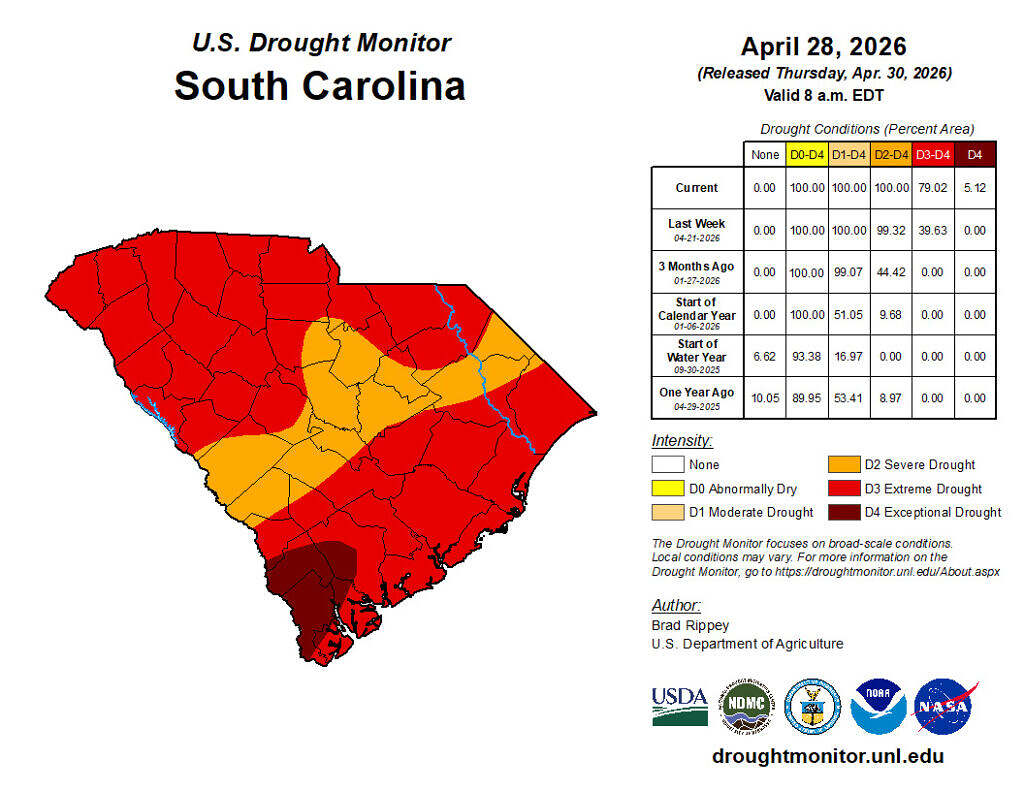
According to the South Carolina Drought Response Committee (SCDRC), drought conditions now impact virtually the entire state – with recent data showing 100% of South Carolina experiencing at least some level of “severe” dryness. Meanwhile, broad swaths of the Palmetto State now classified as being under “extreme” drought conditions.
Even worse, portions of Allendale, Beaufort, Colleton, Hampton and Jasper counties – located in the Lowcountry region of the state – are currently experiencing “exceptional” drought conditions. That’s the highest level tracked by the U.S. Drought Monitor.
Take a look…
***
***
The escalating dryness follows months of historically low rainfall. From September 2025 through March 2026, South Carolina has recorded one of its driest periods in more than a century – a deficit that has left soils depleted, streams running low and reservoirs struggling to recharge.
According to Hope Mizzell, state climatologist with the S.C. Department of Natural Resources (SCDNR), 2026 could could rank as one of the Palmetto State’s driest years on record.
State officials initially moved to declare a statewide moderate drought, but conditions have continued to deteriorate in the weeks since – prompting heightened concern among climatologists, farmers and emergency managers.
“This is not just a short-term dry spell,” forecasters have warned. “This is a long-duration drought event tied to persistent rainfall deficits across the Southeast.”
***
South Carolina’s drought is tightening its grip — with severe conditions now impacting the entire state. Farmers, water supplies and wildfire risks are all under pressure. Tune in to @fitsnews for the full story. #SCdrought #SouthCarolina pic.twitter.com/qOZDpAelgx
— Erin Parrott (@erinparrott24) May 1, 2026
***
The impacts are already rippling through South Carolina’s agricultural sector – a key economic driver.
Farmers across the state reported difficulty planting crops due to dry soil conditions, with some forced to irrigate simply to get seeds to germinate. Pastures have also struggled to grow, forcing livestock producers to rely on stored feed earlier than usual.
At the same time, the danger of wildfires has surged.
Dry vegetation and low humidity levels have prompted burn bans in multiple areas, with officials warning that even routine outdoor fires could quickly spiral out of control.
“Generally, when we get a lot of green plants and herbs on the forest floor, our wildfire activity drops because fires don’t spread as much when they hit wet, green, nice, new fuels,” said Darryl Jones, Forest Protection Chief for the South Carolina Forestry Commission (SCFC). “So, the leaves are turning green, but out in the woods, there hasn’t been enough moisture to force the grasses and other plants to green up, and that green up period is what usually slows down our fire activity and reduces the wildfire threat.”
***
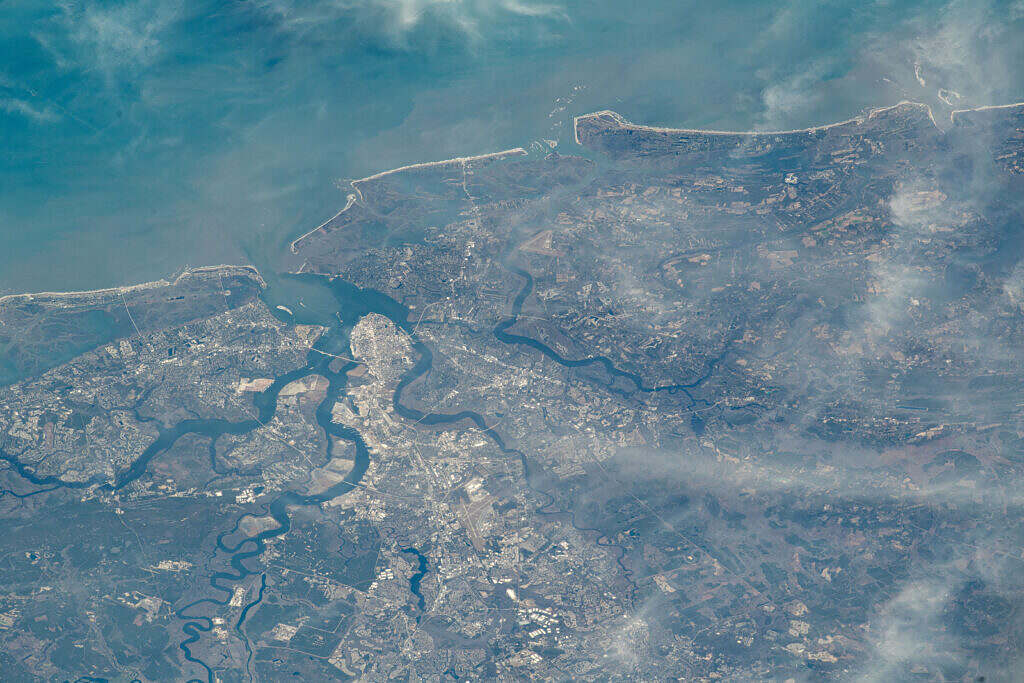
RELATED | S.C. AIR QUALITY IN ‘POOR’ RANGE
***
Across the southeast, the situation is even starker: more than 80% of the region is now classified in severe drought or worse – the largest such footprint recorded since the U.S. Drought Monitor began tracking conditions in 2000.
What’s happening?
Meteorologists point to a combination of factors – including a lingering La Niña weather pattern – which has suppressed rainfall across the southeast since late 2025. The result? A prolonged “recharge failure” during the winter months, when soils, rivers and groundwater systems typically recover.
Instead, South Carolina is heading into its warmer season with significantly reduced water reserves – a troubling setup as demand for water increases in the months ahead.
While South Carolina has not issued a blanket statewide water restriction, drought response is being managed regionally – with local utilities and river basin authorities urging conservation.

***
In the Midlands, for example, officials tied to the Catawba-Wateree basin have already requested voluntary limits on outdoor watering as flows decline.
The SCDRC – which determines classifications ranging from incipient to extreme – is expected to continue monitoring conditions closely and could recommend additional measures if the situation worsens.
For now, relief hinges on one thing: sustained rainfall.
Forecast models suggest some potential for precipitation in the coming weeks – but experts caution that it would take months of above-average rainfall to erase the current deficit.
Until then, South Carolina remains firmly in the grip of one of its most significant droughts in more than a decade.
***
ABOUT THE AUTHOR…

Erin Parrott is a Greenville, S.C. native who graduated from the University of South Carolina in 2025 with a bachelor degree in broadcast journalism. Got feedback or a tip for Erin? Email her here.
***
SOUND OFF…
Got something you’d like to say in response to one of our articles? Or an issue you’d like to address proactively? We have an open microphone policy! Submit your letter to the editor (or guest column) via email HERE. Got a tip for a story? CLICK HERE. Got a technical question or a glitch to report? CLICK HERE.
