
by JENN WOOD
***
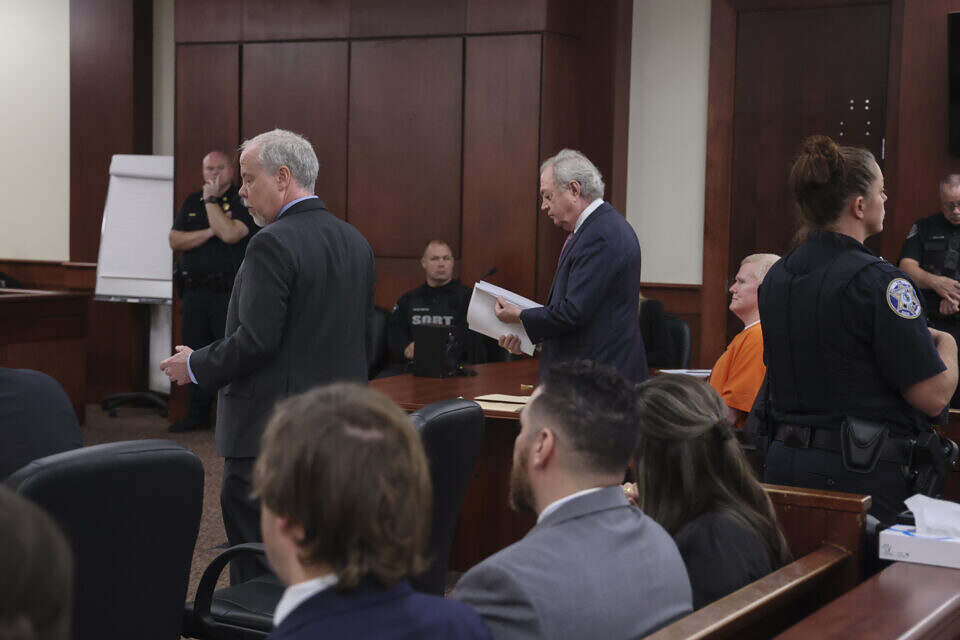
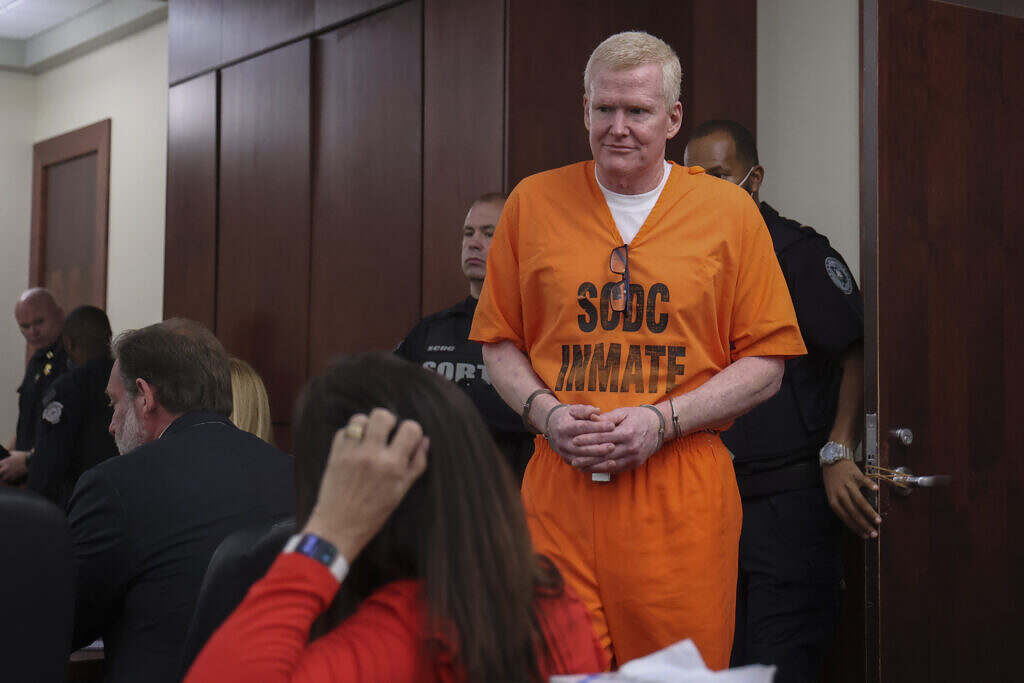
South Carolina prosecutors want to use Alex Murdaugh’s sworn testimony from his first murder trial against him when he is tried a second time for the killings of his wife and son — even if he does not return to the witness stand.
That request was contained in a new round of filings submitted by the office of attorney general Alan Wilson ahead of an August 14, 2026 pretrial hearing in Murdaugh’s case before S.C. circuit court judge Debra McCaslin.
In addition to seeking an advance ruling on Murdaugh’s prior testimony, prosecutors asked McCaslin to approve a written juror questionnaire, renew several evidentiary motions from the first trial and adopt an amended protective order governing discovery. They also responded to a defense request for independent laboratory review of DNA recovered from beneath Maggie Murdaugh’s fingernails.
The most consequential filing could determine whether prosecutors are allowed to place portions of Murdaugh’s 2023 testimony before the new jury — potentially preserving one of the state’s most dramatic pieces of evidence without requiring Murdaugh to testify a second time.

***
THE STATE’S BID TO REUSE HIS TESTIMONY
Murdaugh waived his Fifth Amendment right against self-incrimination during his first trial and testified over two days in February 2023.
On the stand, he admitted he had repeatedly lied to investigators, family members and friends about being at the dog kennels shortly before his wife, 52-year-old Maggie Murdaugh, and their 22-year-old son, Paul Murdaugh, were brutally gunned down on the evening of June 7, 2021. Murdaugh’s presence at the kennels was established by a video recovered from his late son’s phone.
In its latest motion (.pdf), prosecutors asked McCaslin for a preliminary ruling that testimony from the first trial is not automatically inadmissible at the retrial merely because of where it originated.
Prosecutors emphasized that they are not yet asking the court to decide which specific statements may be introduced, whether particular excerpts are relevant or how broadly the testimony could be used for impeachment. Those objections, the State argued, can be resolved later.
The state relied principally on the U.S. Supreme Court’s 1968 decision in Harrison v. United States, which recognized a general rule allowing a defendant’s testimony from an earlier trial to be used in a later proceeding.
But Harrison also established an important exception: prior testimony cannot be used when it was induced by unlawfully obtained evidence introduced by the prosecution at the first trial. In that circumstance, the testimony may be considered the tainted product of the original constitutional violation.
Prosecutors contend that exception does not apply to Murdaugh because there has been no finding that an evidentiary error or unlawfully obtained statement “impelled” his decision to testify.
That assertion is likely to draw scrutiny following the S.C. Supreme Court’s May 2026 decision reversing Murdaugh’s convictions. The court concluded former Colleton County clerk of court Rebecca “Becky” Hill improperly inserted herself into the trial and jury deliberations – directing jurors to watch Murdaugh closely and not to be “fooled” by his testimony.
The high court held Hill’s conduct deprived Murdaugh of the impartial jury guaranteed by the Constitution. It did not, however, find that prosecutors introduced unlawfully obtained evidence that caused Murdaugh to take the stand — the specific circumstance addressed in Harrison.
***
WHAT STATE LAW HOLDS…
***
Prosecutors also relied on South Carolina’s evidentiary rules. Under Rule 801(d)(2) of the S.C. Rules of Evidence, a defendant’s own statements are not considered hearsay when prosecutors use them against him. In other words, the state argued Murdaugh’s sworn testimony can be treated like any other admission he made – even if he chooses not to testify again.
Another South Carolina law makes the issue more complicated.
S.C. Code § 19-11-50 holds that a defendant’s testimony in one criminal case cannot later be used against him in “any other criminal case,” except in a prosecution for perjury.
Prosecutors argued that restriction does not apply in this case because Murdaugh is being retried on the same indictments. From prosecutors’ perspective, this is not another criminal case — it is a second trial in the same case.
That argument finds support in the S.C. Supreme Court’s 1998 decision in State v. Tucker. Tucker’s murder convictions were upheld on appeal, but his death sentence was overturned. When prosecutors sought the death penalty again, they used testimony Tucker had given during his original trial.
The state supreme court allowed it. The justices found Tucker’s testimony was not hearsay because it consisted of his own statements being used against him. They also concluded the resentencing was part of the “same criminal case,” meaning the testimony was not barred by § 19-11-50.
There is an important difference between Tucker and Murdaugh’s case, however. Tucker was not being retried for murder. His convictions remained in place, and the second jury was only deciding whether he should be sentenced to death. Murdaugh’s murder convictions were overturned entirely, meaning the State must prove his guilt again before a new jury.
No reported South Carolina appellate decision appears to directly answer whether prosecutors can use a defendant’s old testimony as evidence of guilt under those circumstances — particularly if the defendant does not testify at the retrial.
South Carolina law is much clearer about what happens if Murdaugh does take the stand again. In State v. Brown, a murder defendant was retried after his original convictions were overturned. Brown testified at the second trial and denied being involved in the killing. Prosecutors then confronted him with conflicting testimony he had given under oath during his first trial.
Brown argued the earlier testimony should not have been allowed because it came from a trial that had later been invalidated.
The state supreme court disagreed.
“Testimony given under oath at a previous trial whose result is subsequently invalidated is admissible impeachment evidence,” the justices wrote, adding that the court would “not condone perjury.”
That means if Murdaugh testifies again and changes his story, prosecutors would have a strong basis for using his former testimony to challenge his credibility.
But the state’s new motion goes further. Prosecutors want the option of using Murdaugh’s prior testimony as direct evidence of guilt — even if he remains silent at the retrial.
That leaves McCaslin with a question South Carolina’s appellate courts do not appear to have directly answered: Can prosecutors place Murdaugh’s prior testimony before the new jury as part of their own case, or can they use it only to challenge him if he takes the stand again?
***
RELATED | Murdaugh Retrial: Evidence Battle Escalates
***
STATE PUSHES BACK ON DNA TESTING
Prosecutors also pushed back (.pdf) against the defense’s request to send remaining material from Maggie’s left-hand fingernail clippings to Othram, an independent laboratory.
The defense has argued more advanced testing could identify an unknown male contributor and potentially produce exculpatory evidence.
The state characterized the unidentified material as an extremely limited profile consisting of only three foreign alleles. Prosecutors noted the finding was disclosed in 2022, explored during the first trial and described by an analyst from the S.C. Law Enforcement Division (SLED) as a “very partial low level profile” that was insufficient for entry into the FBI’s CODIS database.
According to the filing, representatives of the state, defense, SLED laboratory and Othram participated in a July 7 WebEx discussion.
Prosecutors claim Othram founder Dr. David Mittelman described additional testing as “very high risk,” said the unknown contributor represented less than one percent of the mixture and indicated testing would be unlikely to generate enough information for analysis while potentially consuming the remaining extract.
Those characterizations are the state’s account of the call; no affidavit from Mittelman was attached to the response.
The filing also alleged defense attorney Dick Harpootlian reminded Mittelman during the call that he worked for the defense and that his comments should first go through counsel. Prosecutors further claimed Harpootlian would not promise to share Othram’s results with them.
Prosecutors said they were willing to have SLED process and quantify the untested reserve sample, stop before completing the analysis and consult with the defense about the next steps.
Citing South Carolina’s Preservation of Evidence Act, prosecutors opposed transferring the remaining material without assurances governing preservation, consumption and access to the results.
The state asked McCaslin to deny the defense motion and adopt its proposed testing process instead.
***
JURY SELECTION AND RENEWED MOTIONS
With the case having generated years of national coverage, the State is asking the court (.pdf) to use a written questionnaire before formal voir dire.
The parties used a similar process before the first trial, allowing lawyers and the court to identify potential jurors who would inevitably be excused. The State credited the questionnaire with helping complete jury selection in three days and argued written answers may be more candid than responses given publicly in the courtroom.
The proposed questionnaire will be provided separately for review by the parties and the court.
Prosecutors also renewed three motions (.pdf) originally filed before the 2023 trial:
- A request for reciprocal discovery from the defense, including expert reports, exhibits and notice of certain defenses;
- A motion requiring an in-camera hearing before the defense may present evidence suggesting a third party committed the killings; and
- A motion barring references to polygraph examinations or results.
The third-party guilt motion relies on South Carolina precedent requiring more than speculation or a conjectural inference that another person committed a crime. Evidence must establish a sufficient connection to the offense and raise a reasonable inference of the defendant’s innocence.
Prosecutors said they will separately renew their motion concerning evidence of Murdaugh’s alleged financial crimes — an issue certain to receive intense scrutiny after the S.C. Supreme Court concluded the State went “far too long and far too deep” into that evidence during the first trial.
***
RELATED | Murdaugh Retrial: Defense Demands Fresh Search For Evidence
***
PROTECTIVE ORDER
The State’s proposed amended protective order (.pdf) would continue restrictions on the dissemination of discovery, search-warrant materials, State Grand Jury evidence and sensitive information involving victims and third parties.
It would permit defense attorneys, staff, experts, investigators and potential witnesses to review protected material as necessary to prepare for trial while generally prohibiting copies from being distributed or retained outside counsel’s secured custody.
The proposal would not restrict the dissemination of unsealed exhibits that were publicly filed during Murdaugh’s first murder trial or his later guilty plea and sentencing proceedings. Graphic crime-scene and autopsy materials would remain sealed under earlier orders.
McCaslin requested the proposed revision during the last status hearing in this case – held on June 29.
The August 14 hearing is expected to provide the first indication of how the court will manage the evidence inherited from the original trial — and how much of that trial the State will be allowed to place before a new jury.
Murdaugh’s retrial is scheduled to begin April 5, 2027.
***
ABOUT THE AUTHOR …
As a private investigator turned journalist, Jenn Wood brings a unique skill set to FITSNews as its research director. Known for her meticulous sourcing and victim-centered approach, she helps shape the newsroom’s most complex investigative stories while producing the FITSFiles and Cheer Incorporated podcasts. Jenn lives in South Carolina with her family, where her work continues to spotlight truth, accountability, and justice.
***
SOUND OFF…
Got something you’d like to say in response to one of our articles? Or an issue you’d like to address proactively? We have an open microphone policy! Submit your letter to the editor (or guest column) via email HERE. Got a tip for a story? CLICK HERE. Got a technical question or a glitch to report? CLICK HERE.

5 comments
Good reporting Jenn. It is going to be a bumpy ride!
Bumpy ride because prosecutorial misconduct is bound to come up unless swept under the rug.
Here is what I wrote on FITS’ 26 March 2024 story on Alan Wilson’s demand for tougher bonds:
What about the actually innocent forced to live in custody or under horrendous bonds while their rights to speedy trial and/or speedy retrial after a hung jury in a first trial get trampled on? And by none other than Hatchet-for-Hire Heather (“Weiss”) who stands gloating behind Alan Wilson as he urges BASICALLY repeal of the Eighth Amendment which bans excessive bail.
Three stark examples from Richland County, South Carolina, in the 21st Century:
(1) Professor Chi Kei Rick Chow who languished in jail for three years because no judge in the length and breadth of South Carolina had the courage to grant him bail until a half-or-majority-black jury found Professor Chow NOT GUILTY for having, in defense of others, shot a gun-toting 14-year-old who had trespassed with that gun on Professor Chow’s store.
(2) Now-retired SC Circuit Judge Lee who got her nomination to the federal bench withdrawn because of the furor over her having granted bail to a defendant who was later also acquitted by a jury in the bakery shooting cases.
and (3) You guessed it, Dr. Marie Faltas who was made to live in an hotel for 50 months while paying rent for an apartment to which she was forbidden from returning, all because Hatchet-for-Hire Heather Weiss had brought against Dr. Faltas pre-known FALSE harassment charges which were, thank God and due to Dr. Faltas’ able pro se advocacy, ultimately dismissed WITH PREJUDICE.
Weiss knew, and could not not have known (double negative intended) that Dr. Faltas was the victim, not the perpetrator of harassment.
But Weiss was paid $70K/year by the City of Columbia to be its agent in then-Barney Giese’s 5th Circuit’s Solicitor’s Office. And Dr. Faltas was then suing the City of Columbia.
So, who pays the piper calls the tune. And the victim got charged instead of the real perpetrator.
You want prosecutors’ tyranny unchecked by the Eighth Amendment?
Be careful! Some day YOU might need that Eighth Amendment.
Who can give Professor Chow his three years back? Who can give Dr. Marie Faltas her 50 months back?
Does anyone even want to?
Because I always propose ennobling solutions, not pounds-of-flesh vengeance, I proposed a “days bank” where the days an ultimately-acquitted criminal defendant served in pre-trial/pre-dismissal custody may be banked and donated to other bail-eligible defendants who cannot afford the monetary bond.
Remember! Perjury and known-false prosecutions are crimes, too, the latter as misconduct in office.
Bumpy ride because prosecutorial misconduct is bound to come up unless swept under the rug.
Here is what I wrote on FITS’ 26 March 2024 story on Alan Wilson’s demand for tougher bonds:
What about the actually innocent forced to live in custody or under horrendous bonds while their rights to speedy trial and/or speedy retrial after a hung jury in a first trial get trampled on? And by none other than Hatchet-for-Hire Heather (“Weiss”) who stands gloating behind Alan Wilson as he urges BASICALLY repeal of the Eighth Amendment which bans excessive bail.
Three stark examples from Richland County, South Carolina, in the 21st Century:
(1) Professor Chi Kei Rick Chow who languished in jail for three years because no judge in the length and breadth of South Carolina had the courage to grant him bail until a half-or-majority-black jury found Professor Chow NOT GUILTY for having, in defense of others, shot a gun-toting 14-year-old who had trespassed with that gun on Professor Chow’s store.
(2) Now-retired SC Circuit Judge Lee who got her nomination to the federal bench withdrawn because of the furor over her having granted bail to a defendant who was later also acquitted by a jury in the bakery shooting cases.
and (3) You guessed it, Dr. Marie Faltas who was made to live in an hotel for 50 months while paying rent for an apartment to which she was forbidden from returning, all because Hatchet-for-Hire Heather Weiss had brought against Dr. Faltas pre-known FALSE harassment charges which were, thank God and due to Dr. Faltas’ able pro se advocacy, ultimately dismissed WITH PREJUDICE.
Weiss knew, and could not not have known (double negative intended) that Dr. Faltas was the victim, not the perpetrator of harassment.
But Weiss was paid $70K/year by the City of Columbia to be its agent in then-Barney Giese’s 5th Circuit’s Solicitor’s Office. And Dr. Faltas was then suing the City of Columbia.
So, who pays the piper calls the tune. And the victim got charged instead of the real perpetrator.
You want prosecutors’ tyranny unchecked by the Eighth Amendment?
Be careful! Some day YOU might need that Eighth Amendment.
Who can give Professor Chow his three years back? Who can give Dr. Marie Faltas her 50 months back?
Does anyone even want to?
Because I always propose ennobling solutions, not pounds-of-flesh vengeance, I proposed a “days bank” where the days an ultimately-acquitted criminal defendant served in pre-trial/pre-dismissal custody may be banked and donated to other bail-eligible defendants who cannot afford the monetary bond.
Remember! Perjury and known-false prosecutions are crimes, too, the latter as misconduct in office.
How is Harpootlian and Griffin’s search coming for the real killer? Remember how many times we heard that….
It could begin, or be catalyzed by, identifying the now-unknown male DNA under Maggie’s LEFT hand fingernails.
As always, the Alex haters and false-conviction-pushers started insulting our intelligence, or at least MY “sub-zero-IQ” by pretending, without basis, that was from Maggie’s earlier-in-the-day manicure or from the bagging boy at Piggly Wiggly.
Well! If so, why is there no foreign DNA under Maggie’s RIGHT hand fingernails then?
My sub-zero-IQ answer is: that is the hand where Maggie held her phone trying to call for help when she saw the shooting cabal arrive; and a member of that cabal wrestled it off her left hand and ran away with it to hide it in the nearest bush, too far for Maggie to reach for it but near enough for that member to return on foot and assist the other members of the shooting cabal “clean” the scene.
Have I been wrong before?
Certainly not when I stood (in those days I could physically stand) in then-SC-Circuit-Judge Lee’s courtroom on 1 December 2009 and told her a conspiracy was being cooked by the City of Columbia to falsely arrest me to thwart my civil lawsuit against the City of Columbia and others.
Judge Lee took the matter under advisement instead of immediately granting me the injunction I was seeking.
And sure enough, the VERY morning that followed, on 2 December 2009, the City of Columbia, authorized by Hatchet-for-Hire Heather Weiss, and accompanied by one Larry Wayne Mason, a defendant in my civil lawsuit, descended on my apartment, ransacked it and robbed it of the evidence I had for my civil lawsuit and arrested me.
Want to know what else I was right about?
Read the federal cases, including why now-Senior-U.S.-District-Judge Terry Wooten recused himself from one of my cases.