CRIME & COURTS

Scott Spivey’s Death and the Prosecutorial Burden

Different standards, different risks…

Getting your Trinity Audio player ready...

by JENN WOOD

***

In September 2023, a volatile encounter on a stretch of rural highway in Horry County, South Carolina ended with 33-year-old insurance adjuster Scott Spivey being fatally shot just miles from the North Carolina border.

The admitted shooters, Charles Weldon Boyd and Kenneth Bradley Williams, have never been criminally charged in connection with his death. Prosecutors concluded they acted within South Carolina’s ‘Protection of Persons and Property Act’ — also known as the state’s ‘Stand Your Ground’ law — which allows the use of deadly force without a duty to retreat under certain circumstances.

That decision sparked immediate public scrutiny…

In the months that followed, allegations surfaced regarding investigative irregularities by the Horry County Police Department (HCPD), the agency which led the investigation into Spivey’s shooting. Questions were raised about body-camera footage, chain-of-custody documentation and scene handling. The controversy grew serious enough to prompt a corruption probe led by the South Carolina Law Enforcement Division (SLED) and the departure of several HCPD officials.

Meanwhile, Spivey’s family filed a wrongful death lawsuit, arguing the shooting was not lawful self-defense but the culmination of a prolonged and aggressive pursuit along Highway 9. That civil case is now moving forward after a judge denied immunity to Boyd.

Yet one question continues to follow the case: why were there no criminal charges?

The answer lies not in a single piece of evidence — but in the layered legal and institutional complexities surrounding self-defense law, the burden of proof in criminal court and the shadow cast by allegations of investigative misconduct.

Support FITSNews … SUBSCRIBE!

***

THE CRIMINAL STANDARD

In a criminal prosecution, the state must prove guilt “beyond a reasonable doubt.” That is the highest evidentiary standard in American jurisprudence.

It does not mean “more likely than not.” It does not mean “probably.”

It means the evidence must leave jurors firmly convinced of guilt, with no reasonable alternative explanation consistent with innocence.

When self-defense is raised in South Carolina, the burden falls on the state to disprove self-defense beyond a reasonable doubt. If prosecutors cannot negate lawful self-defense at that threshold, a conviction cannot stand.

That legal reality creates enormous prosecutorial risk in cases involving competing narratives and incomplete eyewitness certainty.

***

SOUTH CAROLINA’S ‘STAND YOUR GROUND’ LAW

South Carolina’s ‘Stand Your Ground’ law eliminates the duty to retreat in certain circumstances and provides immunity from both criminal prosecution and civil liability when a person uses deadly force in lawful self-defense.

If evidence suggests the shooter reasonably feared imminent death or great bodily injury, prosecutors must be confident they can prove otherwise — beyond a reasonable doubt — before filing charges.

In the Spivey case, prosecutors ultimately concluded Boyd and Williams were protected under the statute, ending the criminal matter at the charging stage. But the decision came with an unusual qualifier.

Although S.C. attorney general Alan Wilson declined to pursue charges based on the evidence then available, he simultaneously referred allegations of investigative misconduct by Horry County officers to S.C. seventh circuit solicitor Barry Barnette for independent review. Wilson indicated that if the misconduct probe uncovered new evidence materially altering the factual landscape of the shooting, Barnette would be free to pursue charges against Boyd and Williams.

That posture — declining prosecution while acknowledging the investigation itself was under scrutiny — reflects the layered complexity of the case. The charging decision rested not only on the statutory framework of self-defense, but also on the evidentiary integrity of the underlying investigation. If that integrity were compromised in a way that reshaped the facts, the door to potential prosecution was left open.

***

RELATED | JUDGE DENIES ‘STAND YOUR GROUND’ IMMUNITY

***

INVESTIGATIVE TURBULANCE

The shooting quickly became entangled in allegations of investigative irregularities involving the Horry County Police Department.

Among the issues raised publicly and in subsequent proceedings:

  • Concerns about body-camera handling and labeling.
  • Questions surrounding chain-of-custody documentation.
  • Allegations that officers may have engaged in inappropriate conduct at the scene.
  • A later corruption probe led by the SLED.

Several HCPD officials ultimately left the department following the controversy.

Even if the alleged misconduct didn’t involve physical evidence, the mere perception of compromised investigative integrity can create reasonable doubt — and reasonable doubt is fatal to a criminal prosecution.

Jurors do not evaluate cases in a vacuum. Credibility of law enforcement testimony is often central to conviction. Any suggestion of compromised scene handling, preferential treatment or procedural irregularity complicates prosecutors’ ability to carry their burden.

***

CONFLICTING NARRATIVES, SHIFTING STATEMENTS

From the outset, this case involved sharply divergent accounts.

Some witnesses described aggressive driving and the display of a firearm by Spivey. Others questioned whether the encounter escalated into a prolonged pursuit. Over time, key eyewitness accounts evolved in their level of certainty.

In a criminal courtroom, defense counsel would emphasize those inconsistencies aggressively. Every narrowing of certainty becomes an opportunity to argue reasonable doubt.

Prosecutors must evaluate not only what happened — but whether they can prove what happened to the near-certainty required by law.

In contentious self-defense cases, that is a steep climb.

***

police
RELATED | THE ROADSIDE SHOOTING OF SCOTT SPIVEY

***

TOXICOLOGY AND FORENSIC COMPLEXITY

Expert testimony in the civil hearing revealed measurable intoxication on Spivey’s part – and disputed interpretations of the trajectory and timing of the shots fired at the scene.

Dr. Angelina Phillips, a forensic pathologist with the Medical University of South Carolina, explained that the fatal bullet entered near the right armpit crease and traveled from right to left, slightly frontward, across the chest cavity. For that to have happened, Phillips argued, Spivey’s right arm would likely have needed to be raised or positioned away from his torso.

That would be consistent with Boyd and Williams’ statements – and initial witness statements – that Spivey either raised a gun or was firing a gun at the time he was shot.

Also, Spivey’s heart blood showed a blood alcohol concentration (BAC) of 0.13 percent – nearly twice the legal limit. Ethanol was also detected in vitreous fluid from the eye at a similar concentration.

In a criminal trial, the defense would be permitted to argue that intoxication contributed to erratic behavior or aggressive escalation. Even if effectively contested, such evidence could influence juror perception of a threat assessment.

When forensic science can be interpreted in more than one reasonable way, the prosecution’s burden becomes even heavier.

***

WHY CIVIL COURT IS DIFFERENT

Criminal prosecutors are ethically bound not simply to seek convictions, but to bring charges only when they believe they can prove guilt beyond a reasonable doubt — the highest burden of proof in American law.

That standard requires near-certainty.

It is not enough to show a defendant probably acted unlawfully. It is not enough to show competing narratives. Prosecutors must be confident they can disprove self-defense beyond a reasonable doubt in front of twelve jurors — despite every inconsistency, investigative vulnerability or evidentiary gap the defense will highlight.

In a case involving a confirmed display of a firearm, a volatile high-speed roadway confrontation, conflicting eyewitness interpretations, allegations of investigative irregularities and a statutory self-defense framework that tends to favor defendants, the prosecutorial calculus becomes exceptionally complex.

A failed prosecution does more than lose a case — it permanently forecloses criminal accountability under double jeopardy principles. That risk weighs heavily when evidence leaves room for reasonable doubt.

***

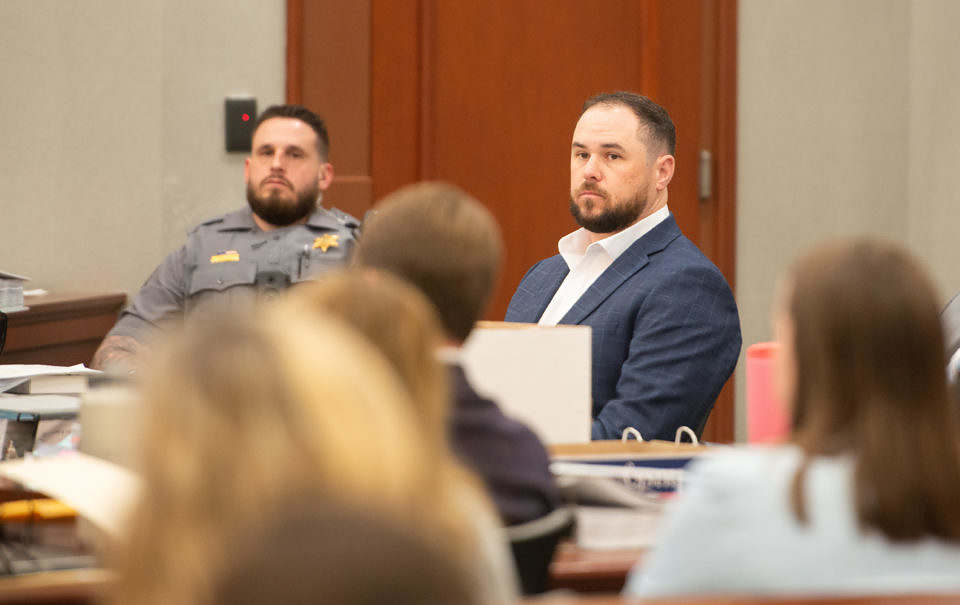
Attorneys confer with S.C. circuit court judge Eugene C. Griffith Jr. during a ‘Stand Your Ground’ immunity hearing in Conway, S.C. on February 16, 2026. (Pool)

***

Civil court operates differently. In the wrongful death lawsuit now moving forward, the burden is far lower. Instead of beyond a reasonable doubt, the standard is merely a preponderance of the evidence — meaning more likely than not.

Even slightly more likely than not…

That distinction is critical.

A case that prosecutors believe cannot clear the criminal threshold may still proceed — and even succeed — under the civil standard. That is why immunity can be denied in civil court even when criminal charges were never filed.

The standards are different. The risks are different. And the strategic calculations are different.

In the Scott Spivey case, prosecutors concluded they could not eliminate reasonable doubt. The civil court must now decide whether the evidence tips the scales — even slightly — in the other direction.

At its core, the Spivey case sits at the crossroads of three powerful forces:

  • Expansive self-defense protections under state law
  • The constitutional requirement of proof beyond a reasonable doubt
  • The fragility of public trust when investigative processes are questioned.

Criminal prosecution is not simply about whether a shooting was tragic. It is about whether the state can prove criminal culpability with near-certainty — in front of twelve jurors — despite every weakness the defense will exploit.

In this case, prosecutors concluded that threshold could not be met.

The civil court will now decide whether a lower threshold can be…

***

ABOUT THE AUTHOR …

Jenn Wood (Provided)

As a private investigator turned journalist, Jenn Wood brings a unique skill set to FITSNews as its research director. Known for her meticulous sourcing and victim-centered approach, she helps shape the newsroom’s most complex investigative stories while producing the FITSFiles and Cheer Incorporated podcasts. Jenn lives in South Carolina with her family, where her work continues to spotlight truth, accountability, and justice.

***

WANNA SOUND OFF?

Got something you’d like to say in response to one of our articles? Or an issue you’d like to address proactively? We have an open microphone policy! Submit your letter to the editor (or guest column) via email HERE. Got a tip for a story? CLICK HERE. Got a technical question or a glitch to report? CLICK HERE.

***

Subscribe to our newsletter by clicking here…

*****

Related posts

CRIME & COURTS

Death on the Tracks: Murder Investigation Moves into Civil Court

Jenn Wood
CRIME & COURTS

South Carolina Worship Leader Facing 20 New Child Porn Charges

Will Folks
CRIME & COURTS

‘There Is No Law on It’: Audio Fuels S.C. Dispensary Trafficking Defense

Jenn Wood

3 comments

J Doe February 23, 2026 at 1:14 pm

Excellent article and explanation, Jenn.

Reply
Avatar photo
The Colonel Top fan February 23, 2026 at 3:40 pm

I’ve actually had a conversation with the AG about this case. Prosecuting Boyd and Williams for murder is a non-starter, manslaughter at best. However, I think that the state has an obligation to pursue the charge. Had they kept going straight at Camp Swamp Road, this wouldn’t be anything more than a traffic incident.

However – and this is a big however, someone needs to go after the Horry County Police Department for all of the shenanigans in this case, beginning with the idiot 911 operator who should have to Boyd in no uncertain terms to back off – through the cop with the “act like a victim” post it to the “I’ve got your back” gang. HCPD needs to be broken up with the sheriff of the aptly named (w)Horr(e)y County taking responsibility for the hinterlands of the County. Having a county wide police department makes little to no sense when Dirty Myrtle has a PD as do Conway and North Myrtle.It’s the only county in the state set up like this.

Reply
Ya know February 24, 2026 at 5:28 am

Stand your ground is markedly different from chasing someone down.

Reply

Leave a Comment