
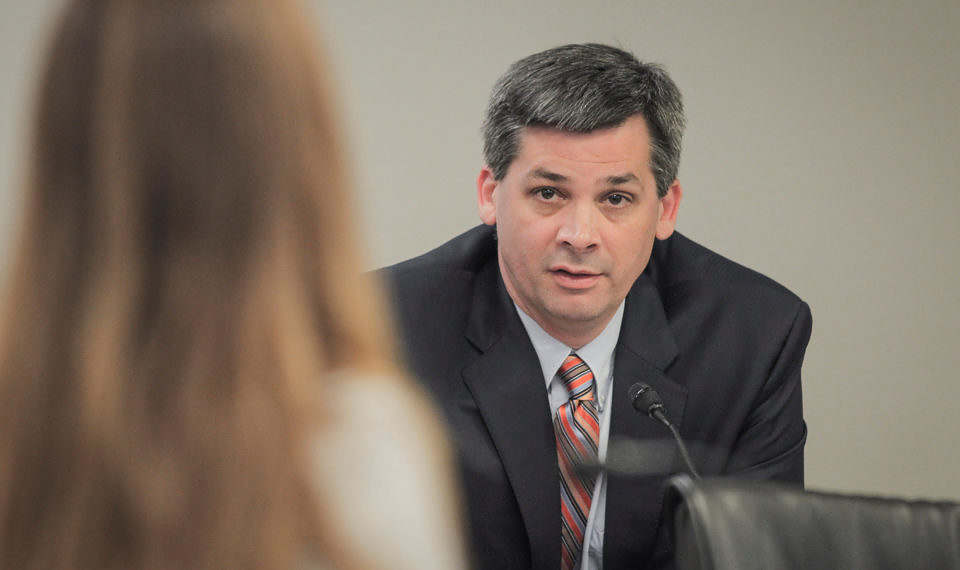
South Carolina Senate Leader: ‘We Are Not Corrupt’
Shane Massey contorts himself trying to defend the Palmetto State’s badly broken “justice” system…
by WILL FOLKS
***
For the second time in as many months, a powerful leader of the South Caroli
13 comments
Gypsies, Tramps and Thieves – The whole lot of them.
“Not corrupt” OK buddy keep saying it. Number one corruption you don’t work for the citizens of the state, corruption number two, you use our tax money like your own personal ATM for your legislative wants. Im sure we can keep going. The judicial is just another example of the back scratching and favoritism. Watch what happens when you clowns vote on former house speaker for the SC supreme court, Jay Lucas. Never even been a judge. We all know what’s going to happen. Not corrupt my ass.
Is corruption now defined as election to an appellate court seat of a very decent and capable person lacking prior judicial experience?
Let’s see!
Blake Hewitt had no judicial experience when he was elected to South Carolina’s Court of Appeals either. What is the difference?
Nor did Jean Toal when elected directly from the General Assembly to South Carolina’s Supreme Court.
No one called her election corruption.
And Blake Hewitt’s entire legal experience before being elected to the bench was entirely appellate. No trial experience at all. And he was elected over Allison Renee Lee who had decades of presiding over trials and a several-months stint as an acting full-time SC Court of Appeals Judge. Why did Senator Massey NOT vote for Judge Lee then or even make such speech against Blake Hewitt’s lack of judicial experience?
I think I know the answer; but to ignore it is to ignore the hypocrisy of attacking a very decent and very capable man because he made “the mistake” of giving a decade of his life to service in South Carolina’s Legislature.
Let’s see!
Blake Hewitt had no judicial experience when he was elected to South Carolina’s Court of Appeals either. What is the difference?
Nor did Jean Toal when elected directly from the General Assembly to South Carolina’s Supreme Court.
No one called her election corruption.
And Blake Hewitt’s entire legal experience before being elected to the bench was entirely appellate. No trial experience at all. And he was elected over Allison Renee Lee who had decades of presiding over trials and a several-months stint as an acting full-time SC Court of Appeals Judge. Why did Senator Massey NOT vote for Judge Lee then or even make such speech against Blake Hewitt’s lack of judicial experience?
I think I know the answer; but to ignore it is to ignore the hypocrisy of attacking a very decent and very capable man because he made “the mistake” of giving a decade of his life to service in South Carolina’s Legislature.
What is abnormal is the long history of effectively-unchallenged retention of seats on South Carolina’s Supreme Court.
It has become royalty, not democracy, with the “heir” to the Chief Justice seat being the one with most seniority, as the oldest prince inherits the king’s throne.
Whoever has the right to vote on any election should be free to vote his/her conscience or even whim or lust without being branded corrupt.
Ronald Reagan used to say that turn-over in the U.S. Congress is lower than in the-then-Soviet-Union’s Polit Bureau.
Well, turn over in South Carolina’s Supreme Court for other than ageing out is ZERO.
Voting a sitting Justice out of his/her seat is NOT corruption. It is democracy in action, for better or for worse.
What is so magical, essential, and pure, about John Cannon Few retaining his throne on South Carolina’s Supreme Court anyway?
What is abnormal is the long history of effectively-unchallenged retention of seats on South Carolina’s Supreme Court.
It has become royalty, not democracy, with the “heir” to the Chief Justice seat being the one with most seniority, just as the oldest prince inherits the king’s throne.
Whoever has the right to vote on any election should be free to vote his/her conscience or even whim or lust without being branded corrupt.
Ronald Reagan used to say that turn-over in the U.S. Congress is lower than in the-then-Soviet-Union’s Polit Bureau.
Well, turn over in South Carolina’s Supreme Court for other than ageing out is ZERO.
Voting a sitting Justice out of his/her seat is NOT corruption. It is democracy in action, for better or for worse.
The “independent jurist” framing is nice, but it skips over the part where Justice Few engaged in textbook judicial activism on the Heartbeat Act. If we don’t stand against rogue judges who clearly legislate from the bench, we erode and even destroy the separation of powers.
In January 2023, Few cast the deciding vote to strike down the law — not by citing a constitutional violation, but by deciding six weeks just wasn’t enough time. That’s a policy opinion, not a legal ruling. Then eight months later, he voted to uphold a virtually identical version of the same law. In that opinion, he wrote it would be a “rogue imposition of will by the judiciary” to strike down a thoroughly debated law simply because a judge disagreed with the legislature.
His words, not mine. By his own standard, that’s exactly what he did in January.
Even Chief Justice Beatty — no one’s idea of a conservative — noted in his dissent that the court “turned a blind eye to the obvious fact” that the two laws were the same. He meant it as a criticism of the reversal, but it proves the point: if nothing meaningfully changed in the law, then Few’s first vote had no legal foundation. He just didn’t like the policy.
There’s a difference between a judge reaching conclusions you disagree with and a judge legislating from the bench. Few’s own contradictory opinions make that distinction for us.
Shaking my head at his gaslighting.
South Carolina is ripe for a movement to change the mode for selection of justices. Better ways exist. Separate from politics.
Especially politics that extoll the benefits of supporting a president that is a convicted felon and drove six businesses into bancruptcy. Read the book, “The Makinng of Donald Trump”, by David K. Johnston.
Another sitting state legislator claimed “no finer group of judges in the country” that South Carolina’s!
Really, FITS, you are either now paid by John Cannon Few, on whose personal shenanigans you previously reported, OR in reality Jay Lucas does not have a chance and you know it BUT you are opposing his election so that, when his candidacy is defeated, you can take credit as the most powerful media outlet in the state.
Let’s examine your, and David Pascoe’s, supposed “logic” and the supposed “logic” of Jay Lucas’ detractors.
First, Jay Lucas has long ago VOLUNTARILY left South Carolina’s Legislature after having served there capably and honorably for a decade.
Jay Lucas has NO more POWER over South Carolina’s House of Representatives than any other lawyer in private practice.
Indeed, having only a solo private practice, Jay Lucas has LESS POWER over South Carolina’s legislators than private lawyers from large law firms such as Maynard Nexsen, previously Nexsen Pruitt, which has groomed for election Michelle Childs and Tanya Gee among others.
The large law firms have power over lawyer legislators because they can hire lawyer legislatures or their relatives.
Jay Lucas’ private SOLO practice cannot do that.
Jay Lucas has EVEN LESS POWER over South Carolina’s legislators that candidates from federal or state governments such as the U.S. Attorney’s office or even county magistrates before whom any lawyer legislator might come as a criminal defendant or as a lawyer for a criminal defendant.
And Jay Lucas has ZERO financial POWER over South Carolina’s legislators because, as a private community-minded solo practice, he has no wherewithal to throw lavish parties or make corporate deals which might benefit a sitting legislator of his/her relatives or friends.
All power Jay Lucas has is the MORAL AUTHORITY of his prior honorable public service which rightly won the affection and admiration of his colleagues.
But you make it sound as if it were a crime to stand for election to any office without prior experience related to that office.
Need I remind Jay Lucas’ detractors that Donald Trump has NO GOVERNMENT EXPERIENCE WHATSOEVER when he first ran for President in 2016?
Need I remind the Democrats that Jimmy Carter had no FEDERAL experience when he ran for President in 1976 and no state government experience when he ran for Georgia Governor before that?
There is NOTHING more democracy-and-freedom-promoting-and-reinvigorating than an outsider challenging an entrenched incumbent and, hopefully, winning.
Back to “no finer group of judges in the country”! That is NOT determined by a South Carolina’s lone sitting legislator’s say-so.
There are OBJECTIVE criteria of how a judge or “group of judges” is rated “in the county.”
These criteria include how often their opinions are favorably cited by other courts and how often their judicial ideas are adopted by other state courts. Same for federal circuit courts of appeals. And for all state courts of last resorts and federal circuit courts of appeals, an additional important criterion is how often they are REVERSED by the U.S. Supreme Court.
By these OBJECTIVE criteria, South Carolina’s CURRENT and PREVIOUS supreme courts do NOT rank much better than South Carolina’s educational system.
Perhaps an outsider might, God willing, help shake that mediocrity off if FITS and David Pascoe would leave that outsider alone to have his fair chance at a free, fair, and transparent election.
State Senator Massey, you ARE corrupt and will so remain if, after reading this transcript you still want to keep John Canon Few on his throne:
[Page 1] ORIGINAL
STATE OF SOUTH CAROLINA Before the Supreme Court of South Carolina
COUNTY OF RICHLAND TRANSCRIPT OF RECORD CORRECTED ORIGINAL
In the Matter of: Marie Assa’ad Faltas, Respondent. Appellate Case No. 2021-000815
A Hearing was held in the Courtroom of the Supreme Court of South Carolina beginning at 1:30 p.m., on Tuesday, February 22, 2022 to confirm the desire of the Respondent to proceed pro se in an upcoming Rule to Show Cause Contempt Action to be held on March 22, 2022.
The Court consisted of Justice John W. Kittredge; Justice Kaye G. Hearn; Justice John C. Few; Justice George C. James, Jr.; and Former Court of Appeals Chief Judge James E. Lockemy.
The Office of the Attorney General was represented by Donald J. Zelenka, Esquire.
The Respondent appeared pro se.
Ms. K.A. Snelling, CVR-M Court Reporter for Office of Commission Counsel
RECEIVED MAR 09 2022
S.C. SUPREME COURT
[Page 2] INDEX TO EXAMINATION
Dr. Marie Assa’ad Faltas
Examination by Justice Few —————– 5
Certificate of Reporter ———————– 22
INDEX TO EXHIBITS
There were no Exhibits Submitted during this Hearing
[Page 3, lines 1-2] (Whereupon, the Hearing commenced at 1:35 p.m. on the 22nd day of February, 2022)
[3] CLERK OF COURT: All rise.
[4 to page 4, line 5] JUSTICE KITTREDGE: [4-9] Please be seated. Thank you. Good afternoon, we’re on the record in the South Carolina Supreme Court, this is In the Matter of Dr. Marie Faltas, who is pre-sent. Chief Justice Beatty is not sitting, and in his stead we’re pleased to have Judge Lockemy with us. Thank you, sir, for sitting with us here. [10-16] The proceeding today arises from a Rule to Show Cause Contempt Action against Dr. Marie Faltas. Dr. Faltas is present, as is Mr. Zelenka from the Attorney General’s Office on behalf of the movant. The limited purpose of today’s hearing is to confirm what ap-pears to be Dr. Faltas’ desire and decision to proceed pro se in this contempt proceeding. [17-23] And Dr. Faltas, we thank you, ma’am, for being here today. We understand from your submissions that you wish to represent yourself, and we understand that and respect that. [24 to page 4, line 3] The law requires that a court ensure that an accused is properly informed of her rights before waiving the right to legal counsel and granting a request to proceed pro se, in other words, self-representation. Dr. Faltas, you’re going to be asked questions from the Court, primarily, if not exclusively, from Justice Few. And it’s nec-essary for us to ensure that whatever decision you choose to make, you do so freely and voluntarily of your own free will. [4-5] I will tell those in the Courtroom if you wish to remove your mask, you’re free to do so at this time.
[6] DR. FALTAS: Judge —
[7-11] JUSTICE KITTREDGE: It’s also necessary that I place you under oath before we begin the ques-tions about your decision for legal representation or your desire to proceed pro se. So at this time, Dr. Faltas, I’d ask if you’d raise your right hand please, ma’am?
[12-17] DR. FALTAS: No, sir, I do not swear for religious reasons. And I also handed to the Clerk a motion for this hear-ing, and it includes documented that both my knees are fractured. So I need at least permission to address the Court from a seated position, unless this is going to be a torture Star Chamber.
[18-23] JUSTICE KITTREDGE: [18-21] No, ma’am, you can remain seated the whole time, there’s no rea-son for you to stand. And we will certainly review the motion that you have filed with the Court. [22-23] Do you affirm that the statements and testimony you give to the Court today will be truthful?
[24] DR. FALTAS: Yes, sir.
[5 to page 5, line 4] JUSTICE KITTREDGE: [5 to page 5, line 3] Thank you, ma’am. That is sufficient for the oath, so now the oath has been administered. At this time I’ll turn it over to Justice Few. [4] Justice Few?
[5] DR. FALTAS – EXAMINATION BY JUSTICE FEW:
[6 to page 7, line 12] Q: [6-13] Dr. Faltas, as you know, you have the right to be represented by an attorney. As you also know, you have the right to represent yourself. As Justice Kittredge mentioned, you have fairly clearly indicated that you wish to represent yourself in this contempt proceeding. To represent yourself however you must make a valid waiver of your right to have an attorney represent you. [14-21] Now I’m going to talk to you about some of the things that we need to talk about today, and I want you to be cooperative with me. Because if representing yourself is what you want, then the purpose of this hearing is to enable you to do that. I’m aware that you are very familiar with all of these things that we’re going to talk about because you’ve been through these hearings before. [22 to page 6, line 3] But I’m going to talk to you about some of the things that I and the other members of this Court, first, must ask you in order to know after you’ve heard everything that I’m going to talk to you about do you still want to represent yourself? And second, if you want to represent yourself we need to know that you are mak-ing a valid waiver to your right to counsel. [4-18] So there are several subjects that are important to your waiver of your right to counsel, and I’m going to discuss those with you now. Your educational back-ground is important to this question. I am aware that you are highly educated. In fact, you have multi-ple degrees including a Master’s in Public Health from the University of North Carolina. You have a graduate degree in medicine from a university in Cairo. You have, in fact, practiced medicine profes-sionally, and you actually taught preventative medicine at the University of South Carolina School of Medicine. This educational background indicates that you are a highly intelligent woman. And I will note that you have listed that you are self-employed as a consultant in medical legal issues. And you have told the Court before that you speak four languages. [19 to page 7, line 3] Your understanding of legal principles and procedures is important to this question. We are aware that you have been involved in extensive litigation over many years at all levels of Court here in South Carolina, both federal and state. From my review of those cases over the years, and from my review of the motions and the returns and the other documents that you have filed in this case it is my impression that you have a broad and deep understanding of legal principles and procedures. [4-10] Your mental health is important to this question. In one of the cases that you have currently on appeal here at this Court you were interrogated by Judge Marion Hanna about whether you had ever been evaluated for mental illness. You told Judge Hanna on March the 28th, 2011 that you had been evaluated for mental health issues and you have no mental health issues. [11-12] Now Dr. Faltas, so far is there anything that I have said that you disagree with?
[13-14] A: Yes, Sir. You said that I have been through these hearings, in the plural, before.
[15] Q: Excuse me?
[16-18] JUSTICE KITTREDGE: Just one second. I want to make sure the Court Reporter can hear be-cause we’re on the record. Can you hear?
[19-20] JUDGE LOCKEMY: Probably need to move that microphone up.
[21-22] JUSTICE KITTREDGE: Which microphone is yours, Madam Court Reporter?
[23] COURT REPORTER: The silver one, if she could —
[24 to page 8, line 1] JUSTICE KITTREDGE: All right, let’s try to move both of them closer. And if you need assistance in doing that we’ll certainly accommodate you, Dr. Faltas.
[2] JUSTICE FEW: Let’s move the other one up too.
[3-5] JUSTICE KITTREDGE: Madam Clerk, let’s see if we can move the other one closer to Dr. Faltas? (Microphones moved closer to Dr. Faltas).
[6-7] Q: Okay. Now I didn’t hear what you said, so could you repeat?
[8-10] A: You’re asking me if there is something that needs correction. And I said yes, there are things that need correc-tion.
[11] Q: Tell me what it is?
[12 to page 9, line 10] A: [12-19] Okay. First you said I have been through those hearings, in the plural, before. I have not. I have been through only one hearing where Judge then South Carolina Circuit Judge Barber gave me the Faretta in-quiry. And I consider it a travesty, that he admitted that he agrees that I have a constitutional right to represent myself, but he said something to the effect that his hands are tied because of what you all ordered. [20 to page 9, line 3] I think judg-es take oath to the Constitution, not to the South Carolina Supreme Court. And I am indignant at what has been done to me. I think it is no better than Jim Crow when you have had at least 400 lawyers who either were suspended definite-ly, publicly reprimanded, indefinitely suspended, disbarred, debarred. And all 400 of them, including one who had con-sumed drugs or alcohol and killed somebody, and you did not take their rights to speak for themselves. [4-10] I consider it a violation of my human rights, basic human rights, forget about Faretta and all that stuff, it’s a basic human right to speak for oneself. And I consider what you’re doing to me Jim Crow revisited on lawful immigrants. And because my conscience requires me to tell the truth, that is part of the truth, so I’ve been only to one hearing where the Faretta —
[11-14] Q: So I used the plural when I described the Faretta Hearings that you had been through before, and you’ve corrected me that you’ve only been through Faretta one time?
[15] A: yes, sir.
[16] Q: Okay.
[17 to page 10, line 9] A: [17-23] The other thing is you said Marion Hanna questioned me. Marion Hanna is obsessed, obsessed with trying to get people to get mentally examined. And that’s why I made the motion for your Court to take posses-sion of her two so-called novels which are easily the worst ever written in English language. Because that is morbid. [24 to page 10, line 5] And that is really another travesty that your Office of Disciplinary Counsel did something to her, but it was — you are supposed to protect the public from women like her. Just as you’re supposed to protect the public from in-competent and ineffective and selfish and treasonous lawyers. And I do not think you’re rising to this duty. [6-9] And you are wanting me to suppress my conscience, I will not do that. I will not suppress my conscience. Now the reason I told Marion Hanna that I, and that was –
[10-11] Q: Ma’am, the reason I brought up Judge Hanna was simply to —
[12] A: She’s not a judge, I’m sorry.
[13-15] Q: — simply to point out the context in which you made the statement that you had been evaluat-ed and you didn’t have any mental health issues.
[16] A: The reason —
[17-23] Q: Let me follow up on that if you don’t mind? I’m going to ask you three questions right here, these are yes or no questions. Depending on your answers an explanation might be warranted. But I would like if you don’t mind, would you give me a yes or no answer to these questions. And then we’ll see whether an explanation is necessary.
[24] A: Yes; Sir.
[25 to page 11, line 1] Q: Have you taken any alcohol, medication, or drugs in the last 24 hours?
[2-3] A: Sir, I take, every day I need to take a replacement thyroid hormone.
[4] Q: So medication. And it’s by prescription?
[5] A: Yes, sir.
[6-8] Q: And when you take that medication have you taken it consistent with the prescription that was given to you by the doctor who prescribed it?
[9-11] A: I have had that condition for 42 years now. And it is just, it’s almost equivalent of insulin for diabetics.
[12-16] Q: But let me repeat my question, and I want to remind you this is a yes or no question. When you’ve taken this medication that you just referred to over the last few weeks, have you taken it accord-ing to the prescription that the doctor gave you?
[17] A: Yes, sir, every day.
[18-19] Q: Okay. Now how about alcohol or any illegal drugs?
[20] A: (Moves head from side to side).
[21] Q: I understand. You’re shaking your head no.
[22] A: No, no.
[23-24] Q: Okay. So are you under the influence today of any drugs or medication or alcohol?
[25] A: No; sir.
[Page 12, lines 1-4] Q: Have you been evaluated for your mental health since that incident that I referred to where you told — you mentioned that you’d been evaluated before, have you been evaluated since?
[5] A: Yes, sir:
[6-7] Q: Did those evaluations as far as you know reveal any mental health concerns?
[8] A: At different times I was very depressed.
[9] Q: Depressed?
[10-17] A: Depressed, yes. And the depression happens even classically in people who have been wrongly incarcerated. And once they are released there is a euphoria of the release, but after that when you look back on how much of your life is lost you do get depressed. To the day, to the day, on 22 February, 2010 I started the five-day jury trial before Judge Clifton Newman.
[18-21] Q: Ma’am, let’s stay focused, okay? And we’ll try to get through this as simply and easily as we can. I’m asking, my question for you is since March of 2011 have you been evaluated for your mental health?
[22] A: I have been depressed since then.
[23] Q: Okay. But —
[24 to page 13, line 7] A: But it doesn’t affect my ability to understand things. And most importantly, sir, one of the cures for depression is creativity. And one of the things, and I tell the joke which is true, that I got admitted to medical school in Egypt at age 17 is because I proved I was superbly qualified to be an engineer. So one of the things that cure my de-pression are the engineering inventions that I work on on my own and that this farce is taking me away from.
[8-12] Q: So I think what you said a second ago is that the depression that you just mentioned is not af-fecting your ability to understand. Are there any other mental issues right now that are affecting your ability to understand?
[13-14] A: I don’t think they affect my ability. But I’m very afraid of you all, I really am.
[15] Q: But you do have the ability to understand?
[16] A: Absolutely.
[17 to page 16, line 5] Q: [17-21] Okay. Now what I’m going to do, it’s also important to a valid waiver of counsel that you be aware of the dangers of representing yourself, and that you understand how and in what way a lawyer can help you on many of these issues. [22 to page 14, line 4] On February 17th of this year in a document that you called Respondent’s Emergency Response to this Court’s February 22nd order, which is the order — I’m sorry, February 15th order, which is the order setting this hearing, you wrote “Dr. Assa’ad Faltas reiterates that she heard the dangers of self-representation previously recited and understands what the judges mean by them.” [5-12] I have no doubt that you understand the dangers of representing yourself, but I’m still going to go over some of them now. And at the end I’m going to ask you if you understand all those dangers. There are jurisdictional issues at stake here, and you have raised some of these jurisdictional issues already. A lawyer could help you to better understand those jurisdictional issues. [13-15] You have raised recusal issues, there may be other issues that you want to raise regarding recusal. And a lawyer could help you to better understand those issues. [16-19] In every proceeding, certainly this one, there are going to be procedural issues, and you have already raised a few of the procedural issues. A lawyer could help you to better understand those procedural issues. [20-24] We have to operate in this Courtroom by rules of Court, they bind us, they bind Mr. Zelenka, and they will bind you. A lawyer could help you better to understand those rules of court and what conduct is permitted and what conduct is not permitted according to those rules. [25 to page 15, line 3] In every proceed-ing such as the one we’re going to have there are going to be evidentiary issues. A lawyer could help you to better understand those evidentiary issues. [4-11] There are substantive issues regarding contempt, and those relate particularly to what the state would have to prove and what this Court would have to find in order for you to be found in contempt of court. There may be defenses that you could assert to the contempt charge. A lawyer could help you to understand better all of the substantive issues, including whether or not there are any defenses to the charge of contempt. [12-18] There are constitutional issues that might be at stake. In fact, you have already raised constitutional issues and you’ve done it here to-day. And I just want to make sure you understand that there are many times when even the judges on this Court don’t understand the constitutional issues, so a lawyer could certainly help you to better un-derstand those constitutional issues. [19 to page 16, line 2] And if you are found guilty of contempt, there could, there are going to be punishment issues. And as you are aware, if the Court finds you guilty of Contempt of Court the Court may choose to fine you, may choose to place other restrictions on you, and even imprison you for a term of up to six months. A lawyer could help you to understand the potential consequences of a finding of contempt and help you to mitigate or perhaps even eliminate those conse-quences. [3-5] Now is there anything that I just explained to you in the way of the dangers of self-representation that you do not understand?
[6-16] A: What I do not understand is whether you’re talking about a hypothetical, rarified, romanticized lawyer who maybe graduated top of her class from Yale, or the average lawyer that is likely to be imposed on me, who works against me, who sometimes some lawyers have been described, at least one by U.S. District Judge Gergel as exhibiting stunning ignorance of the law. So I do not understand whether you mean that all lawyers have the same ability or you agree that there is a range of, number one, competence, and number two, devotion to the client?
[17 to page 17, line 4] Q: [17 to page 17, line 1] As far as I know to answer your question, as far as I know there’s really been no discussion about who the lawyer would be if you chose to be represented by a lawyer. And as you point out, there is a spectrum of quality of lawyering. We would certainly hope that we would find someone who could do what I just talked to you about, which is to help you to better under-stand all of the issues that I discussed which are what I was referring to generally as the dangers of self- representation. [2-4] Now setting the quality of the lawyer aside, do you understand all of the dangers of self-representation that I just went over with you?
[5-6] A: I even understand some that you have not mentioned.
[7-8] Q: So I understand your answer to be yes, and I understand more than what you were telling me?
[9] A: Yes.
[10-12] Q: Okay, good. Now do you have any questions for me about your right to counsel or your right to represent yourself?
[13-23] A: [13-21] I wanted to tell you that I also understand that the judges’ perception that the lawyer is better or smarter or whatever than the pro se person is itself an advantage — a disadvantage and a risk of self-representation. And to that extent, the same brilliant legal argument could come from a lawyer and you would say oh, that’s brilliant, that’s new, that gives us food for thought. But it would come from me and you would say it’s frivolous and say no more than that. [22-23] And I’ve had a natural experiment. Do you know what a natural experiment is?
[24 to page 18, line 2] Q: Well ma’am, I’m going to want us to — we’re almost done, and you’re doing great. But I want to make sure we stay focused. Do you have any other questions that you want to ask me?
[3-7] A: Yes. Do you promise to be as receptive to my pro se advocacy as you would be to a lawyer considering that my objective record so far is better than a lawyer? For one thing, for one thing I pro se, thank God, won a PCR case which withstood the state’s —
[8-15] Q: So let me answer your question. It’s really not my role to make promises here. But I will remind you, as I’m sure you know, that it is our duty to do what you just said. It’s actually part of the oath that we all take as judges to listen fairly to every person who comes in here to raise a position. So that’s my answer to your question. Are there any other questions that you have?
[16-19] A: Yes. In this proceeding you are my accusers. Do I have the right to confront you? And I have a suspicion that you want to impose a lawyer on me because you want that lawyer to force me to give up that choice.
[20-25] Q: My answer to your question is that that is one of the procedural and constitutional issues that could be raised at the trial of these contempt charges, and a lawyer could help you to better understand those procedural issues. Are there any other questions that you have?
[Page 19, lines 1-2] A: I’m sorry, sir, you have not answered my question.
[3-5] Q: Ma’am, you might not be satisfied with my answer, but I gave you my answer. Now I’m going to ask you again, are there any other questions that you have?
[6-7] A: Yes. If you could please look at the motion that I just served?
[8-10] Q: As Justice Kittredge indicated at the beginning of the hearing, we will look at the motion. Yes, ma’am. Are there any other questions?
[11-14] A: Will I be allowed to require discovery from Mr. Zelenka, and will you promise to ensure that he responds to discovery within the limited time that I have? I mean what I’m trying to —
[15-19] Q: I can answer that question by telling you again that’s one of the procedural issues that could be raised. And it is our duty to rule according to the law, and so we will follow that duty. So are there any other questions?
[20-21] A: No, thank you. And thank you for being pleasant today.
[22] Q: All right, ma’am.
[23 to page 20, line 5] A: I really was afraid that if I smiled you’d say you’re taking the procedure as a joke, you’re in con-tempt. If I didn’t smile you would say she has a hostile look on her face, she’s in contempt. Because this is exactly, ex-actly what Marion Hanna did to me. And for 12 years you all failed your duty to protect the public from that. So I was afraid of you. But I want. To thank you for being pleasant.
[6-8] Q: So having heard everything that I had to say to you, do you want this Court to appoint a lawyer for you or do you want to represent yourself?
[9-15] A: I God willing want to represent myself more than ever. However, having reviewed Faretta, the Court does have the right to appoint standby counsel over my objection. So if you want to appoint standby counsel you could do that, it would be over my objection. But I just was, you know, wanting you to have your heart at ease about having done everything possible.
[16-17] Q: So to be clear, in response to what you just said, you would object to standby counsel?
[18-19] A: But Faretta says the Court has the right to do standby counsel over —
[20-21] Q: But let me make sure I have this, you object to it though, right?
[22] A: Yes.
[23 to page 21, line 2] Q: Okay. Now I want to ask you one more question. Has any person or any other cir-cumstance put pressure on you or forced you in any way to make the decision to represent yourself, or in your mind can you tell me that you are doing this freely and voluntarily?
[3] A: Freely and voluntarily.
[4] JUSTICE FEW: Okay. Thank you, ma’am.
[5] DR. FALTAS: Thank you.
[6-7] JUSTICE KITTREDGE: [6] Thank you, Justice Few. [7] And Dr. Faltas, thank you, ma’am.
[8] DR. FALTAS: Thank you.
[9-17] JUSTICE KITTREDGE: [9-13] I will on behalf of the entire Court echo what Justice Few said about our duty to treat all litigants, represented and unrepresented fairly, equally, and in accordance with the law, both procedurally and substantively. [14-17] Are there any questions from other members of the Court? (No response). Hearing none, that concludes this matter. Thank you all for being here today. We’ll issue an order in accordance with our ruling.
[18-19] (Whereupon, the hearing concluded at 2:01 p.m. on the 22nd day of February, 2022)
RECEIVED
MAR 09 2022
S.C. SUPREME COURT
[Page 23] CERTIFICATE OF REPORTER
I, the undersigned K.A. Snelling, Official Court Reporter for the Office of Commission Counsel and Notary Public for the State of South Carolina, do hereby certify:
That the foregoing is a true, accurate, and complete transcript of record of all the proceedings had and any evidence introduced in the captioned matter on the 22nd day of February, 2022.
I do further certify that I am neither related to nor counsel for, nor interest to any party hereto.
IN WITNESS WHEREOF, I have hereunto affixed my hand this 23rd day of February, 2022.
[s/] Kathy A. Snelling CVR-M
Certified Court Reporter
Notary Public for South Carolina
My Commission Expires: May 16, 2028
State Senator Massey, to further help understand what would be wrong with keeping John Canon Few on his throne, I stress two excerpts from the above transcript the of 22 February 2022 Faretta hearing before John Canon Few and his colleagues.
Here are the two stunning transcript excerpts:
[17 to page 10, line 9] A: [17-23] The other thing is you said Marion Hanna questioned me. Marion Hanna is obsessed, obsessed with trying to get people to get mentally examined. And that’s why I made the motion for your Court to take possession of her two so-called novels which are easily the worst ever written in English language. Because that is morbid. [24 to page 10, line 5] And that is really another travesty that your Office of Disciplinary Counsel did something to her, but it was — you are supposed to protect the public from women like her. Just as you’re supposed to protect the public from incompetent and ineffective and selfish and treasonous lawyers. And I do not think you’re rising to this duty. [6-9] And you are wanting me to suppress my conscience, I will not do that. I will not suppress my conscience. Now the reason I told Marion Hanna that I, and that was –
[10-11] Q: Ma’am, the reason I brought up Judge Hanna was simply to —
[12] A: She’s not a judge, I’m sorry.
[13-15] Q: — simply to point out the context in which you made the statement that you had been evaluated and you didn’t have any mental health issues.
[16] A: The reason — * * * * * * *
[25 to page 15, line 3] In every proceeding such as the one we’re going to have there are going to be evidentiary issues. A lawyer could help you to better understand those evidentiary issues. [4-11] There are substantive issues regarding contempt, and those relate particularly to what the state would have to prove and what this Court would have to find in order for you to be found in contempt of court. There may be defenses that you could assert to the contempt charge. A lawyer could help you to understand better all of the substantive issues, including whether or not there are any defenses to the charge of contempt. [12-18] There are constitutional issues that might be at stake. In fact, you have already raised constitutional issues and you’ve done it here today. And I just want to make sure you understand that there are many times when even the judges on this Court don’t understand the constitutional issues, so a lawyer could certainly help you to better understand those constitutional issues.
========================================================
I repeat what John Canon Few said, “And I just want to make sure you understand that there are many times when even the judges on this Court don’t understand the constitutional issues, so a lawyer could certainly help you to better understand those constitutional issues.”
=========================================================
Note how he stunningly admits that he and/or his colleagues do not understand constitutional issues.
So, either HE does not understand constitutional issues and thus is unqualified to remain on his throne OR he rightly or wrongly thinks his colleagues on SC’s supreme court are incompetent; therefore, the had no basis to FALSELY brand ME “frivolous” solely BECAUSE my constitutional arguments went over their heads.
Also notice how “clever and prescient” I was and how indifferent John Canon Few was to SC’s Supreme Court’s duty to protect the public from bad judges and bad lawyers.
And after promises of equal treatment and fairness, Few still threw me in jail for four alleged POLITE emails, which ALL OTHER litigants in SC are allowed to use. And in that fearsome jail, I was struck with Atrial Fibrillation which, due to neglect of my medical needs, became permanent and untreatable.
Neither Few, nor Kittredge, nor anyone on that “not corrupt” court of yours ever expressed remorse or regret until we ended with the Becky Hill mess for which those “Justices” are responsible at least by the examples of their cruelty and callousness.
Anyone interested can certainly FOIA the complete record from SC’s Supreme Court or request that supposedly “not corrupt” court to make SC Appellate case 2021-000815 public on SC C-track. I can’t because they would. God forbid, mercilessly put more contempt on me if I even try to contact them.
The REAL quiet part out loud, to be heard, God willing and FITS permitting, clearly: South Carolina’s Supreme Court Justices THEMSELVES and basically ALL lower SC state court judges, past, present, and future, WANT THE SYSTEM THIS WAY.
They have said it many times to visiting students on case-of-the-month Wednesdays. (This is a program allowing state mostly-high-school classes to attend oral arguments of a case basically once a month and thereafter question the Justices on any polite topic EXCEPT the case that was argued.)
And the Justices make NO SECRET of why they want it this was and consider it superior to all others, although they sugar-coat it as all lawyers sugar-coat anything in their interest.
Plainly put: IT IS THE LAZIEST AND CHEAPEST SYSTEM FOR JUDICIAL CANDIDATES, although in fact other systems open other doors for corruption.
Compared to elections at large, the judicial candidate need not spend any money campaigning and needs to convince only 86 legislators instead of millions of registered voters.
And, to its credit when compared to voting-at-large states, huge campaign donations have given at least the perception, if not reality, of influence buying. A famous case from West Virginia reached the U.S. Supreme Court.
But also think about the other alternatives: gubernatorial appointments with the advice and consent of the senate. Guess what? South Carolina has EXACTLY that for magistrates. How well does that work out?
Besides, South Carolina’s governors being term limited, there is no way for the public to hold a governor accountable for bad judicial choices in his/her second term.
It is further easier to bribe one governor than 86 legislators. So, that alternative is open to corruption and lack of accountability, too.
Finally, South Carolina’s judges like their system this way because it is more likely than any other to produce a diverse bench.
Perhaps the latter is the real reason FITS and his so-called freedom-caucus patrons attack the system or pretend to attack it because their base does not want a diverse bench.
But if the Justices themselves laud their state system as superior to all others, they should not attack it as corrupt when it prefers a candidate with diverse EXPERIENCES to a stale throne-sitter.
So my comment leaves no loose threads: a more feasible and effective answer is tighter recusal laws and a requirement of annual financial disclosures as the federal system requires of its judges.
And again, the judiciary should be stripped of its control of court administration and lawyer discipline. THAT is where the separation of powers REALLY breaks down with the Judiciary arrogating to itself BOTH legislative and executive powers.