
CRIME & COURTS

New Murdaugh Filing Elevates Sanctions Battle, Previews Fight to Dismiss Indictments

The latest discovery battle could give the defense new ammunition as it asks a judge to revisit allegations of fabricated evidence, false grand jury testimony and withheld forensic records…

Getting your Trinity Audio player ready...

by JENN WOOD

***

Attorneys for accused killer Alex Murdaugh are not merely asking for additional evidence ahead of his April 2027 double homicide retrial.

They are building a record.

A motion filed last Friday (September 18, 2026) asked South Carolina circuit court judge Debra McCaslin to compel the state to produce additional DNA evidence, ballistics records and the raw data from a three-dimensional scan of the Moselle crime scene.

As FITSNews previously reported, the filing raised new questions about male DNA detected beneath the fingernails of the late Maggie Murdaugh – and on her cell phone. It also discussed the prevalence of .300 Blackout ammunition in South Carolina crimes – and whether the defense received all of the data it needed to independently reconstruct the scene where Maggie and her son, Paul Murdaugh, were murdered on the evening of June 7, 2021.

But the significance of the motion may extend beyond the immediate fight over what prosecutors must produce.

***

Lead prosecutor Creighton Waters and defense attorneys Dick Harpootlian and Jim Griffin appear before S.C. circuit court judge Debra McCaslin on August 14, 2026, in Lexington, S.C. (Pool)

***

Its allegations closely track a broader theme the defense has advanced for years: that the S.C. Law Enforcement Division (SLED) selectively tested, disclosed and described forensic evidence while resisting efforts by Murdaugh’s attorneys to examine the underlying material for themselves.

That narrative is already at the center of two other matters awaiting resolution ahead of the retrial — a motion seeking sanctions over the handling of disputed blood-spatter evidence from Murdaugh’s first trial and an August 2026 motion asking McCaslin to dismiss the murder indictments altogether.

The latest filing does not prove the misconduct alleged in either motion. Nor does a discovery disagreement, standing alone, establish grounds to dismiss an indictment.

The filing could, however, give the defense additional examples to support its claim that the ongoing controversy surrounding Murdaugh’s white T-shirt – which was used to convict him in the court of public opinion – was not an isolated breakdown.

Instead, his attorneys are likely to argue, it was part of a continuing pattern in which investigators decided what to test, what to report and how much of the underlying evidence the defense would be allowed to see.

Support FITSNews … SUBSCRIBE!

***

MORE THAN A DISCOVERY DISPUTE

The September 18, 2026 motion (.pdf) asked McCaslin to compel the production of three categories of evidence:

  • Biological material and laboratory records involving Maggie Murdaugh’s fingernail clippings and her cell phone.
  • Records and physical evidence involving .300 Blackout ammunition recovered in other South Carolina shootings.
  • The native data from SLED’s FARO scan of the Islandton, S.C. crime scene.

The defense has claimed SLED’s published DNA reports do not fully account for male DNA signals recorded in the agency’s underlying worksheets. It also contends SLED stopped short of additional testing that could have provided more information about an unidentified male contributor.

On the ballistics front, attorneys highlighted an apparent conflict between testimony presented at Murdaugh’s first trial and the state’s current description of .300 Blackout ammunition.

SLED special agent Jeff Croft testified in 2023 that .300 Blackout weapons “were just not that common” and that he had never investigated a murder involving one. Prosecutors used that testimony to help argue that a missing Murdaugh family rifle was used to kill Maggie Murdaugh.

Now, the state says SLED has entered 720 .300 Blackout cartridge cases into its ballistic imaging system since January 2021 – and receives evidence involving the ammunition weekly (if not daily).

The defense also said it received only a viewable export of SLED’s three-dimensional scan of the crime scene, not the native files needed to independently measure and reconstruct it.

While those disputes involve different forms of evidence, the defense connected them through a single accusation.

“The state has held this evidence for more than five years,” Murdaugh’s attorneys wrote. “It has tested what it chose, compared what it chose, and reported what it chose.”

That language echoes the central allegation behind the defense’s unresolved fight over the most controversial forensic evidence from the original investigation: Murdaugh’s white T-shirt.

***

THE SHIRT, THE EXPERT AND THE MISSING FILES

(SLED)

***

On January 18, 2023 — days before Murdaugh’s first trial began — his attorneys filed a motion (.pdf) seeking sanctions against the state over its handling of purported blood spatter on the shirt he wore the night Maggie and Paul were murdered.

The defense asked the court to prohibit prosecutors from presenting testimony from bloodstain-pattern analyst Tom Bevel or anyone whose opinion was derived from his work. It also sought attorneys’ fees and costs associated with the discovery fight.

At the heart of that motion was an allegation that SLED and Bevel failed to comply with a court order requiring the production of the complete file behind Bevel’s conclusions.

SLED initially found no visible blood on Murdaugh’s shirt, but investigators later treated it with Leuco Crystal Violet (LCV), a chemical that can reveal possible bloodstains but is not specific to human blood. Confirmatory HemaTrace testing on the areas in question returned negative results for human blood.

According to the defense, those results were not provided to Bevel before he issued his initial report. Even without them, Bevel originally concluded the shirt did not contain high-velocity impact spatter.

After discussions and an in-person visit from SLED agents, Bevel reversed course. He ultimately identified more than 100 stains he considered consistent with spatter – and said the pattern placed Murdaugh near at least one of the victims when the shots were fired.

The defense alleged that Bevel based his changed opinion on altered or enhanced photographs – but failed to produce the native images and Photoshop files needed to evaluate his work.

“All this came to light because SLED disclosed a copy of Mr. Bevel’s first report by mistake,” Murdaugh’s attorneys wrote in 2023.

By that point, according to the motion, the application and continued oxidation of LCV had darkened the shirt so significantly that an independent microscopic examination was no longer possible.

The state ultimately did not introduce Bevel’s blood-spatter opinion at Murdaugh’s first trial. But the underlying controversy did not disappear — particularly because the disputed findings had previously been described publicly as powerful forensic evidence connecting Murdaugh to the killings.

Although the defense has not yet formally asked McCaslin to rule on the unresolved sanctions motion, its new motion to dismiss placed the same alleged conduct before the court.

***

RELATED | Forensics, Photoshop & Loose Ends

***

THE PUSH TO DISMISS

The blood-spatter controversy is also the foundation of Murdaugh’s August 7, 2026 motion to dismiss (.pdf) the murder indictments against him.

That filing accused SLED’s former lead case agent, David Owen, of presenting false and fabricated evidence to the Colleton County grand jury that indicted Murdaugh.

According to the filing, Owen told grand jurors that physical evidence directly connected Murdaugh to the murders — testimony he later acknowledged at trial was not accurate.

The defense cited a portion of Owen’s cross-examination in which he was questioned about statements made in the probable cause presentation, including the assertion that blood from one of the victims had been found on Murdaugh’s shirt.

No such confirmatory finding was ever presented to the trial jury.

Murdaugh’s attorneys are relying on State v. Thrift, a 1994 S.C. supreme court decision recognizing a limited exception to the general rule that courts do not look behind grand jury proceedings when a defendant presents a “colorable claim of prosecutorial misconduct.”

The August motion is brief and says the grounds will be developed more fully in a supporting memorandum. Its central claim, however, is direct: the murder indictments were secured through perjurious testimony and evidence that the defense says law enforcement fabricated.

Dismissal would be an extraordinary remedy. Courts generally afford prosecutors and grand jury proceedings substantial deference, and the defense will have to establish more than mistakes, disputed interpretations or poor investigative judgment.

The question will be whether the alleged conduct crossed the line from investigative failure into deliberate misconduct — and whether it compromised the integrity of the process used to charge Murdaugh.

***

RELATED | DNA, Bullets And Missing Data

***

A PATTERN — OR SEPARATE DISPUTES?

That is where the latest motion to compel could become important.

The new filing does not allege that SLED fabricated the fingernail DNA, the cell phone data, the ballistic evidence or the FARO scan. Instead, it accused the agency of stopping its DNA analysis before potentially favorable evidence could be fully explored, describing a firearm differently depending on which characterization served the state’s position and providing a limited viewer file instead of the native scan data required for an independent reconstruction.

The state disputes much of that characterization.

In a September 17, 2026 letter attached to the defense motion, senior assistant deputy attorney general Creighton Waters described the male DNA detected in the fingernail extracts as “extremely low.” He also cited concerns that additional testing could consume the remaining material without producing usable results.

On the ballistics issue, Waters said no evidence entered into SLED’s database has generated a lead connecting another shooting to the Moselle murders. Prosecutors have also opposed turning over cartridge cases from open Allendale County investigations.

Standing alone, the latest dispute may not warrant sanctions or dismissal — but the defense could use it to place its earlier allegations in a broader context.

Murdaugh’s attorneys could argue that the same underlying problem runs through each controversy:

  • A published forensic conclusion did not tell the full story contained in the underlying records.
  • Potentially favorable evidence was not pursued to the extent the defense believes it should have been.
  • Native data and source material were not produced without repeated demands.
  • The state sought to control or limit independent testing after conducting its own analysis.
  • Descriptions of evidence changed depending on the purpose for which the state was using it.

With the T-shirt, the defense said SLED failed to provide Bevel with negative confirmatory blood-test results, helped develop a revised opinion and failed to produce the files underlying that reversal.

With the fingernail and phone evidence, it says SLED recorded male DNA indicators but did not perform the testing most likely to isolate a male profile.

With the .300 Blackout evidence, it says prosecutors presented the caliber as uncommon when that helped tie the murder weapon to the Murdaugh family — then described it as “incredibly popular” when the defense sought records from other shootings.

With the FARO scan, it says the state provided a rendered viewer but not the native data needed to test the reconstruction independently.

Viewed separately, prosecutors may characterize each as a technical dispute with a legitimate explanation.

Viewed together, the defense will likely argue, they show why SLED should not be permitted to serve as the final arbiter of what evidence matters, what testing is worthwhile and what underlying information the accused is allowed to examine.

***

THE LIMITS OF THE NEW MOTION

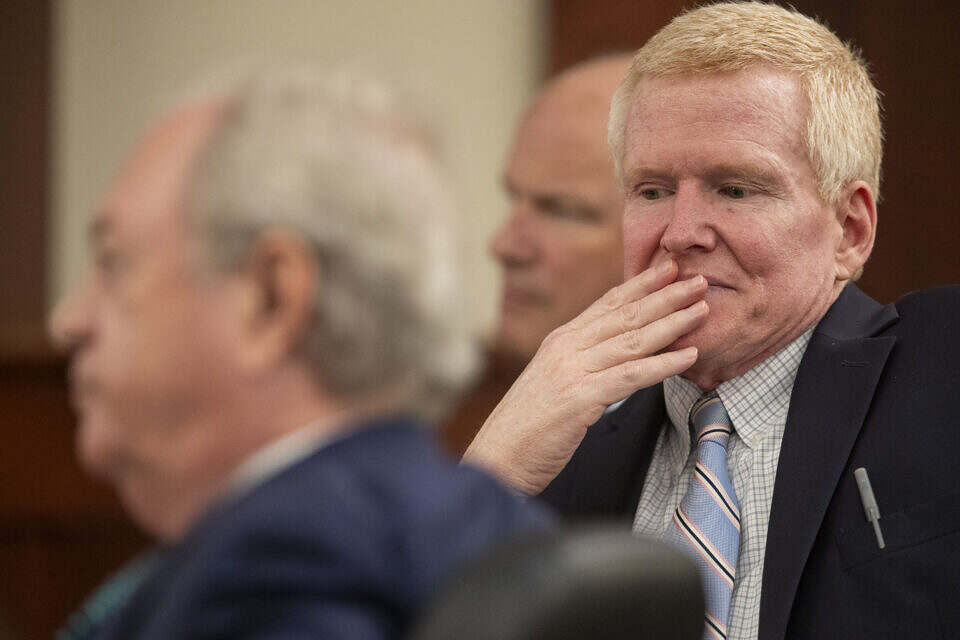
Accused killer Alex Murdaugh looks back to legal aides during a status hearing ahead of his retrial, Friday, August 14, 2026, in Lexington, S.C. (Pool)

***

There are important distinctions among the three pending disputes:

The sanctions motion is focused on an alleged violation of a prior court order and seeks to prevent prosecutors from using Bevel’s blood-spatter conclusions or derivative testimony.

The dismissal motion focuses on what Owen told the grand jury and whether allegedly false forensic claims compromised the indictments.

The motion to compel seeks access to evidence before the retrial. Its primary requested remedy is production — not exclusion or dismissal.

For the newest filing to directly support sanctions, the court would first have to determine what the state is required to produce and whether prosecutors failed to comply with that obligation or with an ensuing order.

Similarly, evidence that SLED declined to perform additional DNA testing would not, without more, establish that Owen knowingly gave false testimony to the grand jury.

There is also no forensic evidence presently establishing that the unidentified male DNA belonged to a killer, that a firearm used in another shooting was connected to Moselle or that the FARO files contain exculpatory information.

The defense’s argument is that it cannot meaningfully answer those questions until it receives and tests the evidence itself.

That distinction will be critical.

McCaslin will not be deciding whether every defense theory is correct. She will be deciding whether the requested evidence is material to trial preparation, whether the state has met its discovery obligations and, in the older motions, whether the alleged conduct warrants exclusion or the far more severe remedy of dismissal.

***

SLED ON TRIAL

S.C. Law Enforcement Division (SLED) chief Mark Keel. (FITSNews)

***

Murdaugh’s first murder trial centered largely on his lies. He repeatedly denied being at the crime scene on his family’s Moselle property in Islandton shortly before Maggie and Paul were killed — until a video recovered from Paul’s phone proved otherwise. He admitted under oath that he lied to investigators, his family and the jury about his movements that night.

That evidence will not disappear at the retrial.

But neither will the unanswered questions about the investigation into the murders.

The defense will enter the Sumter County courtroom armed with disputed blood-spatter evidence, alleged misstatements to the grand jury, unidentified DNA, a murder weapon that was never recovered and continuing fights over access to the state’s underlying forensic records.

The September 18, 2026 motion adds to that list.

It also gives Murdaugh’s attorneys a way to connect controversies that might otherwise appear isolated: not as proof that their client is innocent, but as evidence that the state’s conclusions cannot be accepted without access to the records and physical evidence behind them.

That may not be enough to persuade McCaslin to dismiss the indictments – but it could be enough to strengthen the defense’s case for court intervention, strict production deadlines and meaningful consequences if evidence was withheld, lost or altered.

In 2023, prosecutors placed Alex Murdaugh’s credibility before a jury. In 2027, his attorneys intend to place SLED’s credibility alongside it.

***

ABOUT THE AUTHOR …

Jenn Wood (Provided)

As a private investigator turned journalist, Jenn Wood brings a unique skill set to FITSNews as its research director. Known for her meticulous sourcing and victim-centered approach, she helps shape the newsroom’s most complex investigative stories while producing the FITSFiles and Cheer Incorporated podcasts. Jenn lives in South Carolina with her family, where her work continues to spotlight truth, accountability, and justice.

***

SOUND OFF…

Got something you’d like to say in response to one of our articles? Or an issue you’d like to address proactively? We have an open microphone policy! Submit your letter to the editor (or guest column) via email HERE. Got a tip for a story? CLICK HERE. Got a technical question or a glitch to report? CLICK HERE.

***

Subscribe to our newsletter by clicking here…

*****

Related posts

CRIME & COURTS

Federal Death Penalty Case Ends With Guilty Plea In EMS Worker’s Murder

Jenn Wood
CRIME & COURTS

South Carolina Firefighter Remains on Duty Amid Child Molestation, Incest Charges

Andrew Fancher
CRIME & COURTS

DNA, Bullets And Missing Data: Murdaugh Defense Presses State

Jenn Wood

1 comment

Avatar photo
The Colonel Top fan September 22, 2026 at 10:03 am

Pooty Poot and Jimbo have repeatedly lied about evidence, reported what wanted you to think about the evidence and spun (against all reality) the evidence to support their version of what happened. They’ll keep throwing bombs, hoping some of it sticks. “Aleck Murdawk” is guilty and he will be convicted again – the really nice thing about this from the prosecution perspective is that they can streamline their case and put him back in the hoosegow in two weeks this time.

Reply

Leave a Comment