
by JENN WOOD
***
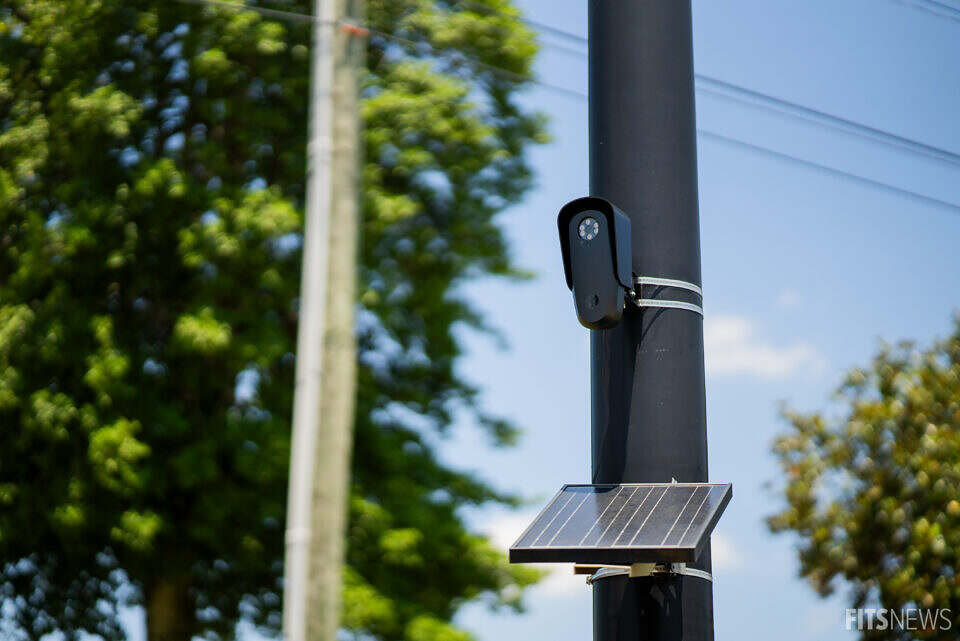
Oconee County could become the first local government in South Carolina to formally push back against Flock Safety cameras and other interconnected surveillance systems.
A sweeping ordinance (.pdf) scheduled for first reading on August 18, 2026, would prohibit county money, property, equipment and other resources from supporting what it defines as “mass surveillance.” The ordinance would also block qualifying systems from county-controlled road rights-of-way and deny discretionary county funding to municipalities that continue participating in them.
The 32-page proposal comes amid a widening debate over automated license plate readers — and a growing list of South Carolina law enforcement officers accused of using Flock’s powerful tracking network for personal purposes.
That debate has now reached Oconee County, where sheriff Mike Crenshaw recently acknowledged his office previously disciplined an employee for misusing the system.
“Have you ever had to take disciplinary action for misuse in Oconee County to this point?” Crenshaw was asked during a July 21 meeting of county council’s law enforcement and public safety committee.
***

***
“I have,” Crenshaw replied. “I did early on. I did have a discipline issue, and that’s when I realized the importance of this, and I upped it.”
Crenshaw said his office had traditionally used progressive discipline, but his approach changed “two or three years ago.”
“It’s immediate termination if you misuse it,” he said.
No additional information was provided regarding the employee’s identity, position, the nature or extent of the searches, when the misconduct occurred or what disciplinary action was imposed.
The acknowledgment is particularly significant given recent revelations elsewhere in the Upstate — where officers allegedly used Flock to secretly track former romantic partners, coworkers and private citizens.

***
“WHERE DO WE DRAW THE LINE?”
The proposed “Protection from Mass Surveillance Ordinance” is being championed by Oconee County Council chairman Matthew Durham, who framed the issue as a test of local officials’ commitment to constitutional limits on government power.
“I took an oath to support and defend the Constitution of the United States, and so did every member of the Oconee County Council,” Durham said in a Facebook video announcing the proposal. “Not simply to wait on a court to tell us when it has been violated, but to defend it right here where we stand.”
Durham acknowledged Flock and similar technology can help law enforcement solve crimes more quickly.
“Without it, some investigations may move slower, some may be harder,” he said. “But that does not outweigh the Fourth Amendment to the United States Constitution.”
According to Durham, the concern is no longer limited to a camera capturing an image of a vehicle traveling along a public road.
“We are talking about a technology capable of building a searchable record of where your vehicle went, when it went there and how often it goes back,” he said. “Your church, your doctor, your attorney, a political meeting — thousands and thousands of people who are suspected of absolutely nothing can have their movements logged, stored and made searchable through networks that go far beyond Oconee County.”
Durham argued constitutional safeguards routinely make government work slower — by design.
“The warrant requirement costs time. Due process costs time. A jury trial costs time,” he said. “We require them anyway because a government that can do its job without limits is exactly the kind of government the founders wrote the Bill of Rights to restrain.”
***
***
WHAT THE ORDINANCE WOULD DO
The proposal does not mention Flock Safety by name. Instead, it creates a broad definition intended to encompass current and future surveillance platforms based on their actual capabilities rather than their branding or stated purpose.
A system would qualify as prohibited mass surveillance when it routinely collects or processes identifying information about people, vehicles or devices in public places and possesses at least one of several listed capabilities.
Those capabilities include:
- Creating searchable histories of a person’s or vehicle’s movements.
- Tracking people, vehicles or electronic devices across multiple locations or times.
- Sharing locally collected information through an external surveillance database or network.
- Allowing access by outside agencies without prior, individualized judicial authorization.
- Using facial recognition, artificial intelligence or algorithmic analysis to identify patterns, associations, routes or behaviors.
- Combining surveillance records with commercial data, social media, public records, mobile-device information or other databases.
Basic license plate recognition would not automatically be prohibited. The ordinance specifically allows optical character recognition used solely to compare a plate against a “specifically identified, lawfully maintained hot list.”
A system would cross the line when it adds historical tracking, outside-network sharing, artificial intelligence, biometric recognition, persistent monitoring or warrantless access by other agencies.
The ordinance would prohibit county funds from paying for subscriptions, cameras, software, data storage, network access, maintenance, training or other support for a prohibited system.
It would also ban those systems from county property and county-controlled rights-of-way. Existing installations would have to be identified within 30 days of the ordinance taking effect, with county-funded connections generally discontinued within ten business days and physical equipment removed within 30 days after notice.
The proposal contains exceptions for ordinary security cameras, body-worn cameras, dashboard cameras, traffic monitoring, emergency dispatch, search-and-rescue operations, incident-specific drone deployments and narrowly tailored investigations.
It would also allow a surveillance system whose retained data is technically inaccessible without prior judicial authorization — provided the system does not contribute information to an outside network or conduct real-time tracking before that authorization is verified.
An internal policy, supervisor approval, case number or after-the-fact audit would not be enough to qualify for that exception.
***

RELATED | Officers Terminated for Abusing Flock Cameras
***
PRESSURE ON MUNICIPALITIES
Some of the ordinance’s most consequential provisions are aimed not at the Oconee County Sheriff’s Office (OCSO), but at municipalities operating their own surveillance networks.
A city or other governmental entity that owns, funds, hosts or contributes information to a prohibited system would become ineligible for discretionary county distributions while it continued participating.
That restriction would apply to general fund appropriations, recreation funds, capital assistance, economic development grants, community grants, sponsorships, reimbursements, accommodations-tax awards and other discretionary county-controlled resources.
The restriction could also reach municipally sponsored festivals and events — including those organized through nonprofit corporations, chambers of commerce, festival committees or other nominally independent organizations.
Under the proposal, municipal police details, road closures, barricades, public works assistance, use of city property, fee waivers, utilities and promotional support could establish sufficient municipal involvement to make an event ineligible for county funding.
“If a municipality chooses to operate mass surveillance on its own people, it will not receive discretionary county funding while it does,” Durham said.
The ordinance would not prevent an Oconee County deputy from requesting or using information lawfully available from a system owned by another jurisdiction. It would instead control how county money, contracts, property and rights-of-way are used.
“This ordinance does not tell the sheriff how to run an investigation,” Durham said. “It governs county money, county property, county-controlled rights-of-way.”
***
A GROWING RECORD OF ABUSE
The Oconee County proposal follows a series of FITSNews investigations by reporter Andrew Fancher documenting alleged Flock abuse by officers across the Upstate.
In July, FITSNews reported two Greer Police Department officers were terminated after an internal audit uncovered allegedly false or deceitful searches.
Former corporal Kareem Lynch allegedly used the system to track a female subordinate with whom he had a previous relationship. Separation records accused Lynch of entering false justifications such as “city planning” and “welfare check” to conceal the purpose of his searches.
A second Greer officer, Sebastian Echeverry, allegedly searched the license plates of “several citizens” while using false or misleading justifications over a five-month period.
Earlier this week, Fancher reported former Mauldin police officer Ellie Anna Hammond allegedly searched for a former significant other’s license plate at least 166 times between March and July 2026. Records alleged Hammond falsely categorized those searches as warrant checks, traffic infractions and welfare checks.
Those cases have intensified scrutiny of the level of access provided to individual officers, the frequency of agency audits and the lack of public disclosure when misuse is discovered.
On August 3, the South Carolina Sheriffs’ Association defended “responsible use” of automated license plate readers, arguing isolated misconduct should not be treated as evidence the technology itself is improper.
All of the state’s active sheriffs support the responsible use of the technology because of its investigative value, according to the association.
There is no question Flock alerts have helped law enforcement apprehend dangerous suspects.
Oconee County deputies recently used the system to locate a stolen vehicle connected to the 2024 kidnapping and attempted sexual assault of a Clemson University student. Deputies pursued the suspect, Darrel Scott Brooks, before taking him into custody near the Georgia state line. Brooks was recently convicted and sentenced to consecutive life terms.
The central question is whether those successes justify the creation of a searchable network containing the movements of thousands of people who have never been suspected of a crime — and whether internal policies are enough to prevent abuse.
***

RELATED | Officer Used Flock to Track Ex-Lover 166 Times
***
A FIRST FOR SOUTH CAROLINA?
South Carolina lawmakers have introduced several bills seeking to regulate automated license plate readers, including proposals addressing retention periods, audits, access logs and agency policies.
None has yet created the kind of local funding and property prohibition contemplated by Oconee County’s ordinance.
Based on a review of publicly available ordinances and reporting, Oconee’s proposal appears to be the first known effort by a South Carolina county or municipality to broadly prohibit local resources from supporting Flock-style mass-surveillance networks.
If approved, the measure would take effect following the required readings and public hearing. Existing systems would then be reviewed, and county staff would have 60 days to present council with an implementation report.
First reading is scheduled for August 18, with a public hearing expected on September 15.
“So we are drawing a line in Oconee County,” Durham said. “The Constitution is not someone else’s job to defend. It’s yours — and defend it where you live.”
***
THE ORDINANCE…
Subscriber-only document
This PDF is available to FITSNews subscribers. Get full access and be able to view documents like this one.
Subscribe for accessAlready a subscriber? Log in here
***
ABOUT THE AUTHOR …
As a private investigator turned journalist, Jenn Wood brings a unique skill set to FITSNews as its research director. Known for her meticulous sourcing and victim-centered approach, she helps shape the newsroom’s most complex investigative stories while producing the FITSFiles and Cheer Incorporated podcasts. Jenn lives in South Carolina with her family, where her work continues to spotlight truth, accountability, and justice.
***
SOUND OFF…
Got something you’d like to say in response to one of our articles? Or an issue you’d like to address proactively? We have an open microphone policy! Submit your letter to the editor (or guest column) via email HERE. Got a tip for a story? CLICK HERE. Got a technical question or a glitch to report? CLICK HERE.
