
by JENN WOOD
***
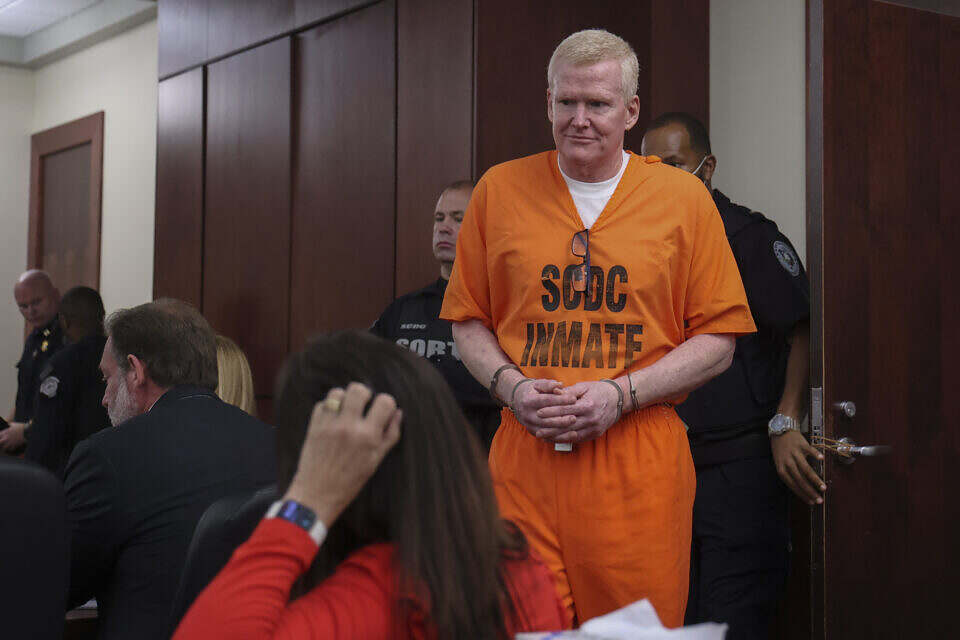
Attorneys for accused killer Alex Murdaugh are asking a South Carolina judge to dismiss the indictments charging him with the murder of his wife and son in early June 2021. In the event Murdaugh’s indictments are upheld, however – or in the event he is re-indicted – his lawyers want his impending retrial moved out of the judicial circuit where his family controlled the levers of justice for nearly a century.
Two defense motions were filed ahead of an August 14, 2026 pretrial hearing before S.C. circuit court judge Debra McCaslin, who was assigned to oversee Murdaugh’s second trial for the murders of his wife, 52-year-old Maggie Murdaugh, and their 22-year-old son, Paul Murdaugh.
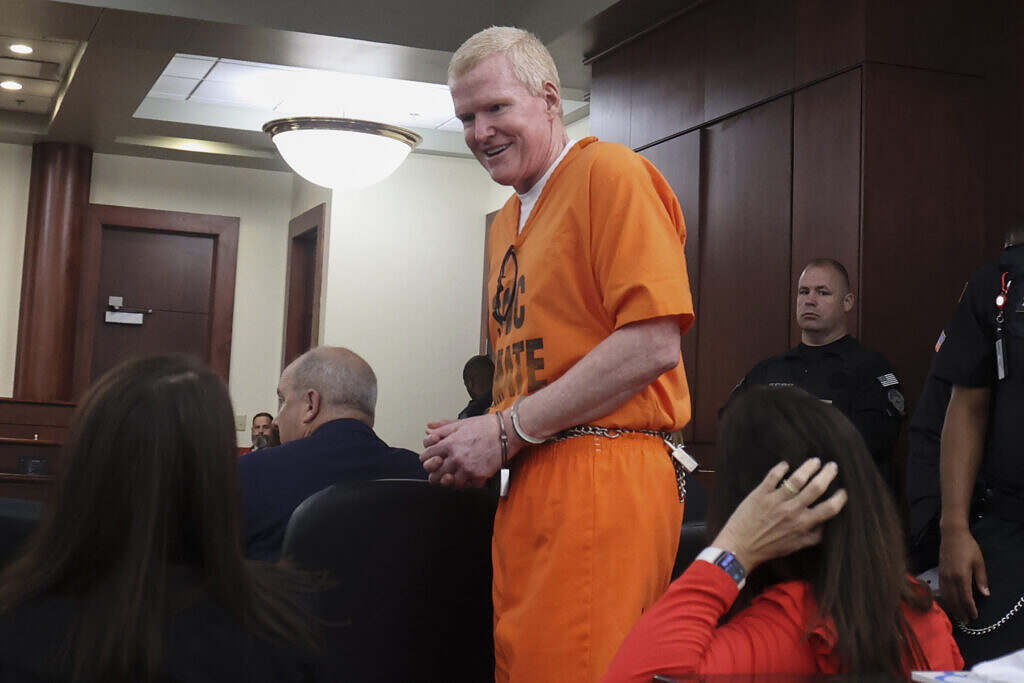
That trial is set to begin in early April 2027.
The first motion (.pdf) asked McCaslin to transfer the case from Colleton County to Charleston County, arguing years of international publicity, Murdaugh’s deeply rooted family connections and former clerk of court Rebecca “Becky” Hill’s jury tampering have made a fair retrial anywhere in the Fourteenth Judicial Circuit impossible.
The other motion took aim at the foundation of the prosecution itself.
Murdaugh’s attorneys contended his indictments should be dismissed because lead S.C. Law Enforcement Division (SLED) agent David Owen presented what they call “perjurious testimony and fabricated evidence” to the Colleton County grand jury that charged Murdaugh with the murders.
The three-page dismissal motion (.pdf) does not fully develop that claim. Attorneys Dick Harpootlian, Jim Griffin, Phillip Barber, Maggie Fox and Andrew Hand said their arguments will be laid out in a forthcoming supporting memorandum.
Still, the motion makes clear Owen’s credibility — already a recurring issue in FITSNews’ coverage of the original investigation and another Lowcountry murder prosecution — will once again take center stage.

***
A BID TO DISMISS…
The defense alleged Owen told the grand jury there was physical evidence directly connecting Murdaugh to the killings, only to admit during the 2023 trial that the information he presented was false.
According to the motion, the evidence was not merely mistaken but “fabricated by law enforcement.” The filing pointed to Owen’s trial testimony and a January 2023 defense motion (.pdf) seeking sanctions over the handling of Murdaugh’s white T-shirt.
The defense relied on the S.C. Supreme Court’s decision in State v. Thrift, which recognized a limited exception to the general rule that courts do not look behind an indictment to examine the evidence presented to a grand jury.
Under Thrift, a court may conduct that review when a defendant makes a “colorable claim of prosecutorial misconduct.”
Murdaugh’s attorneys said Owen’s testimony met that threshold and warranted dismissal of all four indictments — two counts of murder and two counts of possession of a weapon during the commission of a violent crime.
Whether McCaslin will consider dismissal at the August 14 hearing is unclear. The defense has not yet filed the promised supporting memorandum, and the state has not responded.
***
RELATED | The Unresolved Murdaugh Evidence Battle
***
DAVID OWEN’S GRAND JURY TESTIMONY
As FITSNews previously reported, Owen faced one of the most consequential cross-examinations of the six-week murder trial.
Defense attorney Griffin questioned him about two claims presented to the grand jury: that ammunition in weapons seized from the Murdaugh property matched ammunition used in the killings, and that Murdaugh’s shirt contained high-velocity impact spatter connecting him to the shootings.
The murder weapons have never been recovered. Meanwhile, the disputed shirt evidence became one of the most contentious chapters of the investigation. SLED used leuco-crystal violet (LCV) testing on the shirt Murdaugh wore when first responders arrived at Moselle. That testing can reveal stains not visible to the naked eye, but the defense argued the process turned the shirt blue and permanently altered it before Murdaugh’s experts could independently examine the original material.
SLED retained Oklahoma bloodstain-pattern expert Tom Bevel to evaluate the shirt. According to prior defense filings, Bevel initially concluded the stains were consistent with transfers and not back spatter from a gunshot.
After SLED agents traveled to Oklahoma to meet with him, Bevel changed his conclusion and identified what he believed was high-velocity impact spatter, the defense alleged.
***

***
Meanwhile, confirmatory HemaTrace testing performed by SLED produced negative results for human blood on all 74 cuttings taken from the shirt. The State ultimately did not present Bevel’s blood-spatter opinion to the trial jury.
FITSNews reported in 2024 that Owen was grilled about these inaccurate grand jury statements, along with SLED’s failure to search Murdaugh’s parents’ Almeda property until three months after the murders — despite investigators having permission to do so.
Asked whether that delay represented a missed opportunity, Owen responded, “Probably, yes.”
Questions about Owen’s handling of evidence have not been confined to the Murdaugh case.
As this outlet has extensively reported, Owen was also the lead investigator in the prosecution of Lowcountry jeweler Michael Colucci for the 2015 death of his wife, Sara Lynn Colucci.
Colucci’s defense accused Owen of withholding potentially exculpatory information from the defense, the trial court, the arresting magistrate and the Berkeley County grand jury. In June 2025, a judge quashed Colucci’s murder indictment amid that dispute – although the state was not barred from seeking another indictment.
Those cases are legally distinct, and allegations made by defense attorneys are not findings that Owen intentionally lied or fabricated evidence. But his repeated presence at the center of disputes over grand jury presentations and undisclosed evidence will likely sharpen scrutiny of the new dismissal motion.
***
WHY CHARLESTON?

***
The defense’s venue motion is far more detailed.
In a 29-page memorandum, Murdaugh’s attorneys argued three separate factors require the retrial to leave Colleton County and the entire Fourteenth Judicial Circuit, which includes Allendale, Beaufort, Colleton, Hampton and Jasper counties.
First, they pointed to the extraordinary volume of publicity generated by the case: multiple documentaries and dramatizations, a globally ranked podcast, the gavel-to-gavel broadcast of the first trial and continuing coverage of Hill’s conduct and the reversal of Murdaugh’s convictions.
Second, they argued the first jury-selection process already proved Colleton County could not supply an impartial jury.
Approximately 900 prospective jurors were summoned in January 2023, according to the filing. Only 123 were ultimately qualified — fewer than one in seven. When the first panel was asked whether its members had heard, read or learned anything about the case, the trial court observed that everyone appeared to stand.
The prospective jurors included people related to the Murdaugh family, people represented by the family’s former law firm, a friend of Paul Murdaugh, a relative of Mallory Beach and even Hill’s daughter.
Third, the defense argued Hill’s conduct created a courthouse-specific taint that cannot be cured by selecting another Colleton County jury. The S.C. Supreme Court overturned Murdaugh’s convictions in May 2026 after finding Hill made improper comments to jurors and attempted to influence their consideration of the case. The unanimous court described her conduct as a “breathtaking and disgraceful effort” to undermine the jury process.
Hill has since resigned and pleaded guilty to obstruction of justice, perjury and two counts of misconduct in office. Her successor — not Hill — would oversee the clerk’s administrative duties during the retrial.
But the defense argued any new Colleton County jury would still be summoned and managed by the same office, inside the same courthouse, and drawn from the same community in which Hill was elected and served.
“Every consequential proceeding in this case since March 2023 has already been relocated outside Colleton County,” the attorneys wrote, pointing to the Richland County jury-tampering hearing, Hill’s prosecution in Richland County and the decision to hold current pretrial proceedings in Lexington County.
“Only the trial itself — the proceeding for which impartiality matters most — remains assigned there,” they noted.
***
RELATED | Murdaugh Retrial Set For April As New Judge Pushes Case Forward
***
NOT JUST COLLETON COUNTY
The defense does not believe moving the trial to another county within the Fourteenth Judicial Circuit would solve the problem.
Hampton County was home to the Murdaugh family’s law firm and Palmetto State Bank, both of which figured prominently in the evidence surrounding Murdaugh’s financial crimes. Beaufort County was the site of the 2019 boat crash that killed Beach and the resulting criminal and civil cases. All five counties were served for three consecutive generations by a solicitor from the Murdaugh family.
Murdaugh’s attorneys also opposed bringing jurors from another county to Walterboro, an option permitted under South Carolina law. They argued imported jurors would still spend weeks inside the courthouse and community at the center of the controversy, likely requiring costly sequestration.
Instead, the defense wants the entire case transferred to Charleston County.
Charleston has more than 436,000 residents — more than eleven times the population of Colleton County and more than the combined population of the five-county Fourteenth Judicial Circuit, according to the filing.
The defense argued this larger jury pool would allow the court to freely excuse prospective jurors with fixed opinions, hardships or personal connections to the case without exhausting the available pool.
Attorneys also pointed to Charleston County’s experience hosting nationally watched proceedings, including the murder trial of former North Charleston police officer Michael Slager and the federal death penalty trial of Charleston church shooter Dylann Roof.
According to an affidavit from Harpootlian, Charleston County clerk of court Julie Armstrong told him the county could accommodate a trial of this size and specifically referenced the Slager trial as an example of the court system’s capacity.
The defense acknowledged Charleston residents are also likely to know about the Murdaugh case. The distinction, attorneys argue, is not between people who have heard about the case and those who have not.
It is between a large community that watched the case from a distance and the small group of counties whose families, institutions and courthouse officials became part of it.
***
WHAT COMES NEXT
Venue decisions are generally left to the discretion of the trial judge, and South Carolina courts do not require jurors to be completely unaware of a case. The usual question is whether they can set aside what they have heard and decide the case based only on evidence presented in court.
Murdaugh’s attorneys contended this is one of the rare cases where publicity and local entanglements are so pervasive that juror assurances during voir dire cannot cure the prejudice.
Prosecutors have not yet filed responses to either defense motion.
The filings join a growing list of evidentiary and procedural disputes expected to shape the April 5, 2027 retrial. The state has separately asked McCaslin for permission to use Murdaugh’s prior testimony, approve a written juror questionnaire, renew motions from the first trial and maintain restrictions on the release of discovery.
The August 14 hearing could provide the first indication of where the retrial will occur — and whether the defense can force a deeper examination of how the case reached the grand jury in the first place.
***
ABOUT THE AUTHOR …
As a private investigator turned journalist, Jenn Wood brings a unique skill set to FITSNews as its research director. Known for her meticulous sourcing and victim-centered approach, she helps shape the newsroom’s most complex investigative stories while producing the FITSFiles and Cheer Incorporated podcasts. Jenn lives in South Carolina with her family, where her work continues to spotlight truth, accountability, and justice.
***
SOUND OFF…
Got something you’d like to say in response to one of our articles? Or an issue you’d like to address proactively? We have an open microphone policy! Submit your letter to the editor (or guest column) via email HERE. Got a tip for a story? CLICK HERE. Got a technical question or a glitch to report? CLICK HERE.

5 comments
Not that I want to give Pooty Poot and Jimbo any ideas, but why don’t they ask for a dismissal of his confessions as well…
Why did you remove from your YouTube WIR of 8/8/2026 my comment which said:
At minutes 32:23 to 33:35, you, Will and Jenn are, thank God, ALMOST coming around to what I have been saying and writing for years: Richard Alexandre Murdaugh (“RAM”) could NOT POSSIBLY have been THE or A shooter of Paul or Maggie Murdaugh.
But think of what you said next: RAM’s “actions precipitated what happened.”
Whatever RAM did, whether it was not paying his druggies or keeping the insurance fraud loot all to himself and not sharing it with his willing collaborators in the scheme, does it justify whoever shot Paul and Maggie to have taken their lives?
Justice for Paul and Maggie means finding the real shooter(s) and “cleaner(s).”
But PLEASE be careful with that “third gun” story. It raised my hopes up but worried me that your leaking it would give the anti-RAM forces time to spin it away before it gets validated.
PLEASE release all you know about that third gun. And do not worry about validating me because I have been writing for years that Maggie was shot with ONE OF Paul’s two previously stolen guns.
The truth should not be hidden for fear of validating the long-suffering and now-almost-dying Dr. Marie Faltas.
And speaking of my comments on other stories/threads, here is what I wrote on FITS’ 26 March 2024 story on Alan Wilson’s demand for tougher bonds:
What about the actually innocent forced to live in custody or under horrendous bonds while their rights to speedy trial and/or speedy retrial after a hung jury in a first trial get trampled on? And by none other than Hatchet-for-Hire Heather (“Weiss”) who stands gloating behind Alan Wilson as he urges BASICALLY repeal of the Eighth Amendment which bans excessive bail.
Three stark examples from Richland County, South Carolina, in the 21st Century:
(1) Professor Chi Kei Rick Chow who languished in jail for three years because no judge in the length and breadth of South Carolina had the courage to grant him bail until a half-or-majority-black jury found Professor Chow NOT GUILTY for having, in defense of others, shot a gun-toting 14-year-old who had trespassed with that gun on Professor Chow’s store.
(2) Now-retired SC Circuit Judge Lee who got her nomination to the federal bench withdrawn because of the furor over her having granted bail to a defendant who was later also acquitted by a jury in the bakery shooting cases.
and (3) You guessed it, Dr. Marie Faltas who was made to live in an hotel for 50 months while paying rent for an apartment to which she was forbidden from returning, all because Hatchet-for-Hire Heather Weiss had brought against Dr. Faltas pre-known FALSE harassment charges which were, thank God and due to Dr. Faltas’ able pro se advocacy, ultimately dismissed WITH PREJUDICE.
Weiss knew, and could not not have known (double negative intended) that Dr. Faltas was the victim, not the perpetrator of harassment.
But Weiss was paid $70K/year by the City of Columbia to be its agent in then-Barney Giese’s 5th Circuit’s Solicitor’s Office. And Dr. Faltas was then suing the City of Columbia.
So, who pays the piper calls the tune. And the victim got charged instead of the real perpetrator.
You want prosecutors’ tyranny unchecked by the Eighth Amendment?
Be careful! Some day YOU might need that Eighth Amendment.
Who can give Professor Chow his three years back? Who can give Dr. Marie Faltas her 50 months back?
Does anyone even want to?
Because I always propose ennobling solutions, not pounds-of-flesh vengeance, I proposed a “days bank” where the days an ultimately-acquitted criminal defendant served in pre-trial/pre-dismissal custody may be banked and donated to other bail-eligible defendants who cannot afford the monetary bond.
Remember! Perjury and known-false prosecutions are crimes, too, the latter as misconduct in office.
And speaking of my comments on other stories/threads, here is what I wrote on FITS’ 26 March 2024 story on Alan Wilson’s demand for tougher bonds:
What about the actually innocent forced to live in custody or under horrendous bonds while their rights to speedy trial and/or speedy retrial after a hung jury in a first trial get trampled on? And by none other than Hatchet-for-Hire Heather (“Weiss”) who stands gloating behind Alan Wilson as he urges BASICALLY repeal of the Eighth Amendment which bans excessive bail.
Three stark examples from Richland County, South Carolina, in the 21st Century:
(1) Professor Chi Kei Rick Chow who languished in jail for three years because no judge in the length and breadth of South Carolina had the courage to grant him bail until a half-or-majority-black jury found Professor Chow NOT GUILTY for having, in defense of others, shot a gun-toting 14-year-old who had trespassed with that gun on Professor Chow’s store.
(2) Now-retired SC Circuit Judge Lee who got her nomination to the federal bench withdrawn because of the furor over her having granted bail to a defendant who was later also acquitted by a jury in the bakery shooting cases.
and (3) You guessed it, Dr. Marie Faltas who was made to live in an hotel for 50 months while paying rent for an apartment to which she was forbidden from returning, all because Hatchet-for-Hire Heather Weiss had brought against Dr. Faltas pre-known FALSE harassment charges which were, thank God and due to Dr. Faltas’ able pro se advocacy, ultimately dismissed WITH PREJUDICE.
Weiss knew, and could not not have known (double negative intended) that Dr. Faltas was the victim, not the perpetrator of harassment.
But Weiss was paid $70K/year by the City of Columbia to be its agent in then-Barney Giese’s 5th Circuit’s Solicitor’s Office. And Dr. Faltas was then suing the City of Columbia.
So, who pays the piper calls the tune. And the victim got charged instead of the real perpetrator.
You want prosecutors’ tyranny unchecked by the Eighth Amendment?
Be careful! Some day YOU might need that Eighth Amendment.
Who can give Professor Chow his three years back? Who can give Dr. Marie Faltas her 50 months back?
Does anyone even want to?
Because I always propose ennobling solutions, not pounds-of-flesh vengeance, I proposed a “days bank” where the days an ultimately-acquitted criminal defendant served in pre-trial/pre-dismissal custody may be banked and donated to other bail-eligible defendants who cannot afford the monetary bond.
Remember! Perjury and known-false prosecutions are crimes, too, the latter as misconduct in office.
I don’t believe David Owen will ever come back from those he has wronged! He didn’t know how to do his job and hated anyone giving input. The families that he has ruined because of his inability and actions will never be able to forget what he has done. I can forgive him for what he’s done only for myself but I won’t back down! He and others are a disgrace to the profession and I hope in his new position, he has learned. Thanks David!
We will get Justice For Daniel Reed Smith!