

by JENN WOOD
***
For years, law enforcement in South Carolina has treated the death of Daniel Reed “DJ” Smith as an accident — a tragic but straightforward conclusion that resulted in this case being quietly closed.
But the record underpinning this conclusion has never been simple.
From the beginning, Smith’s case was marked by conflicting witness accounts, unanswered questions about his final movements, and physical evidence that did not fully align with the official conclusion that Smith died on a remote stretch of railroad tracks just southeast of Ridgeville, S.C. as a result of an accidental train strike.
These inconsistencies have been meticulously documented – but never fully reconciled, leaving the official narrative intact even as the underlying facts remained unsettled.
Now, Smith’s family is asking a civil court to take that same factual record and reach a dramatically different conclusion. In a motion for summary judgment (.pdf) filed this week on behalf of Smith’s mother, Lesia Melendez, Columbia, S.C. attorney Tucker Player argued the evidence in this case was no longer a matter of competing theories — but rather a road map that “points in only one direction.”
Not towards an accident… but towards a homicide.
In reaching this conclusion, the motion accomplished something the original investigation never fully did — it forced the contradictions, omissions, and unresolved details of this case together into a single, unavoidable question:
What does the evidence actually show?

***
A CONCLUSION THAT NEVER ADDED UP…

***
Daniel Reed “DJ” Smith was 29 years old when his body was found on a remote stretch of railroad tracks in Dorchester County on August 11, 2018.
Smith was a father, a son and the kind of person, his family says, who showed up for his child, for his friends and for anyone who needed his help. By the end of that fateful day, though, his life had been reduced to a case file.
Smith’s death was ultimately classified as accidental — attributed to blunt force trauma consistent with a train strike. The investigation began with the Dorchester County Sheriff’s Office (DCSO) before being transferred to the S.C. State Law Enforcement Division (SLED), the agency which assumed control over the case.
For investigators, the conclusion of an accidental death brought finality. For Smith’s family, the official explanation never added up.
From the beginning, Lesia Melendez knew something didn’t make sense. She has always said she felt it before anyone confirmed it — hearing a call come across the police scanner about a body being found on the tracks and knowing, somehow, that it was her son. What followed was not clarity, but a slow, grinding process of seeking to understand how the official explanation could exist alongside the facts she and her husband were seeing — and the questions no one could answer.
That is where this story began.
Over the past several years, FITSNews has worked alongside the Melendez family — reviewing the same investigative files they previously pored over, walking the same stretch of track where DJ’s body was found, and documenting the same inconsistencies in the case files, inconsistencies that have never been resolved.
***

RELATED | DEATH ON THE TRACKS
***
This effort has been driven in large part by Eric Melendez — Smith’s stepfather and a veteran investigator who was working for the S.C. first circuit solicitor’s office at the time of DJ’s death. Eric Melendez’s involvement lent both professional experience and personal urgency to the case, which he believes was never fully investigated.
As previously reported, Eric systematically reviewed the case file, identified inconsistencies in witness statements, and flagged investigative steps he believed were either incomplete or never taken — including the failure to obtain key phone records and fully develop leads tied to other locations referenced by witnesses.
Those inconsistencies were not isolated, they were foundational to the inquiry. According to Melendez, they included conflicting witness statements, gaps in the timeline of events and credible leads that were identified but never fully pursued. Each of these things, on its own, raised questions. Together they formed a pattern — one that suggested the investigation reached a conclusion without ever fully reconciling the evidence.
Accordingly, the wrongful death lawsuit – filed in February 2024 – was not just a legal action. It was the family’s attempt to force those questions into a forum where they could no longer be ignored. Rather than blindly accepting the accidental train strike theory, Smith’s family insisted he was assaulted, struck by a vehicle, and placed on the tracks to stage an accident.
Now, through their motion for summary judgment, the Melendez family is asking the court to go a step further and determine that these facts are not just possible – but that they have already been proven.
***
“NO GENUINE ISSUE…”

***
Summary judgment is typically used to dismiss claims which lack evidence. In this case, though, the plaintiffs are using it to argue the opposite — that the evidence is so clear as to render a trial unnecessary.
In his new motion, filed on Monday (May 4, 2026), Player contends there is “no genuine issue of material fact” in the case – meaning even when the record is viewed in the light most favorable to the defendants, it supports only one conclusion.
But the filing does more than make a legal argument – it pointedly challenges how the case has been handled for nearly eight years.
“Plaintiff believes it is necessary to present proof that Daniel was murdered as the official position of the state is that Daniel died as a result of an accident,” the motion bluntly intoned. “Nothing could be further from the truth. For the eight years since Daniel’s death, the state conducted an incompetent investigation, hid evidence from the family of the victim, and retaliated against the husband and minor grandchild of plaintiff for daring to demand justice for her son.”
The family’s argument is built on the same case files law enforcement relied on to close its investigation — but viewed through a drastically different lens.
At the center of the motion is something this media outlet has documented since it first began reporting on Smith’s death four years ago: a timeline that never fully aligned with the facts.
***

***
DJ spent the evening of August 10, 2018 – his last night alive – at a bonfire with a couple of friends at their home in Ridgeville, S.C. Witness statements collected at the time were in conflict on numerous critical details — not just trivialities, but matters which went to the heart of what happened that night.
For example, accounts varied as to when Smith left the Ridgeville residence, whether he left the home alone or with others, and whether any altercation may have occurred before he departed. Some witnesses said he left the home shortly after an argument. Others placed him there much later than originally believed. Some witnesses described tension inside the home. Others minimized it. There was no clear consensus on any of these points, and efforts to reconcile the many contradictions were unsuccessful.
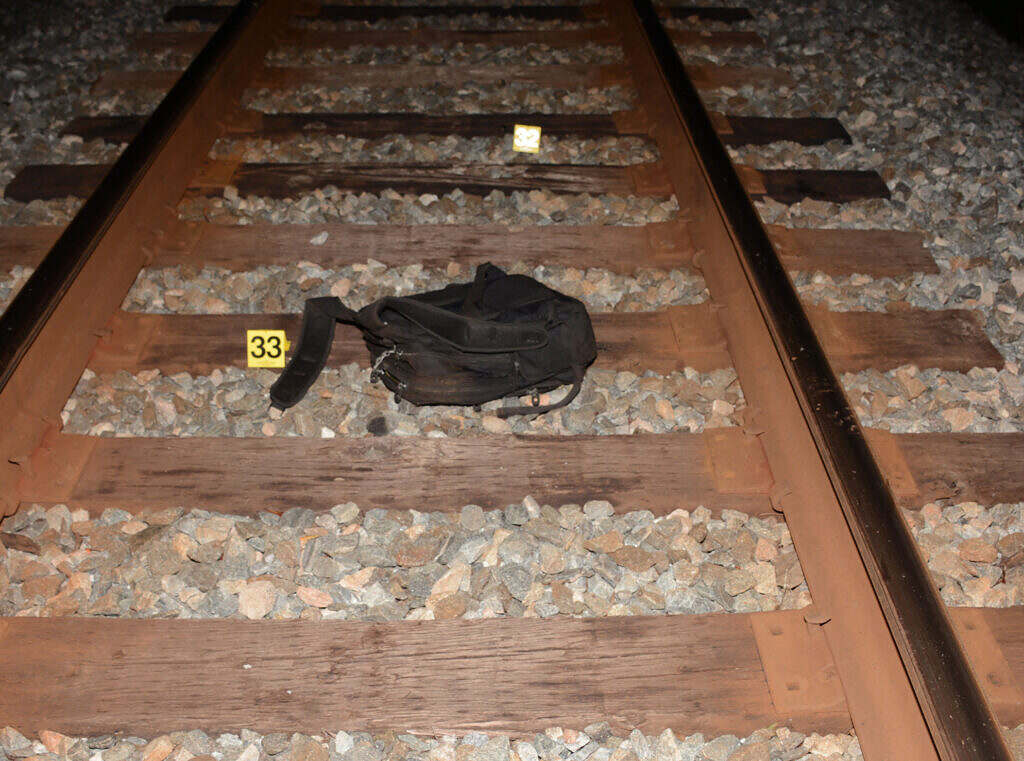
It is believed DJ left the home at some point between 1:00 a.m. and 3:00 a.m. EDT on what was by then the morning of August 11, 2018. What is known is that when he departed, he had a backpack and a cell phone with just three percent battery life remaining.
DJ’s body was found approximately 4.2 miles from the party on the railroad tracks – a short distance away from Norfolk Southern’s 28 Mile sign marker. A video captured by one train at 4:05 a.m. EDT shows what appears to be a person lying between the railroad tracks. Viewing the video, one is unable to determine the position of his body, but it appears to be located between the rails and not outside them.
Worth noting? DJ’s injuries were not indicative of the train hitting him while standing — but rather of it running over him as he lay on the tracks.
***
***
Investigators did not obtain cell phone records from multiple key individuals who were with Smith that night — a basic and often routine step in cases where timelines are disputed. Those records could have clarified who Smith was communicating with, when he left the residence, and whether others left or followed him.
Other leads followed a similar pattern. Witnesses directed investigators to an abandoned property where suspicious activity was reported on the same night — including multiple vehicles arriving, individuals moving in and out of the structure, and what one witness described as a possible gunshot. The location in question was searched, but according to the case file the search effort was limited. Investigators conducted a visual inspection, the document noted, did not obtain a warrant and, as such, did not perform forensic testing that could have confirmed or ruled out the presence of blood or other evidence.
At the same time, inconsistencies in statements from individuals connected to Smith — including their whereabouts, movements, and interactions with him — were documented but never resolved.
In a case built largely on witness accounts, those are not minor gaps. They are foundational to the integrity of the conclusions law enforcement reached… or the lack thereof.
The summary judgment motion filed this week did not attempt to smooth over these inconsistencies. Instead, it reframed them — not as reasons for doubt, but as evidence of an investigation that stopped well short of fully accounting for what actually happened.
***
TESTIMONY UNDER OATH…
One of the most striking elements of the motion is how it uses sworn testimony to bring multiple loose threads into a common focus.
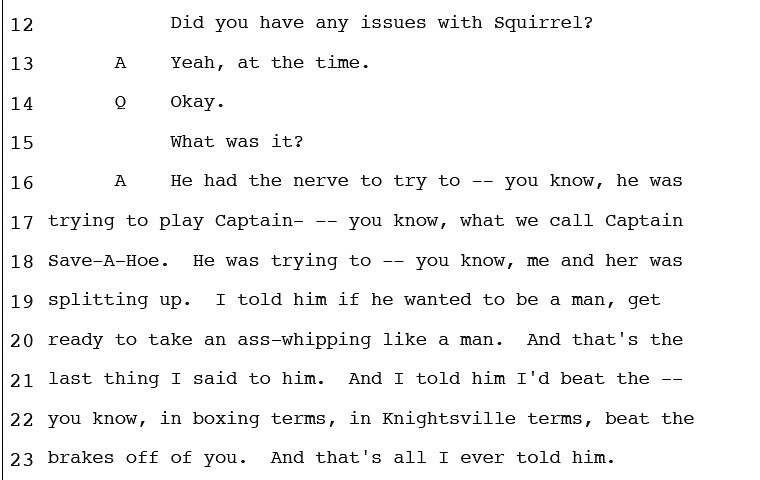
In a deposition (.pdf) tied to the lawsuit, defendant Michael Wayne Bunch Sr. confirmed he had a prior conflict with Smith stemming from a dispute over a woman — and admitted to threatening him.
At one point, Bunch recalled telling Smith he should “get ready to take an ass-whipping like a man.”
***
***
Bunch also placed himself at the residence where Smith was last seen alive on the night of the incident.
According to Bunch, witness Ashley Adams informed him that defendants Corey Dunn, Brandon Reynolds and Trenton Hogg were on their way to the residence “to collect money.”
Bunch said he left with Adams, knowing Smith remained behind — along with the same individuals later identified throughout the investigative file.
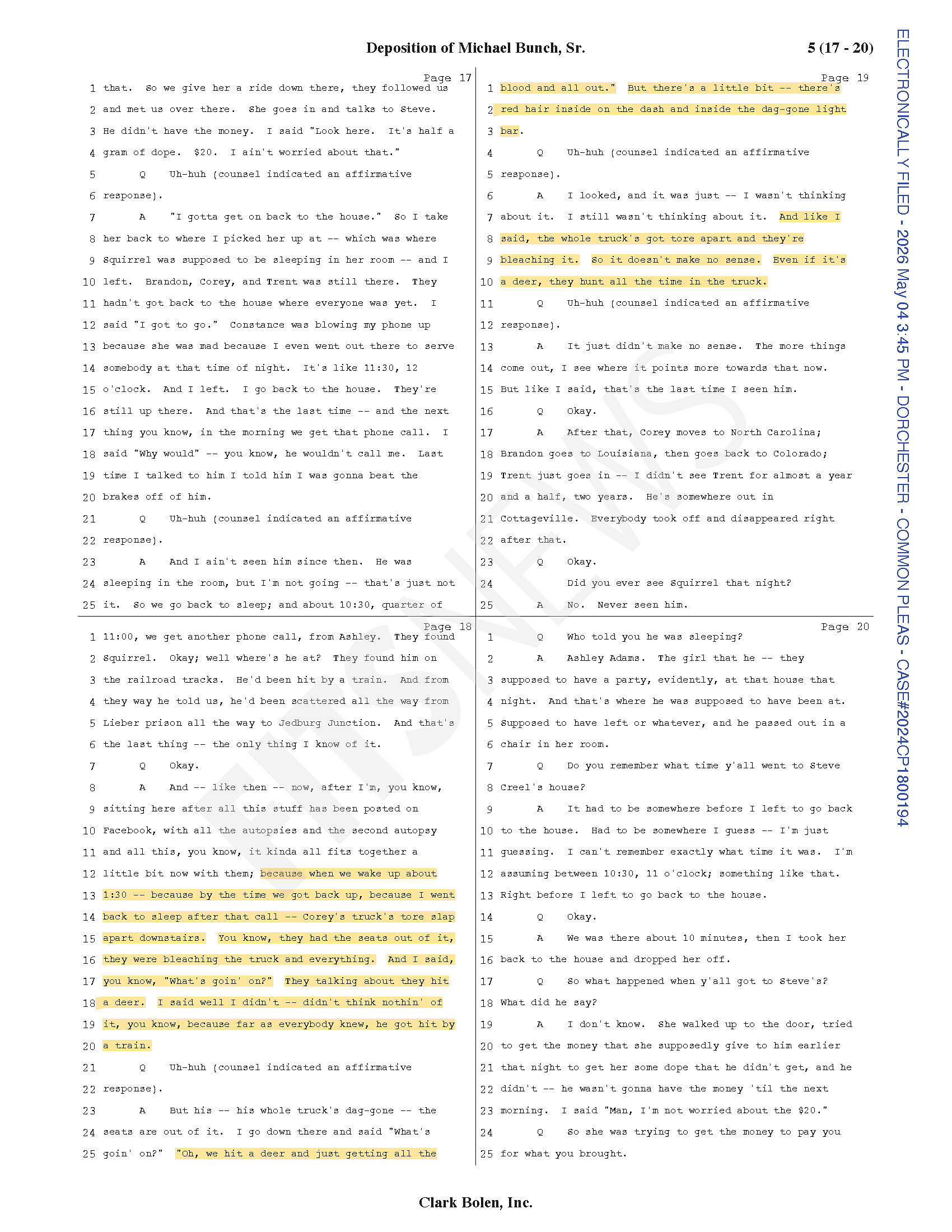
Under oath, Bunch also acknowledged details involving a truck being cleaned in the aftermath of these events — a point reflected elsewhere in the record. This is notable given the timeline investigators were attempting to establish. While Burch did not directly connect that activity to Smith’s death, the reference introduces the possibility of post-incident actions that were never fully explored by law enforcement.
***
***
Burch’s testimony also touched on the presence of red hair found inside the vehicle — another detail documented in the broader record that raised additional questions. As with other aspects of the case, this detail was noted but not definitively resolved.
Bunch denied knowing how Smith died, but his testimony uncovered something the original investigation missed. It connected motive, presence and movement — while introducing post-incident details that deepened the unanswered questions about what happened after Smith walked out of the Ridgeville home that fateful early morning.
Still, as FITSNews previously reported, despite being named in multiple witness statements and emerging as a potential suspect in the case file, Bunch does not appear to have ever been interviewed by investigators — a gap that appears to reflect the same flawed assumptions documented elsewhere in the record. Police believed he was unavailable due to incarceration when, in fact, he was not.
***
INCONGRUENT EVIDENCE…

***
The motion also revisited physical evidence tied to the case that has long complicated — and in some respects directly contradicted — the official explanation of how Smith died.
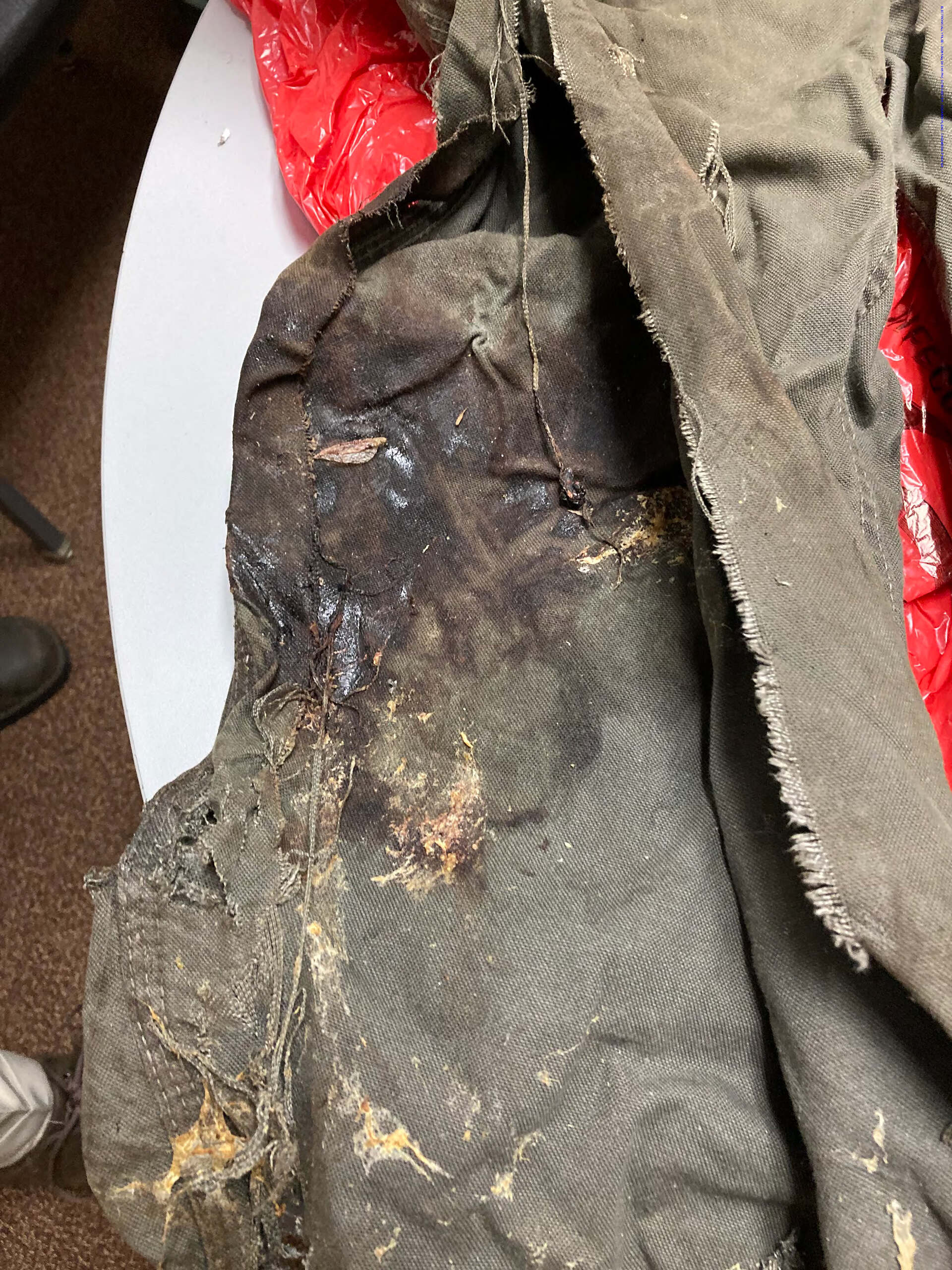
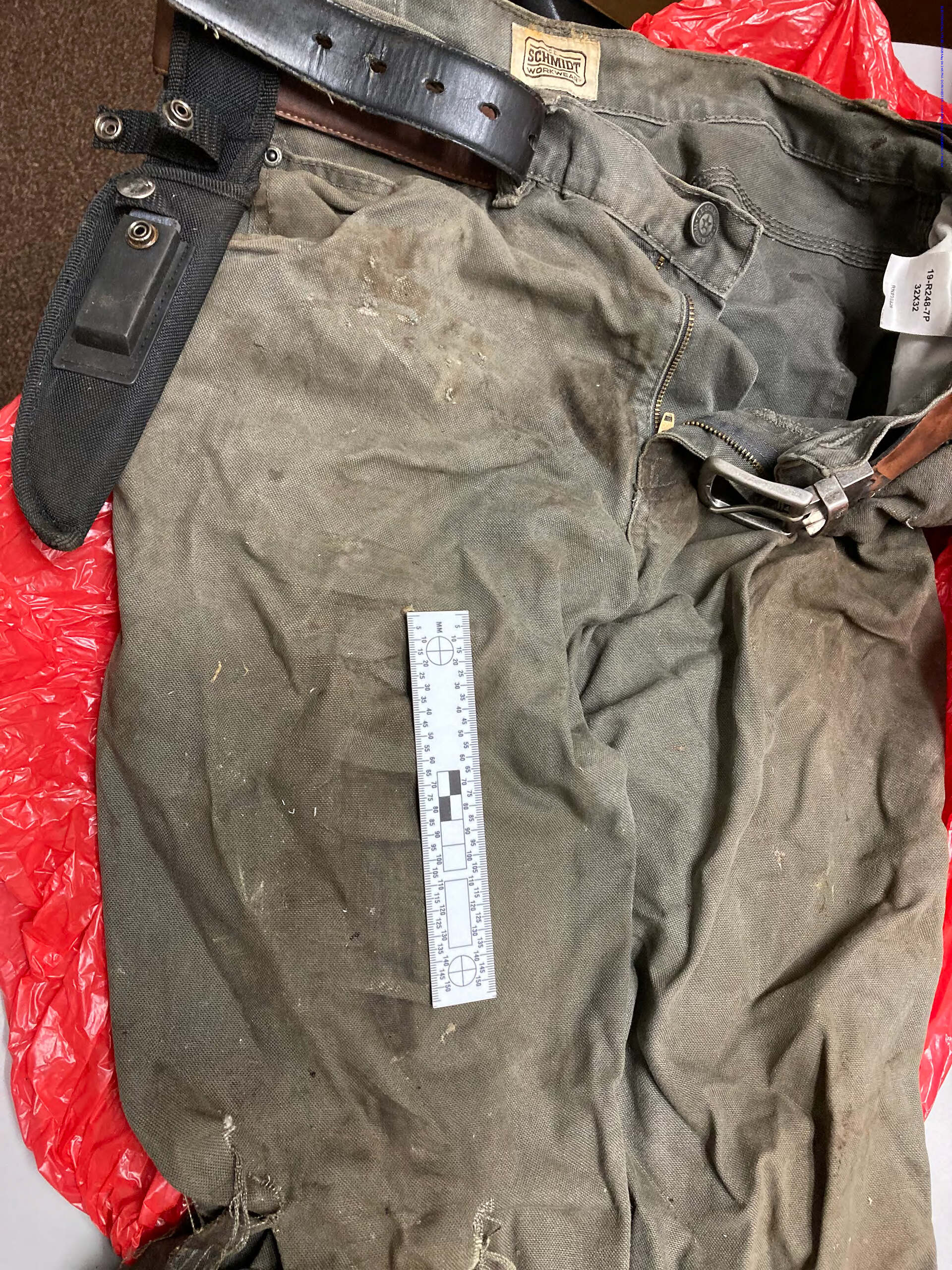
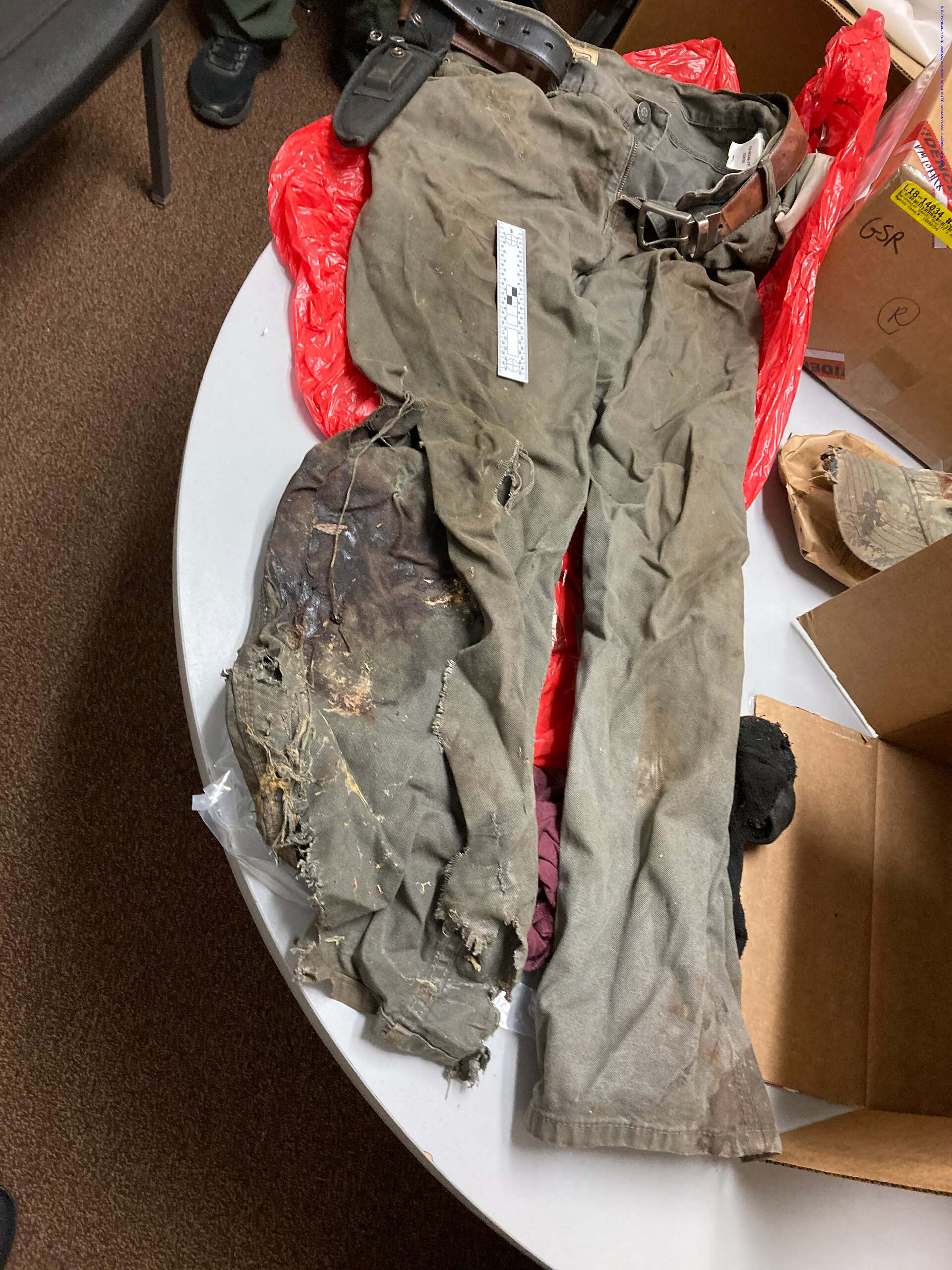
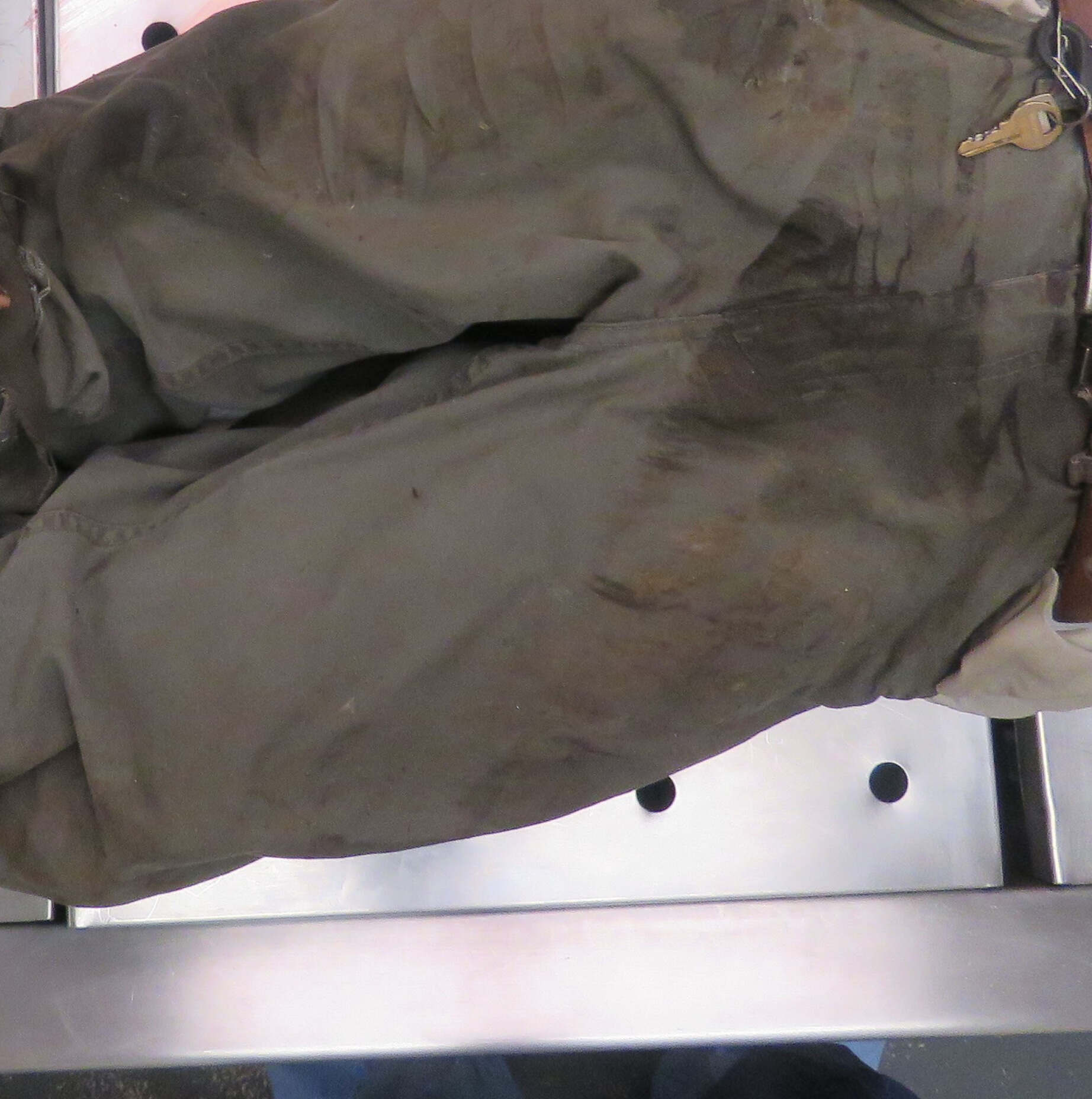
While the autopsy concluded Smith suffered blunt force trauma consistent with a train strike, plaintiffs pointed to an independent medical analysis that reached an altogether different conclusion: notably that Smith’s injuries were more consistent with being struck by a motor vehicle prior to being placed on the tracks.
According to the filing, the condition of Smith’s body — and the lack of corresponding evidence at the scene — is inconsistent with the assumption that he died where he was found.
Among the details highlighted by that report:
- One of Smith’s socks was detached from his body, yet both socks reportedly contained little to no blood
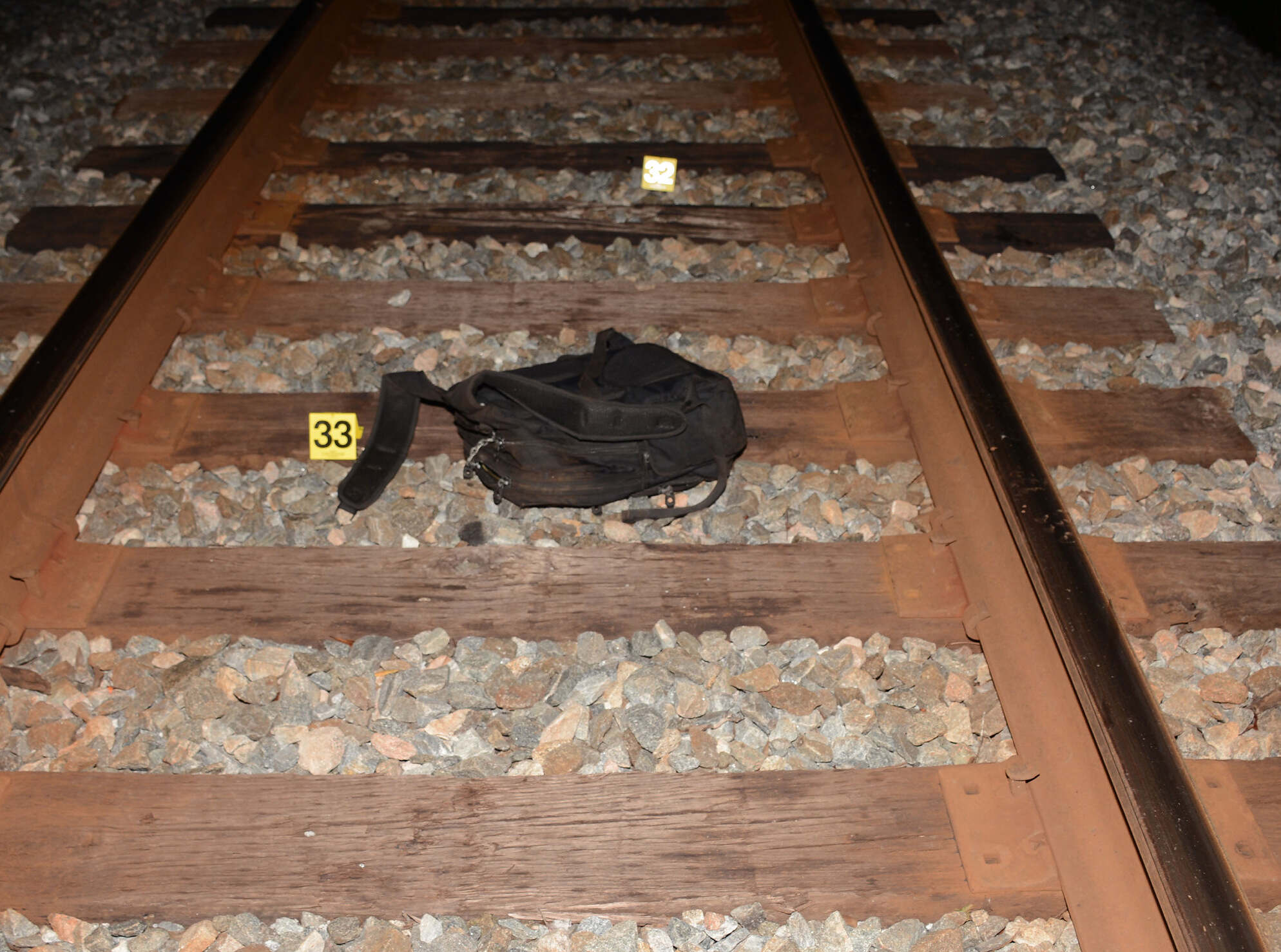
- Crime scene photographs showed only a minimal amount of blood present on or around the tracks
- Despite catastrophic head trauma, only a small amount of brain matter was documented at the scene
- By the time of the autopsy, no brain matter remained in the body, and no alternative explanation — such as animal activity — was identified.
Taken together, the motion argued, those facts are not consistent with a person being killed by a train at that location.
***

***
“Unless Dorchester County has an active vampiric hobo population, the exsanguination of Daniel occurred at some location other than the train tracks where his body was found,” the motion stated bluntly.
A similar argument was made regarding the absence of brain matter on the tracks.
“Perhaps there are brain eating zombies hanging out with the vampiric hobos,” the filing continued, noting that only a fraction of the brain matter expected to be found was documented – despite the extent of Smith’s injuries.
Stripped of its horror film rhetoric, the argument attorney Player laid out is simple and straightforward: if Smith suffered catastrophic injuries on the tracks, the physical evidence associated with those injuries should have been there.
According to the motion, though… it wasn’t.
That absence, the plaintiffs argued, represented more than a gap in evidence supporting the official narrative – it was direct evidence contradicting it.
***
FLAWED PROCESS…
At its core, the motion filed on behalf of Smith’s mother has forced a confrontation between two competing realities — one rooted in the official conclusion, the other in the underlying record leading up to it.
For years, this case has been defined publicly by a single determination: that Smith’s death was accidental. That conclusion brought a measure of finality to the investigation – and has remained largely unchallenged since 2018.
But the record behind it, as noted, is shaped by a myriad of inconsistencies – many of which were documented but never reconciled. That tension – between conflicting evidence and unresolved discrepancies – is at the center of the plaintiffs’ motion.
The argument advanced by the motion is not simply that investigators got it wrong – it is that their conclusion rests on a record that was never fully brought into alignment. When the evidence is considered as a whole, they argue – without the assumptions that guided the original investigation – it points in a different direction.
“This is not a case where the evidence is lacking,” the motion argued. “It is a case where the evidence was never fully reconciled with the conclusion it was used to support.”
In that sense, the motion reframes the issue before the court. The question is no longer what happened to Smith, but whether the process used to answer that question was adequate, whether the contradictions in the record were ever resolved and whether the investigation followed the evidence to its logical conclusion or stopped once a plausible narrative emerged.
It is not just the outcome that is being challenged – it is the path which led to it.
***
WHAT THE COURT WILL DECIDE…
The court is not being asked to determine guilt, but rather to assess whether the evidence in the record is so clear that a trial is unnecessary.
If the motion for summary judgment is granted, the court would effectively conclude that the established record — including the investigative file, sworn testimony, and supporting exhibits — is sufficient to support the family’s claims as a matter of law. If the motion is denied, the case will proceed to trial – where those same facts will be examined in full for the first time, tested through cross-examination and evaluated by a jury tasked with resolving competing interpretations.
Either way, the case has already shifted in a meaningful way. What was once treated as a closed investigation defined by a single conclusion is now an open legal question — one rooted not just in what investigators found, but in what they left unresolved.
From the moment Smith’s body was discovered, his family has maintained he was killed and placed on the tracks. Over time, those concerns did not fade; they deepened. Each new document and each additional piece of the investigative file added context, but rarely clarity.
***

RELATED | A NEW CHAPTER
***
For nearly eight years, Lesia and Eric Melendez have been told their son’s death was an accident. This filing asks a court to examine whether that determination was ever supported by a fully reconciled record — or whether it was the product of an investigation that stopped short.
The motion further alleged that in the years following Smith’s death, efforts by his family to push for answers were met not with transparency, but with actions they describe as retaliatory — directed not only at them, but at those closest to them.
Those allegations are not the subject of this motion, but they are now part of the record – and are likely to shape what comes next in this case.
***
THE MOTION…
Subscriber-only document
This PDF is available to FITSNews subscribers. Get full access and be able to view documents like this one.
Subscribe for accessAlready a subscriber? Log in here
(S.C. Circuit Court)
***
ABOUT THE AUTHOR …

As a private investigator turned journalist, Jenn Wood brings a unique skill set to FITSNews as its research director. Known for her meticulous sourcing and victim-centered approach, she helps shape the newsroom’s most complex investigative stories while producing the FITSFiles and Cheer Incorporated podcasts. Jenn lives in South Carolina with her family, where her work continues to spotlight truth, accountability, and justice.
***
SOUND OFF…
Got something you’d like to say in response to one of our articles? Or an issue you’d like to address proactively? We have an open microphone policy! Submit your letter to the editor (or guest column) via email HERE. Got a tip for a story? CLICK HERE. Got a technical question or a glitch to report? CLICK HERE.

Who Owns Your Lawyer? S.C. Court Considers Private Equity in Law Firms