
|
Getting your Trinity Audio player ready...
|
by JENN WOOD
***
Oconee County’s fight over automated license plate readers has moved beyond a philosophical debate regarding privacy and into a battle over who gets to see how law enforcement is using (or misusing) the technology.
Leaders of South Carolina’s westernmost county voted to pursue access to unredacted law enforcement logs week after sheriff Mike Crenshaw acknowledged his office had disciplined an employee for misusing its license plate reader system.
At the same August 18, 2026, meeting, council voted 4-1 to give first reading to the county’s proposed Protection from Mass Surveillance Ordinance (.pdf). The proposed measure would prohibit county money, property, personnel and other resources from supporting surveillance systems capable of compiling or sharing searchable histories of people’s movements. It would also place financial pressure on municipalities that continued operating qualifying systems by making them ineligible for certain discretionary county funding.
Councilman John Elliott cast the only vote against the ordinance.
“Public safety is a top priority for county council,” Elliott said. “Flock cameras are used for public safety. Therefore, I’ll be voting no.”
The remaining members backed what appears to be the first county-level effort in South Carolina to defund Flock-style surveillance systems. The ordinance still needs two additional readings before it can become law.

***
WHAT DO THE LOGS SHOW?
Council’s push for audit records could provide a more immediate answer to a question hanging over the controversy: how has Oconee County’s system actually been searched?
Councilman Tommy James directed county staff to communicate with the sheriff’s office and request that council members be allowed to review the unredacted audit log associated with the county’s license plate readers.
Councilman Don Mize asked whether the request could be expanded to include logs maintained by municipalities operating cameras within Oconee County. James questioned whether the county would have jurisdiction to compel those records, but chairman Matthew Durham said council should at least ask.
That motion passed unanimously.
Crenshaw has since asked the office of S.C. attorney general Alan Wilson for guidance on whether he may provide the unredacted records to council.
According to Crenshaw, the logs can contain a license plate number or vehicle description, the suspected crime and a corresponding case number. His concern is that giving council access could effectively open portions of active criminal files — including cases involving juveniles or sexual assault victims — to officials who are not part of the investigation.
“It’s not that I don’t want to,” Crenshaw told The Journal. “I don’t feel like legally I can release that information.”
Crenshaw said he may be able to provide redacted information or allow council members to inspect records at the sheriff’s office without copying or photographing them. For now, however, he is awaiting a legal opinion.
The dispute places council’s demand for independent oversight against the sheriff’s responsibility to protect sensitive investigative information. It also raises a narrower question that may be easier to resolve: whether council can verify the legitimacy of searches without receiving the identities of victims, witnesses or confidential investigative targets.
***
***
MONTHLY AUDITS — AND AN EARLIER MISUSE CASE
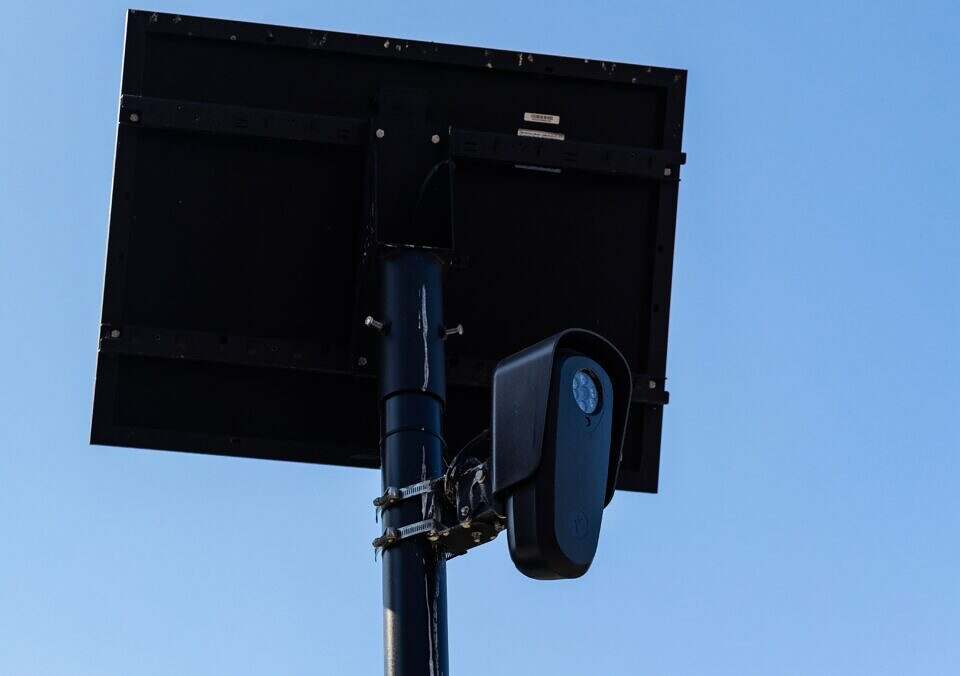
The sheriff’s office currently operates five Flock cameras – paying approximately $3,000 per camera annually, according to Crenshaw. Another 19 cameras in Oconee County are reportedly operated by municipalities or private entities.
Crenshaw said his agency audits its system monthly. Captains review searches conducted by personnel under their command and confirm the license plate or vehicle description is connected to the listed case.
If the relationship is not clear from the original report, the employee must file a supplemental report within three days explaining why the search was conducted.
Flock data available to the agency generally reaches back 30 days, Crenshaw said, meaning some searches may relate to investigations that remain open when the monthly audit occurs.
The sheriff has said he is confident in both the logs and the searches his office reviews. He has also acknowledged, however, that an employee was disciplined for misuse early in the county’s use of the technology.
Crenshaw has not publicly identified that employee, described the unauthorized search or specified the discipline imposed. He said the incident led him to abandon progressive discipline for Flock misuse in favor of immediate termination.
That earlier admission gave council’s demand for the logs added weight. An audit system can detect improper activity only if supervisors know what to look for — and if someone outside the agency can verify the process is working.
Crenshaw said prosecuting officers who misuse the technology could deter abuse. He also supports additional statewide guardrails and has indicated he would consider a warrant requirement or a special law enforcement unit responsible for approving searches.
“We’ve got to work to find a solution to that to allow law enforcement to continue to use this technology to help our citizens and to keep our citizens safe and to solve these crimes,” he said.
***
RELATED | South Carolina County Takes Aim At Flock
***
MORE MISUSE — AND MORE SCRUTINY
The Oconee debate is unfolding as the list of alleged abuses in South Carolina continues to grow.
As FITSNews previously reported, two former Greer police officers were terminated after an internal audit uncovered allegedly false or misleading searches. One was accused of using the system to track a female subordinate with whom he had a previous relationship.
Former Mauldin police officer Ellie Anna Hammond was later accused of searching for a former significant other’s license plate at least 166 times between March and July 2026 while entering purportedly false justifications.
Since Oconee’s initial debate, a still more extensive case has emerged in Colleton County.
Former lieutenant Ruben Carter was fired after an enhanced audit allegedly identified more than 2,700 unauthorized Flock searches involving 14 people over approximately one year. Those searched reportedly included Carter himself, fellow deputies, friends and former associates.
Colleton County sheriff Guerry “Buddy” Hill asked the South Carolina Law Enforcement Division (SLED) to investigate possible criminal conduct and sharply restricted access to the system. Individual deputies may no longer conduct routine searches; the communications division will handle them, with temporary access permitted only for specific investigations and subject to review.
Those cases have strengthened critics’ argument that a required case number or typed justification does little to prevent misuse when the person conducting a search can enter a false reason.
Supporters counter that the misconduct represents abuse by individual officers — not proof that a tool credited with locating stolen vehicles, missing people and violent suspects should be abandoned.
Crenshaw has pointed to cases in which Flock alerts assisted Oconee deputies, including the apprehension of Darrel Scott Brooks after the 2024 kidnapping and attempted sexual assault of a Clemson University student. Brooks was recently convicted and sentenced to consecutive life terms.
The value of that arrest is not disputed. The question before Oconee County is whether the same result can be achieved without maintaining a broad, searchable record of people who are suspected of nothing.
***
RELATED | Mauldin Police Officer Used Flock to Track Ex-Lover 166 Times
***
BACKLASH TURNS DESTRUCTIVE
The political backlash against Flock has also been accompanied by a troubling wave of vandalism.
In July, cameras in Pageland, South Carolina, were cut from their poles shortly after the town purchased ten units. Police described the devices as important tools for investigating stolen vehicles, wanted suspects, homicides and hit-and-run crashes.
In August, at least two of Irmo’s 11 existing cameras were coated with foam sealant, impairing the devices as the town prepared to expand its network under a contract worth more than $400,000.
Most recently, authorities reported that a Flock camera pole on Highway 41 near Herper’s Ferry Road in the Mount Pleasant area was cut and its internal wires severed. The repair cost was estimated at approximately $1,000.
Other cameras across the Upstate have reportedly been knocked down, dismantled or had their wires cut.
The vandalism is part of a growing backlash against Flock cameras as public anger intensifies over mass surveillance and repeated cases of law enforcement misuse.
Destroying the cameras is illegal and carries consequences, but the pattern underscores how quickly distrust of the technology has moved beyond council chambers and public meetings.
South Carolinians are no longer merely asking whether Flock cameras solve crimes. They are asking who can search the system, which agencies can access the data, how searches are audited, whether misuse carries criminal consequences and whether the government should collect the information in the first place.
***
FUNDING AS LEVERAGE
Oconee County Council cannot dictate how an independently elected sheriff conducts a particular criminal investigation. Durham has acknowledged that limitation.
What council does control is the county’s money, property, contracts and road rights-of-way.
If adopted, the ordinance would prevent county funds from paying for prohibited systems and require qualifying equipment to be removed from county property or county-controlled roads. Municipalities that continue participating in those systems could lose access to discretionary county grants, recreation money, accommodations-tax awards and other support.
The proposal would not prohibit ordinary security cameras, body-worn cameras, dashboard cameras, emergency deployments or basic license plate comparisons against a defined law enforcement hot list. Its restrictions are aimed at systems that create historical movement records, use artificial intelligence or biometric analysis, or share information through broader surveillance networks without individualized judicial authorization.
Elliott and Crenshaw argue the county risks discarding a valuable crime-fighting tool. Durham and the council majority contend that effectiveness alone cannot answer the constitutional and privacy questions.
“We don’t have the authority to tell the sheriff how to run his office, but we do control funding,” Durham said.
Whether the ordinance survives its final readings remains unresolved. So does council’s access to the audit logs.
But Oconee County has already forced the debate into a more concrete phase — away from generalized assurances and toward the money, records and rules governing one of law enforcement’s most powerful surveillance tools.
***
ABOUT THE AUTHOR …

As a private investigator turned journalist, Jenn Wood brings a unique skill set to FITSNews as its research director. Known for her meticulous sourcing and victim-centered approach, she helps shape the newsroom’s most complex investigative stories while producing the FITSFiles and Cheer Incorporated podcasts. Jenn lives in South Carolina with her family, where her work continues to spotlight truth, accountability, and justice.
***
SOUND OFF…
Got something you’d like to say in response to one of our articles? Or an issue you’d like to address proactively? We have an open microphone policy! Submit your letter to the editor (or guest column) via email HERE. Got a tip for a story? CLICK HERE. Got a technical question or a glitch to report? CLICK HERE.


