

by MARK POWELL
***
It’s not much as far as figures go. In fact, 3% is downright paltry. For example, business types consider a meager 3% return on an investment a failure.
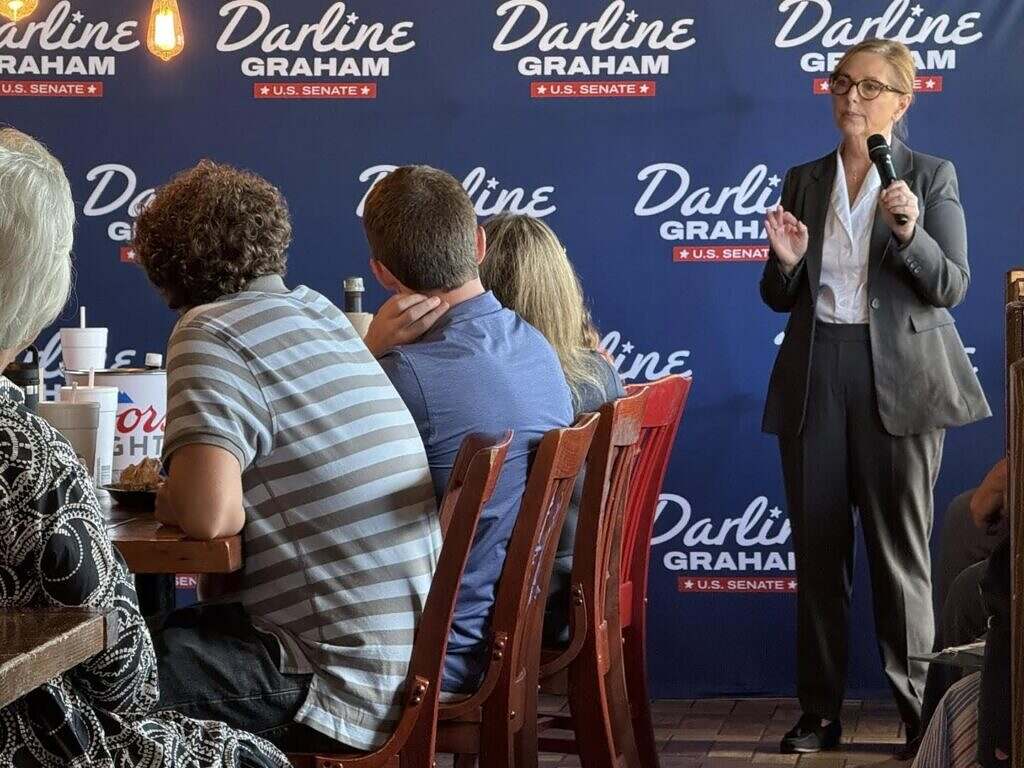
But in today’s oh-so-tight special Republican runoff election for U.S. Senate, 3% could make all the difference in whether congressman Ralph Norman or interim senator Darline Graham Nordone replace the late Lindsey Graham on the GOP ballot this fall.
Early voting stats reveal why…
During the three-day early voting window prior to the August 11, 2026 primary, 61,775 ballots were cast. Two weeks later, during the three-day early voting period leading up to the runoff – the early voting number rose to 63,716. This uptick occurred despite the fact that leading contenders from the first round of balloting – such as congressman Russell Fry, businessman Mark Lynch and former governor Mark Sanford – were no longer in the running.
“That’s a head scratcher for sure,” one longtime Palmetto politico told us. “It means something. But just what exactly is hard to say.”

***
Participation in runoff elections is typically lower than in the preceding election. Also, while early voting can often be an indicator of what to expect on Election Day – it’s an imperfect one. A rule of thumb is that the more folks vote early to avoid waiting in line on Election Day, the bigger the turnout will be on Election Day itself.
However, that isn’t written in stone.
What makes this particular 3% increase so intriguing is the consistently close polling in the race.
Polls shared privately with this news outlet paint a conflicting picture. Some show Norman leading by a whisker; others find Nordone ahead by a nose; still others deem the race to be a dead heat.
But they all agree on one thing: This is a very, very close contest.
Whether it’s a presidential election or a local ballot referendum, outcomes hinge on the same thing – turnout. An old axiom in politics reminds us, “elections are decided by those who show up.” And it’s the show-up part that’s causing significant anxiety for the two finalists right now.
***
***
A lot has happened during the final few days of the race. U.S. president Donald Trump went to Myrtle Beach on Friday night and held a rally promoting Nordone’s candidacy. Also, over the weekend, Sanford officially endorsed Norman. And while he finished fourth on the initial ballot, Sanford still received more than 50,000 votes – just shy of 15%.
If the runoff is as close as polling suggests it could be, Sanford’s backing could help Norman somewhat reduce the impact of Trump’s support.
There’s significant debate about just how much impact Trump’s backing still carries these days, though. We spoke with a couple of Republicans who attended Friday’s rally strictly to see the president.
“Love him; don’t like her,” one put it.
On top of all that, there’s a “been there, done that” quality to Trump’s endorsement of Nordone. Polling shows 98% of likely Republican voters are now aware of it – but only half of them are in her corner.
“Unless you’ve been living under a rock this month, you can’t help but know,” one veteran political operative pointed out. “If you’ve taken the mail out of your mailbox, watched TV, or gone online, you can escape the messaging that she’s Trump’s gal.”
***
RELATED | DEI DARLINE
***
Which brings us back to the 3% factor. Will this slight uptick be the determining factor come Tuesday?
Having inherited her late brother’s political organization, Nordone is expected to have a potentially decisive edge when it comes to getting out the vote (a.k.a. “GOTV”). If turnout continues to trend higher than it did during the first round of voting, most pundits believe that also works to her advantage.
Nordone has benefitted from a massive spending advantage – a veritable barrage of special interest-subsidized advertising supporting her (and trashing Norman). This barrage has inundated mailboxes, computer screens, televisions and smart phones across the state.
Will it carry her to victory?
One thing in this runoff is crystal clear: whoever wins will be the next U.S. senator from South Carolina. A generation has passed since the Palmetto State last elected a Democrat to the U.S. Senate. If that trend continues this November, it is extraordinary to think the person who occupies the late Lindsey Graham’s former seat for the next six years will have been determined by a handful of Republican voters.
***
ABOUT THE AUTHOR…

J. Mark Powell is an award-winning former TV journalist, government communications veteran, and a political consultant. He is also an author and an avid Civil War enthusiast. Got a tip or a story idea for Mark? Email him at mark@fitsnews.com.
***
SOUND OFF…
Got something you’d like to say in response to one of our articles? Or an issue you’d like to address proactively? We have an open microphone policy! Submit your letter to the editor (or guest column) via email HERE. Got a tip for a story? CLICK HERE. Got a technical question or a glitch to report? CLICK HERE.

1 comment
You can put the 2 of them together and not have a combined IQ that breaks out of the double digits.