
|
Getting your Trinity Audio player ready...
|
by WILL FOLKS
***
Charlotte, North Carolina-based Duke Energy is betting big on nuclear power, extending licenses on its existing fleet of reactors while seeking to expand capacity via the construction of new reactors – including small modular reactors (SMRs).
Those plans could wind up accruing to South Carolina’s economic benefit, depending on which method of generation the company chooses.
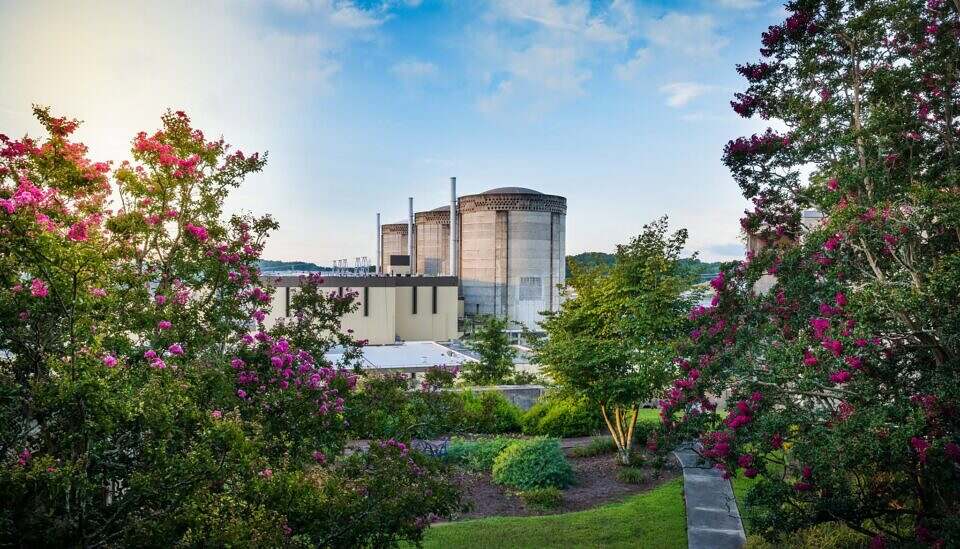
As it relates to existing facilities, last March Duke’s Oconee Nuclear Station – located on Lake Keowee near Seneca, S.C. (approximately thirty miles west of Greenville) – received a second 20-year license extension from the Nuclear Regulatory Commission (NRC). That authorization permitted its three pressurized water units to continue generating power until the early 2050s.
Commissioned in the early 1970s, the three Babcock & Wilcox reactors housed at Oconee marked Duke’s initial foray into nuclear power generation – and were originally scheduled to operate through 2013. Last spring’s extension marked their second twenty-year continuation – meaning if all goes according to plan they will wind up generating power for a total of eighty years.
In addition to being the oldest, Oconee is the largest of Duke’s nuclear facilities – generating more than 2,500 megawatts (enough to power approximately 1.9 million homes).
Rounette Nader, vice president of new nuclear generation and license renewal at Duke, appeared before a gubernatorial panel in Columbia, S.C. earlier this month to discuss her company’s plans to maintain and expand its nuclear footprint – plans which could involve significant investments in Palmetto State facilities. Nader began her career at Duke in 1992 as a mechanical engineer at the Oconee Plant, incidentally.
***

***
Last month, Duke submitted its latest integrated resource plan for North and South Carolina – revealing the extent to which the company was banking on new nuclear power to meet explosive energy demand.
“The plan for new nuclear shows the need for 11 gigawatts of new nuclear through the planning horizon,” Nader said. “That’s doubling the size of the existing fleet.”
By 2041, the company is planning on bringing an additional 4,468 megawatts of new nuclear power.
Where is that power going to come from? Duke hasn’t decided. According to Nader, the first 1,100-1,200 megawatts scheduled to hit the grid in 2037 would come from either a “large, light-water reactor” to be constructed at the W.S. Lee Station in Cherokee County, S.C. (approximately 25 miles east of Spartanburg, S.C.) or the first of up to six small modular reactors at the Belews Creek Station in Stokes County, N.C. (located approximately 21 miles northwest of Greensboro, N.C.).
“We have not selected a technology at this time,” Nader told the panel.
That testimony is consistent with “technology neutral” language peppered throughout Duke’s resource planning document, seemingly indicating the company will follow the path of least regulatory resistance and maximum operational efficiency.

***
The Lee facility in Cherokee County would not be a new concept for Duke. Initially proposed twenty years ago, the site was supposed to have housed a pair of AP1000 pressurized water reactors. Duke was licensed in 2016 to construct these reactors (licenses which are still active, incidentally), but abandoned the project around the same time the infamous ‘NukeGate‘ fiasco was unfolding.
Questioned by the panel, Nader noted Duke had focused extensive attention on small modular reactors in recent years – but added that “a lot of the interest and incentives have started to go more towards the large, light-water reactors.”
“Just in the last year or so we have turned our attention and put a lot more attention on the Lee site and the AP1000s,” she said, referencing a dramatically shifting demand curve.
Does that mean South Carolina is in the drivers’ seat for Duke’s new nuclear projects?
We shall see…
Duke Energy Carolinas serves an estimated 2.9 million residential, commercial and industrial customers across a 24,000 square mile service area in the western half of North Carolina and the South Carolina Upstate. Meanwhile, Duke Energy Progress serves an estimated 1.8 million residential, commercial and industrial customers across a 28,000 square-mile service area in eastern North Carolina and the Pee Dee region of the Palmetto State.
FITSNews has been harshly critical of Duke in recent years for its poor resource management – which has repeatedly resulted in unnecessary price hikes on consumers. Count on us to keep close tabs on the company as its nuclear expansion gets underway.
***
ABOUT THE AUTHOR…

Will Folks is the founding editor of the news outlet you are currently reading. Prior to founding FITSNews, he served as press secretary to the governor of South Carolina. He lives in the Midlands region of the state with his wife and eight children.
***
SOUND OFF…
Got something you’d like to say in response to one of our articles? Or an issue you’d like to address proactively? We have an open microphone policy! Submit your letter to the editor (or guest column) via email HERE. Got a tip for a story? CLICK HERE. Got a technical question or a glitch to report? CLICK HERE.
