
by JENN WOOD
***
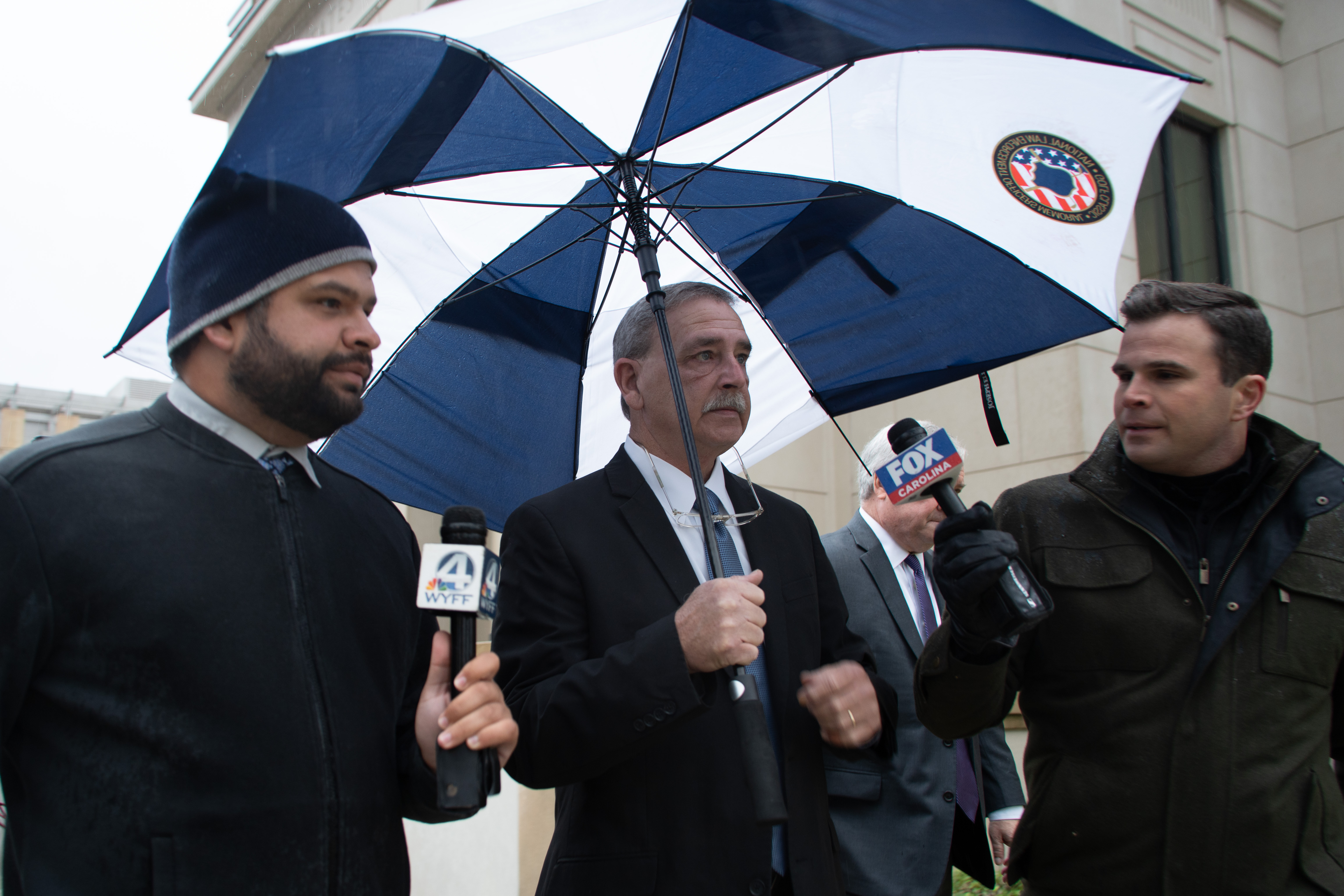
Federal prosecutors are pushing back forcefully against former Spartanburg County sheriff Chuck Wright‘s bid for leniency, arguing his crimes were not simply the byproduct of addiction – but rather part of a years-long pattern of corruption that exploited the power and authority of his office.
In a sentencing memorandum (.pdf) filed this week ahead of Wright’s July 7, 2026 sentencing hearing, the U.S. attorney’s office urged the court to view Wright’s conduct as a “grave breach of the public’s trust,” detailing allegations that he stole money intended for struggling deputies, protected a relative through a taxpayer-funded no-show job and leveraged his position as sheriff to obtain prescription drugs.
The filing represents the government’s most detailed response yet to Wright’s efforts to secure a sentence below the advisory federal guideline range of 33 to 41 months in prison. Last week, federal prosecutors and Wright’s attorneys agreed to that guideline range along with restitution totaling $462,866.06. U.S. District Judge Timothy M. Cain will ultimately decide Wright’s sentence.

***
Wright’s attorneys — including former congressman Trey Gowdy — have asked the court to consider what they describe as extraordinary rehabilitation, longstanding prescription drug addiction and significant post-traumatic stress disorder stemming from decades in law enforcement. They argue those factors justify a sentence below the advisory guidelines.
Federal prosecutors, however, contend the facts of the case warrant a guideline sentence.
“A democracy is effective only if the people have faith in those who govern,” prosecutors wrote in the opening lines of their filing, arguing Wright shattered that trust through multiple fraud and corruption schemes.
***
BENEVOLENCE FUND AT THE CENTER OF GOVERNMENT’S ARGUMENT

***
Much of the government’s filing focused on Wright’s admitted misuse of the Spartanburg County Sheriff’s Office (SCSO) Chaplain Benevolence Fund — a charitable account intended to assist deputies and their families during times of hardship.
According to prosecutors, Wright treated the account as a personal funding source, taking more than $89,000 in cash withdrawals despite policies prohibiting cash withdrawals from the fund. The filing alleges he used benevolence fund money for personal travel, hotels, meals and other expenses while repeatedly draining the account faster than donations could replenish it.
The memorandum included one particularly troubling example.
According to prosecutors, the wife of a sheriff’s deputy was suffering from stage-four cancer and receiving hospice care when the family sought financial assistance from the benevolence fund. They were reportedly turned away because there was not enough money available in the account. Prosecutors argued Wright’s misuse of the fund contributed directly to those shortages.
The government also alleged Wright used county resources for personal benefit, charging more than $17,000 in personal expenses to a county-issued credit card. Those expenses allegedly included entertainment subscriptions, online games, electronics purchases and other non-government expenditures.
Taken together, prosecutors contend Wright stole more than $112,000 through the benevolence fund scheme and related misuse of county funds.
***

RELATED | PROBE OF CHUCK WRIGHT ESCALATES
***
‘EVERYONE KNEW’
The filing also revisited the no-show job arrangement involving Wright’s cousin, Lawson “LB” Watson.
Federal prosecutors alleged Wright ensured Watson remained on the sheriff’s office payroll for years despite performing little or no actual work. The arrangement came to light after an anonymous complaint accused Watson of collecting taxpayer-funded paychecks while rarely reporting for duty.
According to the memorandum, more than twenty witnesses interviewed by investigators described Watson’s employment as an open secret inside the sheriff’s office.
“Everyone knew that Watson was not working,” one supervisor reportedly told investigators. Other employees allegedly described Watson as a “unicorn” because of his ability to draw a paycheck without showing up for work.
Prosecutors argued the arrangement survived because employees feared challenging someone viewed as a close ally of the sheriff.
The government contends Wright’s actions enabled Watson to collect nearly $350,000 in salary and benefits for work that was never performed. Wright and Watson have agreed that restitution tied to that scheme totals $349,885.22.
Watson is separately seeking a downward variance (.pdf) from his advisory sentencing range of 10 to 16 months in prison, citing his age, medical conditions, community service and lack of prior criminal history.
***

RELATED | POWER, PILLS AND PENDING CHARGES
***
DRUG ADDICTION REMAINS CENTRAL TO DEFENSE
Wright’s attorneys do not dispute his criminal conduct. Instead, they argued his offenses were driven by a prescription drug addiction that developed following multiple surgeries and years of physical and psychological trauma accumulated during his law enforcement career.
The defense filing stated Wright sought treatment before charges were filed, voluntarily resigned as sheriff, surrendered his firearms and has maintained more than sixteen months of sobriety through treatment and counseling.
His attorneys also say psychologist Dr. Donna Maddox diagnosed him with significant post-traumatic stress disorder, which they argued contributed to his addiction and eventual criminal conduct.
Prosecutors acknowledged Wright’s addiction but argue it does not diminish the seriousness of his conduct.
Their filing detailed allegations that Wright obtained prescription pills from employees, community members and a street-level dealer while serving as sheriff. Prosecutors further contend Wright used the authority of his office to pressure subordinates and others into providing him with medication.
***
SENTENCING APPROACHES
The competing filings highlighted the central question now facing Judge Cain: whether Wright’s addiction, treatment and rehabilitation efforts warrant a sentence below federal guidelines or whether the nature of the offenses and abuse of public trust justify a prison sentence within the advisory range.
Wright’s attorneys argued that similarly situated South Carolina sheriffs who pleaded guilty to misconduct historically received far lighter sentences, often including probation or relatively short prison terms.
Federal prosecutors countered that Wright’s crimes involved repeated abuses of public authority, substantial financial losses and conduct that undermined confidence in law enforcement itself.
Wright is scheduled to be sentenced on July 7, 2026. Watson is scheduled for sentencing two days later, while former sheriff’s office chaplain Amos Durham — who faces an advisory guideline range of six to twelve months and agreed to pay $95,442.39 in restitution — is scheduled to be sentenced on July 14.
For Cain, the question is no longer whether Wright committed the crimes. The former sheriff admitted that months ago. The question now is whether the court views Wright primarily as a recovering addict who lost everything — or as a powerful elected official whose abuse of public trust demands a substantial prison sentence.
***
THE SENTENCING MEMORANDUM
Subscriber-only document
This PDF is available to FITSNews subscribers. Get full access and be able to view documents like this one.
Subscribe for accessAlready a subscriber? Log in here
***
ABOUT THE AUTHOR …
As a private investigator turned journalist, Jenn Wood brings a unique skill set to FITSNews as its research director. Known for her meticulous sourcing and victim-centered approach, she helps shape the newsroom’s most complex investigative stories while producing the FITSFiles and Cheer Incorporated podcasts. Jenn lives in South Carolina with her family, where her work continues to spotlight truth, accountability, and justice.
***
SOUND OFF…
Got something you’d like to say in response to one of our articles? Or an issue you’d like to address proactively? We have an open microphone policy! Submit your letter to the editor (or guest column) via email HERE. Got a tip for a story? CLICK HERE. Got a technical question or a glitch to report? CLICK HERE.

3 comments
He deserves the max. We trusted him in Spartanburg County. LEO’s should be held to a higher standard and not all excused away because of PTSD. That’s an insult to our servicemen who really struggle with it.
What the hell does he have PTSD from? He was a traffic cop before he was sheriff , and not a good one. He spent a lot of time In internal affairs because he was a terrible officer. He was very adept at fooling the electorate in Spartanburg much like his RINO lawyer.
Since Attorney General Alan Wilson did not file state charges against Wright, Trump will be able to pardon Wright before he steps into a jail cell. Trump cannot pardon criminals convicted of state charges; governors can.