
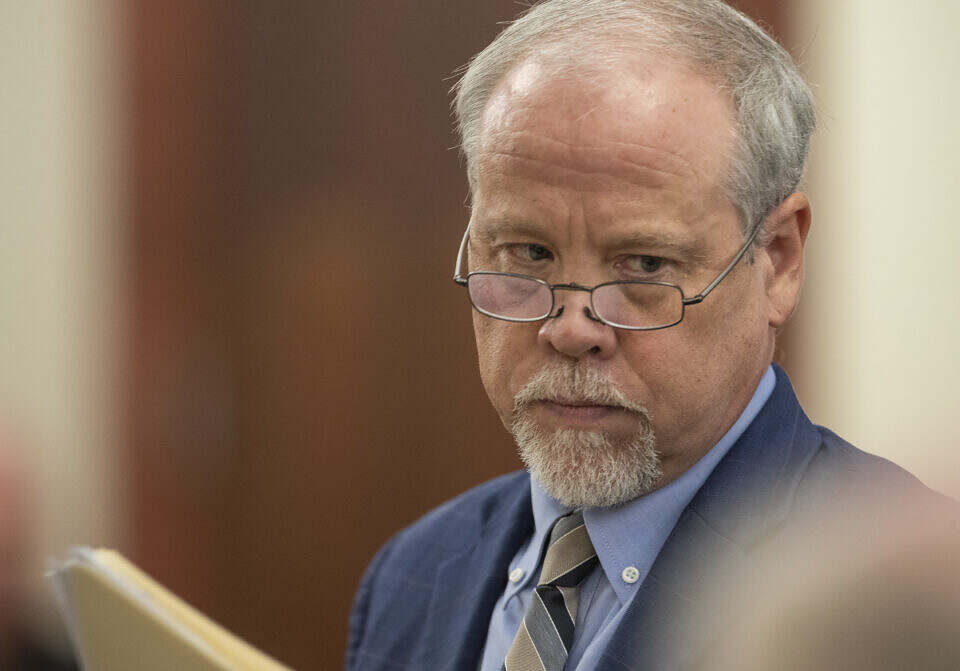
Murdaugh Retrial: State Accuses Defense Of ‘Brazen Falsehoods’
Prosecutors cite defense emails and a signed discovery receipt as tensions escalate ahead of October 16 hearing…
by JENN WOOD
***
The fight over evidence in Alex Murdaugh’s upcoming murder retrial has sudd
6 comments
Pooty Poot and Jimbo been lyin their asses off!
Who is Timothy Gillespie?
I shall, God willing, keep at it because, though never seeking it, I earned a right AND A DUTY to lecture the system, and because the system is so self-righteous and self-congratulatory it is blind and deaf at all levels, I have to explain why that “unethical as hell” was a “lose-lose-lose” for society; and why now the majority of those who “tolerate” Alex Murdaugh’s retrial do so only in the smug assurance that he will age and die in prison anyway even if he is acquitted of the murders, and even if he were shown ACTUALLY INNOCENT of the murders.
It is lose-lose-lose for society when prosecutors decide, and judges accept and encourage, plea deals OUT OF SHEER PHYSICAL AND INTELLECTUAL LAZINESS.
Assuming Valerie Bauerlein told the story accurately (which would be an exception to her inaccuracies-filled book), all parties lost.
If Harpootlian’s client has NOT swerved to hit the victim, that client went/goes through life with an involuntary manslaughter conviction of which he is innocent and which has long-term consequences even if he did not serve time for it after the plea. That client probably lost all incentives to avoid drinking and avoid bar fights or bars altogether.
If Harpootian’s client HAD intentionally swerved to run over the victim, Society has let a murderer free because the prosecutor’s law firm on the side represented the victim’s family and had much to gain from a civil lawsuit against that murderer set free on a plea to a MUCH lesser offense.
But how could we have known which is it, you ask.
Aren’t trials supposed to be searches FOR THE TRUTH, I answer.
And here is the problem, the system is NOT built to search for the truth but to achieve what it perceives as easy “win-win-win” results.
Prosecutors, and defense lawyers the majority of whom are indeed former prosecutors, never develop the skills OR THE DESIRE to reach the ACTUAL TRUTH for its own sake BECAUSE ultimately that is the most valuable to society.
Prosecutors instead develop “skills” in finding out the narrative a jury and the public will accept, or to which a criminal defendant will plea and a judge will wink, whether that narrative were the truth or the opposite of it.
And those “skills” are manifest here: instead of true skills at ballistics matching, we are suddenly given a narrative as stupid as the Prosecution’s motive theory in the first trial, that someone magically knew the specs of the murder weapons the night of the murders and was allowed to see Police Chief Alexander stash them in an evidence locker, along with bloody clothes to boot, and having supplied Alex with a fresh change of clothes (we are not told where Chief Alexander would have gotten Alex’s size) to boot.
Mind you, if Alex were the killer, all he had to do for “a fresh change of clothes” is go to his own closet which is less than a mile from the kennels instead of going 50 miles away to Yemacee for that “fresh change of clothes.” But nothing is too stupid or too far-fetched for the committed Alex haters to accept.
If Creighton Waters wants to perpetuate such system, he should worry about what that system might someday do to his yet unborn grandson as it did to Buster-the-Elder’s grandson years later.
I know what the system did to me and why no one in that system stood up for me or even for their own self-respect.
In that “win-win-win” story, even Buster-the-Elder’s law firm lost. Sure, they won an easy $300K for a few hours work in the shade; but they lost the sense of honest earnings. Alex’s skimming of the top was only a manifestation of his “education” that easy money is proof of intellectual superiority, not moral inferiority.
If lawyers really wanted the good of society, they would be working against drunk driving and against drinking in the first place.
Instead they marinate each other (and marinate judges) in drinks in social functions and profit from drunk driving at all levels: the criminal defense lawyers get handsome fees for DUI defenses and civil plaintiffs’ lawyers get handsome contingency fees from victims’ law suits.
And the rest of society keeps getting drunk and ever more stupid.
Reminder: in Rogan Gibson’s OFFICIAL first-trial testimony, Richard Alexander Murdaugh (“RAM”) early-on TACITLY admitted having briefly gone to the kennels that night:
(R. GIBSON – DIRECT EXAMINATION BY MR. WATERS [1437 = RoA_2670])
[2] Q. And are those other missed calls that came in?
[3] A. 10:25 p.m. and 10:30 p.m.
[4-6] Q. When you spoke to Special Agent Croft on June 8th of 2021, did you tell him and Special Agent McCallister who you thought you heard on that phone call at 8:40?
[7] A. I did.
[8] Q. And who did you say you heard?
[9] A. I thought it was Mr. Alex but I wasn’t exactly sure.
[10] Q. And did you give him a percentage?
[11] A. I did.
[12] Q. What did you say?
[13] A. 99 percent.
[14] Q. That you heard Mr. Alex on that phone call at 8:40.
[15] A. That’s correct.
[16-17] Q. As time went on after the murders, did you go to Moselle where all of the family and friends were gathering?
[18] A. I did.
[19] Q. Were you there a fair amount?
[20-21] A. Probably the whole part of that — or that — later that week.
[22-24] Q. While you were there at the house where the family and friends had gathered, did anyone ever ask you about your last contact with Paul?
[25] A. There was.
[1] Q. And who asked you? (R. GIBSON – DIRECT EXAMINATION BY MR. WATERS [1438 = RoA_2671])
[2] A. Grandmar.
[3] Q. And that would be Ms. Branstetter?
[4] A. That’s correct.
[5] Q. Maggie’s mother?
[6] A. That’s correct.
[7] Q. And what did you say?
[8-10] A. I told her, yeah, that I had talked to Paul about the dog. I told her that I heard Ms. Maggie in the background, and I heard a male voice that I thought was Mr. Alex.
[11] Q. Was he in the room then?
[12] A. Yes.
[13] Q. Did he stand up and say no, I wasn’t there?
[14] A. He didn’t.
[15-16] Q. Did you ever have any conversation with Alex Murdaugh about what happened that night?
[17] A. No, sir.
[18-19] Q. Did he ever ask you about whether or not you heard him on that phone that night?
[20] A. No, sir.
[21] Q. Did he ever tell you what he did that night?
[22] A. No, sir.
[23] Q. Did you ever ask him what he did that night?
[24] A. No, sir.
[25] Q. Not a subject you wanted to talk about, was it?
[1] A. That’s correct. (R. GIBSON – DIRECT EXAMINATION BY MR. WATERS [1439 = RoA_2672])
I reiterate what I wrote many times before: that kennels video is IRRELEVANT to the REAL time of the shootings AND Paul MOST LIKELY did not send it because: (1) no problem with Cash-the-dog’s tail appears in the video; (2) Paul’s phone’s battery charge was down to 1%; and (3) Paul had gone to the kennels/shed area to prepare for replanting the dove field, not to mess with dogs.
Conscientiously consider this very relevant analysis of mine:
Know why it was crucial for SLED/the Prosecution to fabricate that the Murdaughs loaded their shotguns with alternating birdshot and buckshot ammo, WHICH NO EXPERIENCED HUNTER EVER DOES and which NO hunting or self-defense manual EVER recommends?
BECAUSE Paul was shot with TWO different shotguns: one loaded with birdshot and another with buckshot ammo.
Why is that important?
BECAUSE it blows the single-shooter theory out of the water.
And instead of a two-shooter theory, we have a THREE-SHOOTER likelihood, with a concomitant necessity of a shooting cabal, about which I have been writing for a while, and which is the INEVITABLE result of Malicious Mandy Matney’s (“MMM”) relentless incitement against Paul MONTHS before his indictment for the boat crash case.
And no, No, NO! These were NOT the much ridiculed “random vigilantes” wondering what to do on a damp Low-Country June evening.
This was an organized, role-assigned, cabal formed after several interviews among MMM and the wider circle of the young Murdaughs’ supposed friends and the older Murdaughs’ supposedly loyal employees.
And it was also carefully planned to pin it ALL on RAM.
For example, they pretend RAM “lured” Paul to Moselle. But why did Paul go to Moselle that day? To replant the dove field.
And why did the dove field need to be replanted?
Because the flowers had died after having been sprayed with pesticide.
And who sprayed the pesticide?
You got it. CB Rowe.
Whether the unknown Murdaugh-unrelated DNA under Maggie Murdaugh’s finger-nails and on her cell phone turns out to be CB Rowe’s or not, CB Rowe’s main role was already complete: poison the dove field.
Then comes a name, Olivia Boyles, from MMM’s book “Blood on Their Hands,” as a respondent to MMM’s advertising for info on the boat crash and on Stephen Smith’s death.
Of course, it could be a coincidence of a not-rare name, or Olivia Boyles could be related to the male Boyle room-mate/best friend of Paul’s according to RAM’s 8 June 2021 interview with SLED.
“But the birdshot and the buckshot came from the same shotgun” you say.
“Says who?” I answer.
You see, all that controversial testimony about ammo/firearm identification relates MAINLY to the black-out 300 rifle, where the ammo casing is metal, the firearm bore is striated, and the firing pin’s impact on the primer can be talked about.
But shotguns’ bore is smooth; and the casing is plastic which does not carry striation marks and explodes on ejection, and the firing pin on primer impact is pretty uniform.
Meaning the impact of the firing pin on the primer is going to look similar, if not identical, of 12 gage ammo fired from DIFFERENT shotguns of the same caliber and manufacturer.
Prove me wrong if you can.
Find below the complete extracted defense reply without the caption and without the defense attorneys’ names, phone numbers, and email addresses. I do not know what else to do for FITS to not censor this useful contribution of mine.
My analysis shall, God willing and FITS permitting, follow in the next comment:
I. Introduction
Defendant Richard Alexander Murdaugh submits this reply to the State’s Response in Opposition to De-fense Motion to Dismiss the Indictments, filed November 6, 2026 (the “Response”). The Response con-cedes that SLED’s laboratory reported “no human blood” on the shirt eight months before the lead case agent told the Colleton County Grand Jury that an expert had found the victims’ blood spatter on it; that the report sat in SLED’s own file; and it reproduces the agent’s admission that his sworn statement to the State Grand Jury that shotguns at Moselle were loaded like the gun that killed Paul Murdaugh “was not accurate,” while allowing that the same claim may not have been “precisely expressed” to the Colleton County Grand Jury. (Resp. at 4, 10, 16.) The State’s answer is that the agent did not know what his own laboratory had reported, that an expert the State never called has since said he stands by his opinion, that the shotgun testimony was “imprecise,” and that the grand jury would have indicted anyway.
None of that answers the motion. An expert’s after-the-fact adherence to an opinion formed without the laboratory’s results does not make true what the grand jury was told: that the stains were the victims’ blood. The State’s own exhibits show that no shotgun at Moselle was loaded like the murder weapon. And the authorities the State cites concern honest misstatements about collateral matters, not an agent’s ad-mitted falsehoods about the only forensic evidence connecting the accused to the shootings. The indict-ments should be dismissed without prejudice.
[NOV 9 2026 PM 4:27 COLLETON CO GS, GARY HALE] [page 1]
II. Argument
A. The Response confirms the facts on which the motion rests.
1. The State does not dispute the laboratory results, the report’s issuance to the agent, or the agent’s trial admissions; it is silent as to Agent Owen’s statements about DNA in the purported spatter.
The Response recounts SLED’s work on the shirt from June 2021 through the engagement of Tom Bevel of Bevel, Gardner & Associates in “late 2021,” listing the presumptive test, the LCV treatment, and the July 25, 2021, DNA report, and then concludes: “Given these findings … SLED … engaged” the expert. (Resp. at 2.) The account omits what happened between those events and the engagement. On August 10, 2021, SLED’s DNA analyst, in the presence of her supervisor, ran the laboratory’s confirmatory test for human blood on every cutting that had reacted to the LCV, and every cutting was negative. (Mem. Ex. F; Trial Tr. 3275-76, 3305-06 (Reply Ex. A).)
Six weeks later, SLED wrote to Mr. Bevel to engage him. (Mem. Ex. G.) Seven weeks after the negative results, SLED’s forensic administration captain recorded, for the next LCV case, the understanding that “no HemaTrace testing would be done.” (Mem. Ex. H at 11.) On November 10, 2021, the laboratory is-sued the report, addressed to the lead case agent, SLED Senior Special Agent David Owen, recording “No human blood identified” for each cutting. (Mem. Ex. J at 2.) The State’s chronology resumes with the transmission of materials to the expert on January 4, 2022. (Resp. at 2-3.)
The State does not dispute any of this. It concedes that the November 10, 2021, report “was in the SLED lab case file,” and that the agent did not provide it to the expert he retained for the purpose of answering whether “the stains on the shirt [are] consistent with a gunshot.” (Resp. at 4; Mem. Ex. K.) The report was addressed to that agent. (Mem. Ex. J at 1.) The State concedes that Agent Owen told the grand jury the expert’s opinion. (Resp. at 4.) And it cites, without [page 2] mentioning the admission, the page on which Agent Owen agreed that “what [he] told the Colleton County Grand Jury was not correct.” (Resp. at 4; Trial Tr. 3689 (State’s Ex. J).)
The State’s explanation is that the report was “inadvertently missed by the agent.” (Resp. at 4.) The expla-nation does not excuse the State. The report was the laboratory’s work, reviewed and signed by its ana-lysts, and it recorded a result the laboratory’s supervisor had witnessed. (Trial Tr. 3305-06 (Reply Ex. A).) The November 10 report is also the report that recorded the DNA results for the blue raincoat seized at Almeda (Mem. Ex. J at 2), and Agent Owen’s grand jury narrative presented those results to the grand jury: “No DNA found on the raincoat.” (State’s Ex. N at 18.) The analyst recalled giving Lt. Ghent prelimi-nary raincoat results before the report issued (Trial Tr. 3308 (Mem. Ex. A)); the report nonetheless issued to Agent Owen, and the State does not say he never received it. The knowledge of the laboratory is the knowledge of the State, Kyles v. Whitley, 514 U.S. 419, 437-38 (1995); State v. Durant, 430 S.C. 98, 108-10, 844 S.E.2d 49, 54—55 (2020), and the question under Thrift is whether the State presented to the grand jury evidence it knew to be false, not whether the particular agent who spoke had read the report ad-dressed to him, State v. Thrift, 312 S.C. 282, 303, 440 S.E.2d 341, 352-53 (1994).
Nor was the knowledge confined to the laboratory. The State represents that the report “had not been previously provided in the norma! discovery process to the Attorney General’s Office.” (Resp. at 4.) The analyst who wrote it gave a different account. In preparation for the April 20, 2022 meeting that the Attor-ney General’s office requested with SLED’s DNA staff “to discuss reports,” she reviewed the November 10 report on each of the two preceding days. (Trial Tr. 3308-09 (Mem. Ex. A); Mem. Ex. V at 2.) She testified that the HemaTrace results on the shirt “probably” were discussed “in the meeting where we went over all of the results of my reports,” and that April 2022 “was the first meeting after that report was issued where we had a discussion about the reports.” (Trial Tr. 3310 (Mem. Ex. A).) Mr. Waters later asked her to re-search the literature on “negative hematrace results” and to summarize it in a memorandum, “[b]ecause there were negative hematrace results in this case from the shirt.” (Trial Tr. 3311 (Reply Ex. A).) The At-torney General’s office was advising SLED on how the shirt should be delivered to Mr. Bevel before it was hand-carried to Oklahoma in March 2022. (Resp. at 3 n.3.) The indictments were sought on July 14, 2022.
The Response’s account of how the expert came to reverse his opinion is also inaccurate, and the State has had the correction in hand since January 2023. The Response states that Agent Owen and Lt. Wallace carried to Oklahoma “‘raw’ photographs of the shirt taken prior to its processing with LCV,” and that Mr. Bevel reversed himself after “[r]eviewing the higher quality images taken prior to LCV processing.” (Resp. at 3; see Resp. at 7 (“the images he reviewed did [assist him]”).) Mr. Bevel has stated in writing that the photographs he received were not RAW files. In a statement dated January 20, 2023, he wrote that he had asked Agent Owen for “the RAW photos,” that he “believed the CD contained the Raw images,” and that “I now know my belief was in error as what I received on the CD was in JPEG format.” (Bevel Statement, Jan. 20, 2023, ¶¶ 7-10 (Reply Ex. B).) The statement was prepared after the defense had moved for sanc-tions and shown that the files produced from Mr. Bevel contained no RAW image files (Def.’s Mot. Sanc-tions, Jan. 18, 2023, at 24 (Reply Ex. C)), and Deputy Attorney General Zelenka handed it to defense counsel at trial. The State’s agent wrote in his chronology that “Raw data of photographs” were delivered in Oklahoma (Mem. Ex. P); the State’s own expert then confirmed that the CD he received in connection with the March 10, 2022, viewing of the treated shirt “was in JPEG format” (Reply Ex. B ¶¶ 8-9); and his final report lists no photographs beyond those considered in February (Mem. Ex. T at 2). The Response repeats the claim and cites emails about travel arrangements for it. (Resp. at 3 (citing State’s Ex. G).)
Finally, the Response says nothing about the second half of the statement Agent Owen made to the grand jury. His narrative told the grand jurors not only that an expert “found multiple particles of blood spatter on the shoulders and front of Alex’s shirt,” but that “[t]he DNA in the areas of spatter were identified as belonging to Alex, Maggie, and Paul.” (State’s Ex. N at 18.)
The State’s own exhibit, the July 25, 2021, DNA report, shows that Paul Murdaugh’s DNA was not found in any cutting from the areas Mr. Bevel marked as spatter. (State’s Ex. C; Mem. Ex. E at 1-9.) Under the State’s theory, the spatter would have been from the shooting of Paul Murdaugh. (State’s Ex. O, outline at 2 (“Shooter in doorway — Paul”).) Mr. Bevel’s report identified the second shot to Paul Murdaugh as the only shot to him “likely to create back spatter,” and placed the shooter of Maggie Murdaugh “at the four (4) foot range or farther,” with “the primary force… away from the shooter.” (State’s Ex. H at 11.) Spatter on the shooter, on that theory, would include Paul Murdaugh’s blood. The laboratory found no human blood in the spatter areas and none of Paul Murdaugh’s DNA. The grand jury was told the opposite, and the State offers no defense of that statement.
2. The expert’s addendum does not make the grand jury testimony true.
The State’s principal answer on the spatter is that Mr. Bevel, after receiving the November 10, 2021, report on December 1, 2022, “confirmed his prior opinion,” so that “nothing false was presented to the Colleton County Grand Jury.” (Resp. at 4, 7.) The argument fails for four reasons.
First, the addendum is dated December 18, 2022, five months after the grand jury returned the indict-ments. (State’s Ex. I.) Whether the State presented false evidence in July 2022 is determined by what the State knew and said in July 2022. In July 2022 the laboratory’s confirmatory test had found no human blood on the shirt, the agent told the grand jury there was, and the expert whose opinion he relayed had never been told of the laboratory’s result. A later document cannot change what the grand jury heard.
Second, the addendum concedes the point the motion makes. Mr. Bevel acknowledges that “there is not a conformation [sic] test for human blood on the questioned white t-shirt,” and his opinion is that the origi-nal opinion “based on the information available at the time is still correct.” (State’s Ex. I at 2.) An opinion on incomplete information is not the same thing as a true statement of fact. The grand jury was not told that an expert, unaware of the laboratory’s results, had inferred spatter from photographs. It was told that blood spatter containing the victims’ DNA was found on the shirt.
Third, the addendum’s hypothesis, that LCV treatment produced a false negative, contradicts the literature the State’s own laboratory assembled before the addendum was written.
As noted above, Mr. Waters asked the SLED analyst who had performed the tests to research the litera-ture on negative HemaTrace results and to summarize it in a memorandum. Her memorandum to the la-boratory file, dated December 13, 2022, attached the manufacturer’s technical information sheets and the two studies that addressed HemaTrace on LCV-treated stains, and reported their findings: HemaTrace returned positive results on LCV-treated bloodstains in seventeen of seventeen trials at one dilution and sixteen of eighteen at another, and it returned positive results on samples on which LCV had returned negative results. (SLED Mem. to File, Dec. 13, 2022, at 2 (Reply Ex. D); Trial Tr. 3313-14 (Reply Ex. A).) The literature the State’s own laboratory assembled reports that HemaTrace detected LCV-treated blood in thirty-three of thirty-five trials, and nothing in it supports the proposition that LCV would defeat the confirmatory test on every one of the twelve samples SLED tested, which comprised seventy-four cut-tings. SLED’s result on the shirt was negative for every sample. (Trial Tr. 3305, 3314 (Reply Ex. A).)
Mr. Bevel’s contrary finding rests on an experiment he “devised and conducted” himself over the weekend that followed the laboratory’s memorandum, outside any laboratory (Mr. Bevel has none and works from his home), without reference to any published study, and without review beyond a “[t]echnical review” by his own associate. (State’s Ex. I at 1-2; Def.’s Mot. Sanctions, Jan. 18, 2023, at 18-20 (Reply Ex. C).) Work-ing in his personal residence, he misted expired blood obtained from a blood bank onto squares cut from a T-shirt, sprayed them with LCV, and reported that they then tested negative; he attributed the result to stain size and dilution, not to any property of the shirt in evidence. (State’s Ex. I at 1-2; Def.’s Mot. Sanc-tions, Jan. 18, 2023, at 19-20 (Reply Ex. C).) As the defense documented at the time, he produced no bench notes, no laboratory record, and no photographs beyond a few low-resolution slide images. (Def.’s Mot. Sanctions, Jan. 18, 2023, at 20, 24 (Reply Ex. C).) The State had the laboratory’s memorandum and the studies in hand when the addendum arrived. Notably, the State does not mention them in the Re-sponse. The State did not offer Mr. Bevel at trial. In closing, the State told the jury that the blood evidence “was investigated,” that “they’ve looked into this and it didn’t turn out to be,” and that “[w]e didn’t try to present it.” (Trial Tr. 5841 (Mem. Ex. A).) The State now calls that decision “strategic.” (Resp. at 8.)
Fourth, the State’s characterization of the issue as “weight not admissibility” (Resp. at 8) mistakes the in-quiry. The motion does not ask whether Mr. Bevel’s opinion would have been admissible. It asks whether the State, which possessed a confirmatory laboratory result finding no human blood on the shirt, could present to a grand jury, through an agent to whom that result was addressed, the statement that the vic-tims’ blood and DNA were on the shirt. The State may not knowingly use false evidence, and it may not allow false evidence “to go uncorrected when it appears.” Napue v. Illinois, 360 U.S. 264, 269 (1959); Rid-dle v. Ozmint, 369 S.C. 39, 48, 631 S.E.2d 70, 75 (2006). The State corrected nothing. The laboratory’s re-sult reached the defense, unremarked, in the State’s November 2022 production, and the grand jury’s find-ing was never revisited.
3. The State’s own exhibits show that no shotgun at Moselle was loaded like the gun that killed Paul Murdaugh.
Paul Murdaugh was killed with a 12-gauge shotgun loaded with a Federal Premium double ought buck-shot shell and a Winchester Drylok No. 2 steel waterfowl shell. (Trial Tr. 1907, 1932 (State’s Ex. L); Resp. at 9.) Agent Owen agreed at trial that he had told the State Grand Jury in November 2021 that four shot-guns on the property “were loaded with buckshot and turkey load,” and read from the transcript his tes-timony that they were loaded “in a similar fashion,” and his answer, “Yes, sir,” to the question whether that meant “one turkey load and one buckshot load.” (Trial Tr. 3695-97 (State’s Ex. M).) The narrative he was editing on July 7, 2022, a week before he testified to the Colleton County Grand Jury, stated that “[t]he shotgun located in Alex’s possession the night of June 7, as well as shotguns located in the Moselle property were found to be loaded in the same manner (buckshot shell and one turkey/ bird load shot shell) as those that were used in the murder of Paul,” and that the two shells found near Paul Murdaugh’s body “were found to be a consistent load found in the 12-gauge shotgun found in Alex’s possession . . . as well as two other shotguns found in the Murdaugh residence.” (State’s Ex. N at 12 & metadata sheet (doc-ument last modified by Agent Owen on July 7, 2022).)
The Response sets out what the four shotguns held. (Resp. at 13.) The Benelli Super Black Eagle 3 that Mr. Murdaugh retrieved from the house after calling 911 held a Federal buckshot shell and a Winchester 16-gauge No. 8 birdshot shell, a shell that SLED’s firearms examiner reported ““was not correct for use in the shotgun.” (SLED Firearms Report, Oct. 6, 2022, at 2 (State’s Ex. L); Trial Tr. 763, 1909 (State’s Ex. R).) The Mossberg held one turkey load. (Trial Tr. 1010 (State’s Ex. S).) The Browning was unloaded when it was seized. (Trial Tr. 1010 (State’s Ex. S).) The Benelli Super Black Eagle 2 held two turkey loads; asked whether its Winchester shell was a Drylok, the examiner answered, “No, sir.” (Trial Tr. 1977 (State’s Ex. U).) No shotgun at Moselle held a buckshot shell and a waterfowl shell. No shotgun held “buckshot and turkey load.” No shotgun other than the one Mr. Murdaugh carried to meet the deputies held buckshot and birdshot of any kind, and that one held a shell of the wrong gauge. The statement that “shotguns lo-cated in the Moselle property” were loaded “in the same manner” as the murder weapon, and that “two other shotguns found in the Murdaugh residence” held “a consistent load,” was false, and the agent con-ceded at trial that the same claim, as he had sworn to it before the State Grand Jury, “was not accurate.” (Trial Tr. 3696-97 (State’s Ex. M).)
The State’s answer is that a different document, Lt. Ghent’s outline of July 12, 2022, “accurately cor-rect[ed]” the description of the fatal load to “Waterfowl load/buckshot.” (Resp. at 12, 14; State’s Ex. O.) That outline, however, repeats the claim three entries later, in the same section: “types of loads consistent in inventoried weapons.” (State’s Ex. O, outline at 1-2.) And the document Agent Owen described at trial matches his own narrative. He told the trial jury that he “prepared an outline of [his] presentation” that set out “a narrative of what [he was] going to tell the grand jury,” that he followed it “[f]or the most part,” and that the narrative stated that an expert had found blood spatter on the shirt. (Trial Tr. 3684-85 (State’s Ex. J).) The statement appears in the Owen narrative (State’s Ex. N at 18), and the Ghent outline carries it in abbreviated form on the page that follows the “Waterfowl load/buckshot” entry: “DNA/blood spatter (mist) on shirt (Bevel Gardner conclusion) (Shooter in doorway — Paul).” (State’s Ex. O, outline at 2.) Whichever document the agent followed, the grand jury heard both claims.
The State’s remaining points are unavailing. That loose shells of various makes were found in bins and boxes on the property (Resp. at 13) is not the statement the motion challenges; the grand jury was also told that shotguns were “loaded in the same manner” as the murder weapon, which is a different fact and the only one that connects a gun in the house to the killing. That the agent may have “ha[d] a misunder-standing about what he was told” (Resp. at 8) is not what the agent said under oath. Asked whether he was mistaken, he answered, “No,” and explained that he had meant only that the shotguns held “different loads”; the transcript then read to him showed that he had sworn to “one turkey load and one buckshot load,” which he conceded “was not accurate.” (Trial Tr. 3696-97 (State’s Ex. M).) And the State’s descrip-tion of the matter as “a very minor circumstantial point” (Resp. at 14) is belied by its use. The agent thought the claim important enough to put to Mr. Murdaugh as “trickery” during his August 11, 2021 in-terview, to swear to before the State Grand Jury, and to write into the narrative for the Colleton County Grand Jury. (Mem. Part II.C.1.) A fact used three times to tie the accused to an unrecovered murder weapon is not minor.
B. The State’s authorities concern honest misstatements about collateral matters, not admitted falsehoods about the central evidence.
1. The South Carolina cases do not foreclose the inquiry; Thrift opens it.
The State invokes State v. Needs, 333 S.C. 134, 146, 508 S.E.2d 857, 863 (1998), for the proposition that a court “generally has no power to dismiss a properly drawn indictment.” (Resp. at 15, 18.) The sentence appears in Needs’s discussion of a different question: whether a prosecutor [page 10] committed miscon-duct by charging the defendant’s alibi witness. Our Supreme Court’s answer was that charging decisions belong to the prosecutor, and the authority it quoted for that proposition was Thrift itself. Needs, 333 8.C. at 145-46, 508 8.E.2d at 863 (citing Thrift, 312 S.C. at 291-92, 440 S.E.2d at 346). Needs involved no claim that false evidence had been presented to a grand jury, and it did not purport to narrow the exception Thrift recognized four years earlier for “a colorable claim of prosecutorial misconduct.” Thrift, 312 S.C. at 302, 440 S.E.2d at 352.
The cases collected in the State’s footnote 4 are similar. State v. Williams, 263 S.C. 290, 210 S.E.2d 298 (1974), State v. Sanders, 251 S.C. 431, 163 S.E.2d 220 (1968), and Margolis v. Telech, 239 S.C, 232, 122 S.E.2d 417 (1961), predate Thrift and concern grand jury secrecy and the sufficiency of the evidence, which Thrift confirmed is “ordinarily” beyond inquiry before stating the exception. 312 S.C. at 302, 440 S.E.2d at 352. State v. Batchelor, 377 S.C. 341, 344 – 45, 661 S.E.2d 58, 59-60 (2008), rejected a challenge because the form of the indictment “does not prove the State misinformed the grand jury.” Here David Owen has testified that he did in fact misinform the grand jury with inaccurate statements.
Evans v. State, 363 S.C. 495, 611 S.E.2d 510 (2005), and State v. Thompson, 305 8.C. 496, 409 S.E.2d 420 (Ct. App. 1991), state the presumption of regularity and hold that speculation will not overcome it. Mr. Murdaugh does not ask the Court to speculate. He relies on the State’s laboratory report, the State’s agent’s sworn admissions, the State’s expert’s concession that there is no confirmation of human blood on the shirt, and the State’s own description to the trial jury of evidence that “didn’t turn out to be.” That is the “clear evidence” to which the presumption yields. Evans, 363 S.C. at 514, 611 S.E.2d at 520. Thomp-son, after rejecting a claim that rested “entirely on speculation by counsel,” added that the court “yield[s] to no one in [its] zeal to insure that the grand jury continues to perform its historic function as a shield be-tween the accused and abuse of [page 11] the prosecutorial power of the State,” and that “[t]he courts of South Carolina stand guard to see that the grand jury is not reduced to a ‘mere plaything of prosecutors.’” 305 8.C, at 501-02, 409 S.E.2d at 424 (quoting State v. Capps, 276 S.C. 59, 67, 275 S.E.2d 872, 875 (1981) (Lewis, C.J., dissenting)).
The State also distinguishes Thrift on the ground that the State Grand Jury proceeding there was tran-scribed and the Colleton County proceeding was not. (Resp. at 5.) The absence of a transcript is not a shield. The record here consists of the narrative the agent prepared and followed, which the State itself has filed, and the agent’s sworn account of what he told the grand jury. The State does not contend that either misstates what the grand jury heard.
2. The federal cases the State cites applied the standard the State fails.
The State’s federal authorities each turned on a finding that the challenged testimony was an honest mis-take, collateral, or both. In United States v. Moore, 184 F.3d 790, 794 (8th Cir. 1999), the agent “mistakenly testified” that the defendant and a co-conspirator were married and that they had given another co-conspirator a key; the statements “were made based on [the agent’s] belief at the time,” and the court found them immaterial. In United States v. De Rosa, 783 F.2d 1401, 1405 (9th Cir. 1986), the testimony was “irrelevant to the charges,” and the court weighed “the prosecutor’s admonitions to the grand jury that tended to neutralize the effect of the agent’s testimony.” In United States v. Lombardozzi, 491 F.3d 61, 79 (2d Cir. 2007), the court stated the governing standard, whether the conduct “amount{ed] to a know-ing or reckless misleading of the grand jury as to an essential fact,” and found “no basis to conclude that [the agent} knowingly or recklessly misled the grand jury.” And in United States v. Fritz, 852 F.2d 1175, 1178 (9th Cir. 1988), the mistakes “d[id] not appear to be deliberate” and did not “amount to flagrant de-ception or overreaching of a grand jury,” which the court contrasted with United States v. Samango, 607 F.2d 877, 882 (9th Cir. 1979), where dismissal was affirmed. [page 12]
Measured by those cases, this motion should be granted. As to the shotguns, the agent, asked under oath whether he had been mistaken, answered “No,” and conceded that what he swore to “was not accurate.” (Trial Tr. 3696-97 (State’s Ex. M).) As to the spatter, the agency that employed Owen held the report that refuted what he said, and the report was addressed to him; an agent who swears to a forensic finding without reading the laboratory report addressed to him acts, at the least, recklessly. The statements were not collateral. The spatter was the only forensic evidence placing Mr. Murdaugh at the shootings, and the shotgun claim was the only evidence tying a gun in his house to the murder weapon. No prosecutor ad-monished the grand jury, because, as the State emphasizes, no prosecutor was present. (Resp. at 15.) And the knowing or reckless presentation of material false testimony is the “flagrant deception” that Fritz ex-cepted from its rule.
The State’s observation that “prosecutors were not present in the county grand jury room” (Resp. at 15} does not transform the agent’s testimony into something other than the State’s. The agent was the State’s only witness. The Attorney General’s office advised SLED on the delivery of the shirt to Mr. Bevel, met with the laboratory about its reports three months before the indictment, and prepared the agent’s State Grand Jury presentation with him. (Resp. at 3 n.3; Mem. Part II.D & Ex. AA at 050.) Bank of Nova Scotia v. United States, 487 U.S. 250, 256 (1988), and Thrift ask whether misconduct by the government “substan-tially influenced the grand jury’s decision to indict,” Thrift, 312 8.C. at 303-04, 440 S.E.2d at 353, and the knowledge of the State’s investigating agency is the knowledge of the State. Kyles, 514 U.S. at 437-38.
3. Neither the petit jury’s vacated verdict nor the asserted sufficiency of the other evidence answers the Bank of Nova Scotia question.
The State argues that the case “survived directed verdict (and got a jury verdict) without presentation of these supposed errors.” (Resp. at 17.) The memorandum anticipated the point. [page 13] (Mem. Part III.B.1.) The inquiry under Bank of Nova Scotia and Thrift is whether the misconduct “substantially influ-enced the grand jury’s decision to indict,” or whether there is “grave doubt” that the decision was free of that influence, 487 U.S. at 256; Thrift, 312 S.C. at 303-04, 440 S.E.2d at 353, and it is answered by what the grand jury heard. The verdict has been vacated because the Clerk of Court’s improper external influ-ence deprived Mr. Murdaugh of an impartial jury, State v. Murdaugh, 448 S.C. 1, 931 8.E.2d 294 (2026), and a vacated verdict establishes nothing. The State’s argument also marks the difference between the two proceedings: the petit jury did not hear the spatter evidence because the State did not offer it, and the grand jury did hear it, from the State’s only witness, as the finding of an expert.
The State’s remaining answer is that there was “ample other evidence” of probable cause. (Resp. at 8, 15-16.) Bank of Nova Scotia does not ask whether the grand jury could have indicted on the untainted evi-dence, but instead, it asks whether the tainted evidence substantially influenced the decision it made or leaves grave doubt. 487 U.S. at 256. A grand jury was told that a State’s bloodstain pattern expert had found the victims’ blood spatter on the defendant’s shirt, that their DNA was in it, that shotguns in the Murdaugh family home were loaded like the murder weapon, and was told that the physical evidence closed the case. The rest of what the State lists (Resp. at 16) is the circumstantial evidence on which, as our Supreme Court observed, the State’s case “rested largely,” Murdaugh, 448 $.C. at 29, 931 S.E.2d at 309, and part of it concerned the financial crimes investigated by the State Grand Jury rather than the murders. The State cannot show that the grand jury’s decision was free of the influence of the only foren-sic evidence that placed the victims’ blood on the defendant and a gun like the murder weapon in his house, and it has not tried. It argues instead that the evidence was true, despite a record showing that it was not. [page 14]
C. The motion is timely.
The State suggests the motion is “stale” because the defense knew the facts before the first trial and “in-tentionally did not move to dismiss.” (Resp. at 17-18.) The State cites no rule. The statutory timing re-quirement for objections to an indictment is South Carolina Code § 17-19-90, which requires objections “for any defect apparent on the face” of the indictment to be made “before the jury shall be sworn.” This motion does not concern a facial defect, and it was made before any jury was sworn for the trial now set.
The facts on which the motion rests also were not all available before the first trial, and several were not available until weeks ago. Agent Owen’s admissions that his grand jury testimony “was not correct” and “not accurate,” and that his statement to Mr. Murdaugh was “trickery,” were made at trial in February 2023. (Trial Tr. 3689 (State’s Ex. J); Trial Tr. 3695-97 (State’s Ex. M).)
The iLab audit showing when the November 10, 2021, report was accessed was provided by SLED’s gen-eral counsel on January 24, 2023, during trial. (Mem. Ex. V.) Mr. Bevel’s confession that he never received any new evidence before reversing his original opinion that the shirt did not have high-velocity blood spatter was delivered to the defense during trial as well. Agent Owen’s case-management history and the State Grand Jury subpoena log, which document the use of the State Grand Jury in the murder investiga-tion before and after the indictments, were produced on October 20, 2026. (Mem. Exs. AA, AB.) The sub-poena to Chief Alexander issued on August 31, 2026, and the State’s description of what it expects from that inquiry was made to this Court on October 16, 2026. (Mem. Exs. AD, AE.} The State’s own principal exhibit on the spatter, the addendum, postdates the indictments by five months. And from the verdict in March 2023 until our Supreme Court vacated it, the indictments had merged into a judgment of convic-tion on appeal, and no motion addressed to them could have been made in this Court. [page 15]
Nor does the State identify any prejudice from the timing. The remedy sought is dismissal without preju-dice; the Colleton County Grand Jury next sits on December 10, 2026; and the trial date need not move. (Mem. Part III.C.3.) The State would stand where it stood in July 2022, free to seek true bills from a grand jury that has not been told that the victims’ blood was on the defendant’s shirt.
D. The State’s denial of the leak and its account of the State Grand Jury confirm the pattern the motion describes.
The memorandum stated that the spatter opinion was leaked to the press in April 2022 and that the de-fense knows its source. (Mem. nn.1, 4.) The State’s denial is narrower than the allegation: no leak “ha[s] been authorized or directed by the undersigned,” and the only leaks of which Mr. Waters said he was aware, at a hearing on August 29, 2022, were “two indiscretions about procedural issues” that “had noth-ing to do with any substantive evidence.” (Resp. at 15 n.6.)
The April 26, 2022, article did not concern a procedural step. It reported, in detail that traces only to Mr. Bevel’s March 29, 2022, report, that “high-velocity impact spatter” on Mr. Murdaugh’s shirt “directly ties” him to the murders. (Mem. Ex. W.) The report was then in the hands of Mr. Bevel’s firm and SLED, which had met with the Attorney General’s office about the laboratory’s reports six days earlier. (Trial Tr. 3308-10 (Mem. Ex. A).) A statement that no leak was “authorized or directed” by counsel of record is not a statement that the leak did not come from the State, and the State does not make that statement. It can-not—the State is the only possible source of the leak because only the State had the report it leaked.
On the State Grand Jury, the State’s position is that the subject is “completely irrelevant” (Resp. at 18), and in the same section it confirms the memorandum’s account. The State says that it will “assess the allega-tions” concerning the disposal of the weapons used to kill Maggie and Paul Murdaugh, “whether they prove to be nothing, inculpatory, or exculpatory.” (Resp. at 19.) [page 16] The State does not say whom that evidence would inculpate or exculpate, or in what case. As to this case, the only person that evidence could inculpate or exculpate is Mr. Murdaugh, and the State has already signaled to the Court that this evidence “could be very, very damning to Mr. Murdaugh about one of his ride or die friends.” (Hr’g Tr. 72, Oct. 16, 2026 (Mem. Ex. AE) That is the use of a grand jury to develop evidence on a pending indict-ment. United States v. Moss, 756 F.2d 329, 332 (4th Cir. 1985); United States v. Alvarado, 840 F.3d 184, 189 (4th Cir. 2016); see United States v. Flemmi, 245 F.3d 24, 28 (1st Cir. 2001) (abuse shown where “the gov-ernment used the grand jury principally to prepare pending charges for trial”). The State’s point that an obstruction inquiry “will necessarily require some inquiry into the facts of the underlying, ongoing case,” Alvarado, 840 F.3d at 193 (Resp. at 20), describes incidental overlap. It does not describe an inquiry whose stated object is to determine whether the evidence it develops is “inculpatory, or exculpatory” in the pending case. The provision the State invokes for the sharing of State Grand Jury material with other investigations, South Carolina Code § 14-7-1720(A)(3), 1s an exception to the Act’s secrecy rule that oper-ates only “when directed by a court.” The State does not say that any such order exists. If one does, it should be produced; if none does, the State has described a use of the State Grand Jury that the Act does not authorize. The memorandum’s point was only that this conduct is further misconduct to be weighed with the rest, and it bears on the remedy, because dismissal without prejudice would require the State to present its case to a grand jury with jurisdiction over the offense, on a record subject to the ordinary rules. (Mem. Part III.B.2.) The Response confirms rather than refutes it.
Ill. Conclusion
The Response does not contest the facts on which the motion rests. SLED’s laboratory reported “no hu-man blood” on Murdaugh’s shirt eight months before the State’s only witness told the Colleton County Grand Jury that an expert found the victims’ blood spatter and DNA on it, and [page 17] that witness has admitted that his sworn claim that multiple shotguns at Moselle were loaded like the murder weapon “was not accurate.” The State’s assertions that the agent had not read the report addressed to him, that an expert it chose not to call at trial later stood by an opinion formed without the laboratory’s results, and that the grand jury would have indicted anyway do not answer the question Thrift and Bank of Nova Scotia ask: whether the false evidence substantially influenced the decision to indict, or leaves grave doubt that the decision was free of its influence. Bank of Nova Scotia, 487 U.S. at 256; Thrift, 312 S.C. at 303-04, 440 S.E.2d at 353. These were not collateral misstatements. They were the only forensic evidence placing the victims’ blood on the accused and the only evidence tying guns in his house to the murder weapon, and the State never corrected them. Dismissal without prejudice would not delay the trial date and would re-turn the State to where it stood in July 2022: free to seek true bills from a grand jury that has not been told the victims’ blood was on the defendant’s shirt. For all these reasons, Mr. Murdaugh respectfully re-quests that the Court dismiss Indictment Nos. 2022-GS-15-00592, -593, -594, and -595 without prejudice. [signature page to follow] [page 18]
[footnote 1] The State erroneously asserts that the HemaTrace report was uploaded for discovery on November 30, 2022 and provided to the defense on December 2, 2022. However, the State acknowledges that this report was attached to the defense motion to exclude the Bevel report filed on November 23, 2022. In fact, the HemaTrace report was produced on November 3, 2022 when the Attorney General’s Office downloaded the SLED Laboratory Case File to an external hardrive provided by the defense. [page 3]
Respectfully submitted, Attorneys for Richard Alexander Murdaugh
November 9, 2026 Columbia, South Carolina
NOV 9 2026 PM: 27 COLLETON CO GS,GARY HALE [page 19] [page 19]