
by WILL FOLKS
***
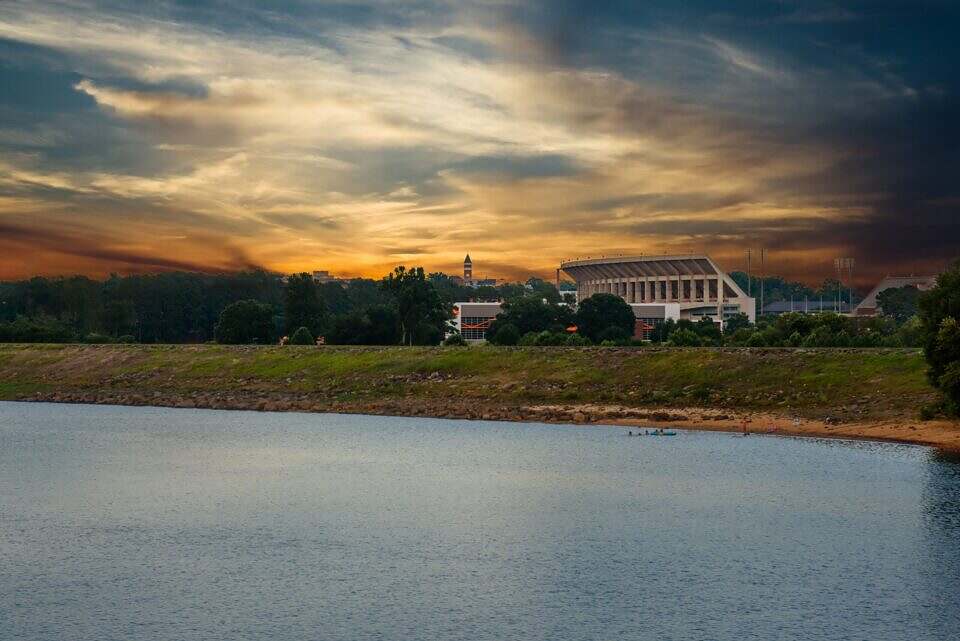
It’s no secret Clemson University is drowning in red ink, but is the specter of actual drowning something its faculty, students and staff ought to be concerned about?
That’s a question in the back of more than a few minds following a disconcerting engineering announcement made last week involving the earthen dams surrounding the Upstate South Carolina campus.
Last Wednesday (August 26, 2026), the Savannah District of the U.S. Army Corps of Engineers (USACE) announced it was imposing additional lake level restrictions at Lake Hartwell – a 56,000-acre man-made reservoir bordering South Carolina and Georgia. The announcement was attributed to the worsening condition of an earthen dam meant to protect the campus from flooding.
Specifically, USACE announced it was lowering the lake’s normal operating level to 656 feet mean sea level (MSL) and its maximum level to 662 feet mean sea level (MSL) in an effort to “reduce pressure” on the dam. Lake Hartwell’s previous normal operating level was 660 feet MSL and its previous maximum level was 665 feet MSL.
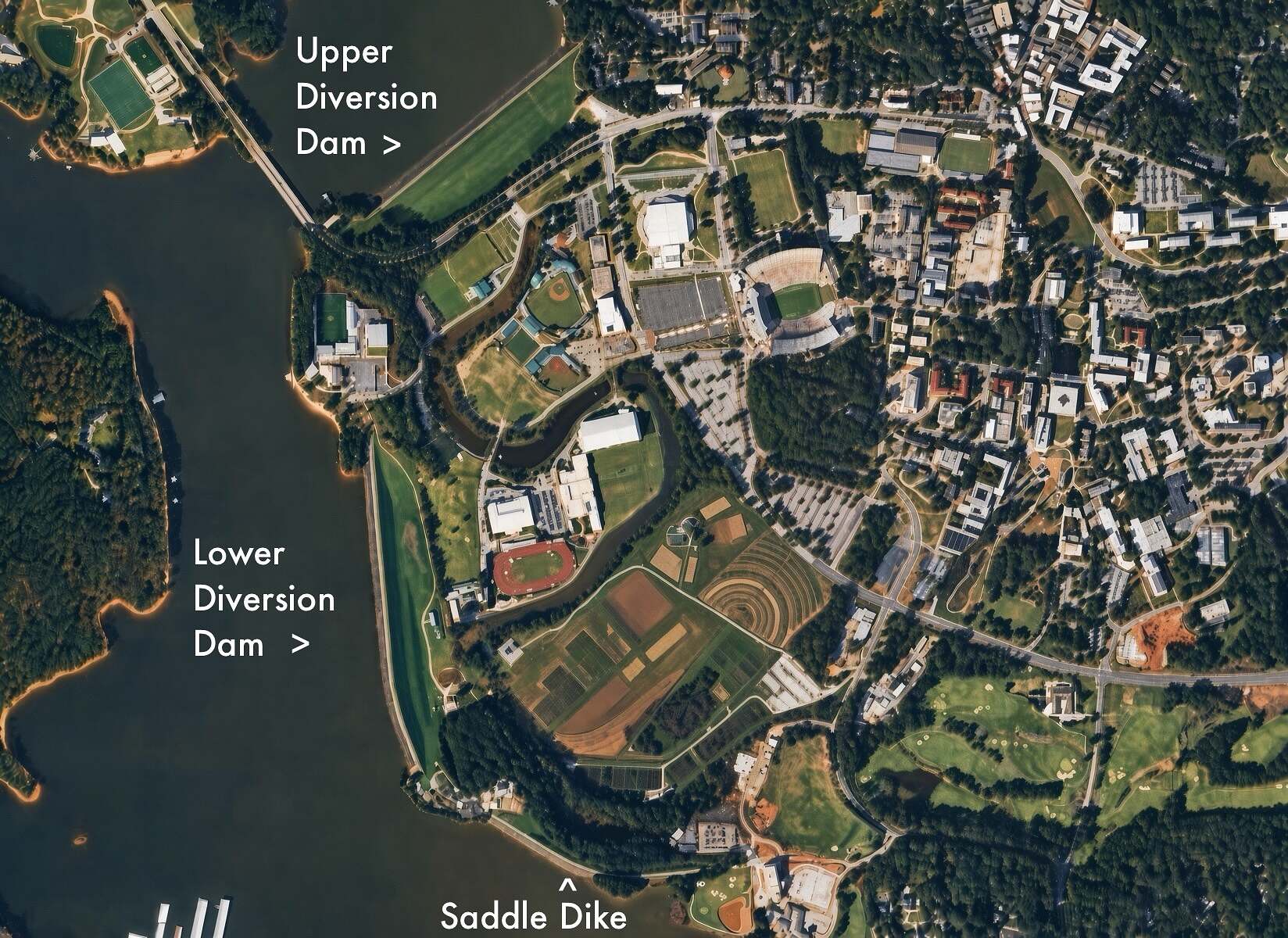
According to the USACE, these new restrictions will remain in place “until a long-term engineering solution is designed and built to resolve flood risks associated with a seepage deterioration path identified at Clemson Lower Diversion Dam Saddle Dike.”
***
RELATED | CODE ORANGE
***
Seepage deterioration paths form when lake water exploits small cracks and loose spots in an earthen dam. The path in the Saddle Dike was uncovered during a recent evaluation that exposed multiple “structural deficiencies” in the levee.
If left unaddressed, the dike will fail.
“Safety is our priority,” said Justin Nixon, the Savannah District’s dam safety program manager. “The current condition of the Clemson Lower Diversion Dam Saddle Dike does not meet the USACE’s acceptable risk standards. These actions will help reduce risk while we develop and construct a permanent solution. Communities and the environment deserve a serious review.”
Nixon said the new lake level limits will “reduce stress on the Clemson Saddle Dike by limiting how high Hartwell Lake can rise during periods of heavy rainfall.” As of 7:00 a.m. EDT on the date of this publication (August 31, 2026), Lake Hartwell’s water level was 650.83 feet MSL – just five feet below its new limit.
Created by the construction of the Hartwell Dam between 1955 and 1963, Lake Hartwell was challenged by Clemson on the grounds that land the school obtained from the U.S. Department of Agriculture (USDA) after construction on the project began would be lost due to its impounded waters – resulting in “irreparable damage” to the college.
To protect the school’s newly obtained acreage – and ensure the economic viability of the project – the Seneca River was diverted around Clemson’s campus by series of protective works which included the Upper Diversion Dam, Lower Diversion Dam and the Saddle Dike.
***
***
These dams were initially constructed of “random earth fill raised on alluvial soil,” but within twenty years of their completion structural integrity issues were already surfacing.
“Seepage on the dry, or protected, side of the structures required numerous repairs over the years,” a history of the project published by USACE noted.
In 1982, a “permanent” solution was implemented – one involving the construction of “concrete cutoff walls within the existing earthen dams, using the slurry wall panel method.”
“This technique, borrowed from an earlier construction method used at the West Point project, involved excavating a trench along the entire length of each of the earthen dams, and filling the trenches with a soupy masonry mixture that, when hardened, formed a relatively impervious concrete wall,” USACE noted. “Work on the lower diversion dam at Clemson was completed in December 1982, and seepage was reduced to the level anticipated. Work on the upper dam began in June 1983, and was completed in June 1984, well ahead of schedule.”
Seepage issues have persisted, though, with USACE tracking seepage under the Saddle Dike dating as far back as 2015.
***
Savannah District to Maintain Lake Level Restrictions at Hartwell Lake
— SavannahCorps (@SavannahCorps) August 26, 2026
For the full press release: https://t.co/Hbh2wXg4oN pic.twitter.com/HrjmGDdafo
***
It could take another decade for the problem to be remedied, during which time significant impacts will likely be felt by property owners in Anderson, Oconee and Pickens counties.
“We are talking about impacting a 1,000 miles of shoreline,” one real estate agent told local radio host Rob Jones. “This is going to hurt real estate values.”
Clemson downplayed the situation, issuing a press release stating there was “no immediate danger to the public” and “no impact on university operations.”
“All University facilities adjacent to the lake… will remain open and fully operational,” the school noted, adding that university officials would “continue to monitor the situation and its potential impacts on Clemson University.”
FITSNews is traveling to Clemson this month and plans on obtaining additional information regarding the Saddle Dike’s vulnerability. USACE has also announced two “virtual public meetings” at which its officials intend to “discuss the engineering findings, explain the temporary lake level restrictions and answer questions.”
Dates for those meetings will reportedly be announced once details “are finalized.”
***
ABOUT THE AUTHOR…
Will Folks is the founding editor of the news outlet you are currently reading. Prior to founding FITSNews, he served as press secretary to the governor of South Carolina. He lives in the Midlands region of the state with his wife and eight children.
***
SOUND OFF…
Got something you’d like to say in response to one of our articles? Or an issue you’d like to address proactively? We have an open microphone policy! Submit your letter to the editor (or guest column) via email HERE. Got a tip for a story? CLICK HERE. Got a technical question or a glitch to report? CLICK HERE.

1 comment
Interesting that the state’s “premier skool a enjineerin” has an “enjineerin” problem. That part of the campus could use a little urban renewal anyway…