by MARK POWELL
***
This week, the federal government’s bean counters confirmed what anyone who’s purchased anything lately already knew: prices just keep going up.
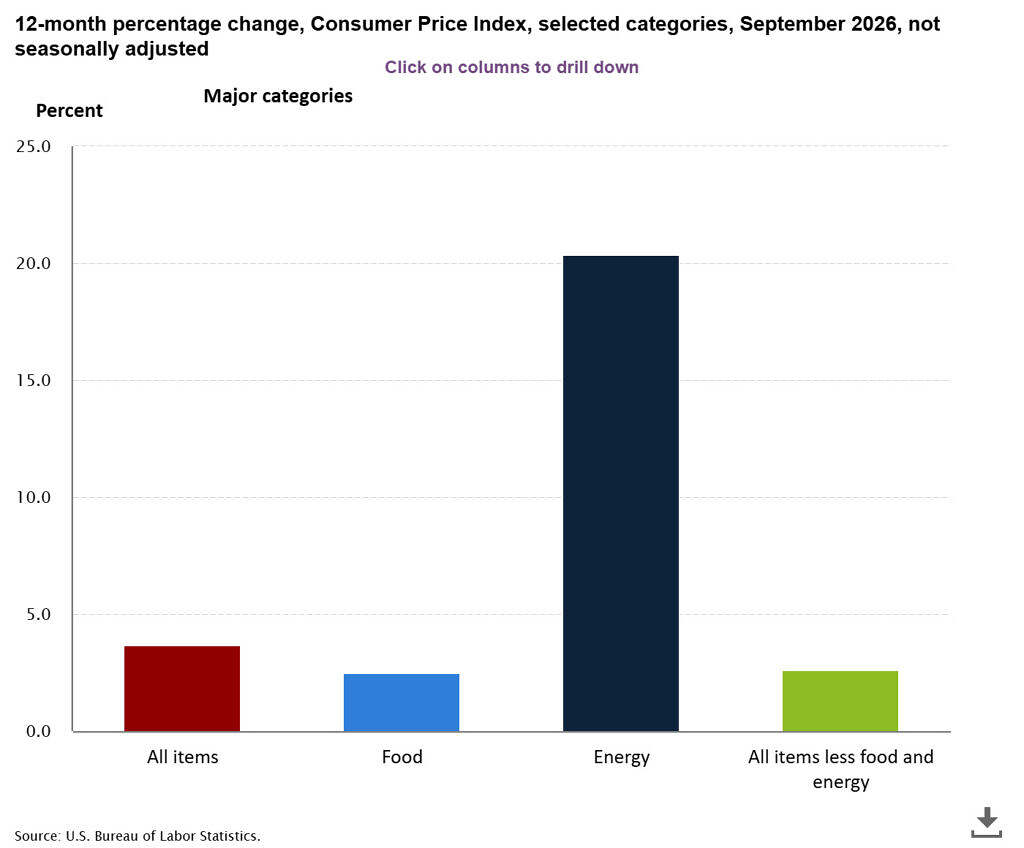
The stats released on Wednesday (October 14, 2026) by the Bureau of Labor Statistics (BLS) are grim. The Consumer Price Index (CPI) – a basket of goods and services purchased by urban consumers – was 3.7% higher in September than it was a year ago and 0.6% higher than it was the previous month. Higher gasoline and diesel prices were the chief culprits, jumping 9.1%. But the cost of housing, cars and trucks, clothing, and pretty much everything else kept inching up as well.
For the past year, energy costs have skyrocketed by 20.4%.
***
***
Beyond the official numbers are other indicators of how middle-class Americans are spending – or more tellingly, not spending – their money. And those are similarly bleak.
“We do think inflation is going to be with us for, unfortunately, I think many more years at an elevated level,” McDonald’s CEO Chris Kempczinski said recently.
When a company that caters to bargain-priced burger buyers isn’t moving meat, you know things aren’t rosy (McDonald’s stock is down 21.96% over the past six months, incidentally).
It’s no surprise, then, that affordability remains the defining campaign issue in these closing weeks of the 2026 election cycle. In fact, the term “affordability” itself is a new wrinkle. Candidates used to talk about “cost of living.” Whatever you call it, you’d better be able to address it – or you’ll wind up political roadkill. Remember former president Bill Clinton campaign’s famous adage, “The economy, stupid?” What was true in 1992 remains every bit as true today.
***

RELATED | S.C. FARMERS SEEK RELIEF
***
Democrats have made affordability one of their two key issues, alternating between “prices are too high” and their promise to impeach deeply unpopular U.S. president Donald Trump a third time. Republican messaging seems to boil down to, “things will get better soon – trust us,” which sounds ominously close to Herbert Hoover’s 1932 promise at the depths of the Great Depression.
“Prosperity is just around the corner,” Hoover vowed.
Spoiler alert: it wasn’t.
“Affordability is a double-edged sword for both parties,” a Washington, D.C.-based political strategist explained. “For Democrats, it’s easy to point to high prices and say, ‘Look what they did!’ While it’s widely accepted their spending spree when they controlled congress in 2021, 2022 and 2023 inflamed the current inflation to epidemic levels – that was then, and this is now. A consumer who’s experiencing pain at the pump or cash register shock at checkout time doesn’t stop to think back: they’re dealing with the present. The party that controls Congress and has the White House is forced to take ownership of the economy.”
“When those consumers become voters next month, it won’t be pretty for Republicans at the ballot box,” the strategist added.
Affordability has dominated discussion on the campaign trail in South Carolina, a state where inflation hits particularly hard due to citizens’ historically low income levels.
“My opponent is going to stand up here tonight and call me a socialist, because that’s what her script says, and also because she doesn’t want to talk to you about your high gas prices, (and) grocery prices,” Democrat nominee Annie Andrews said during a U.S. Senate debate earlier this week.

***
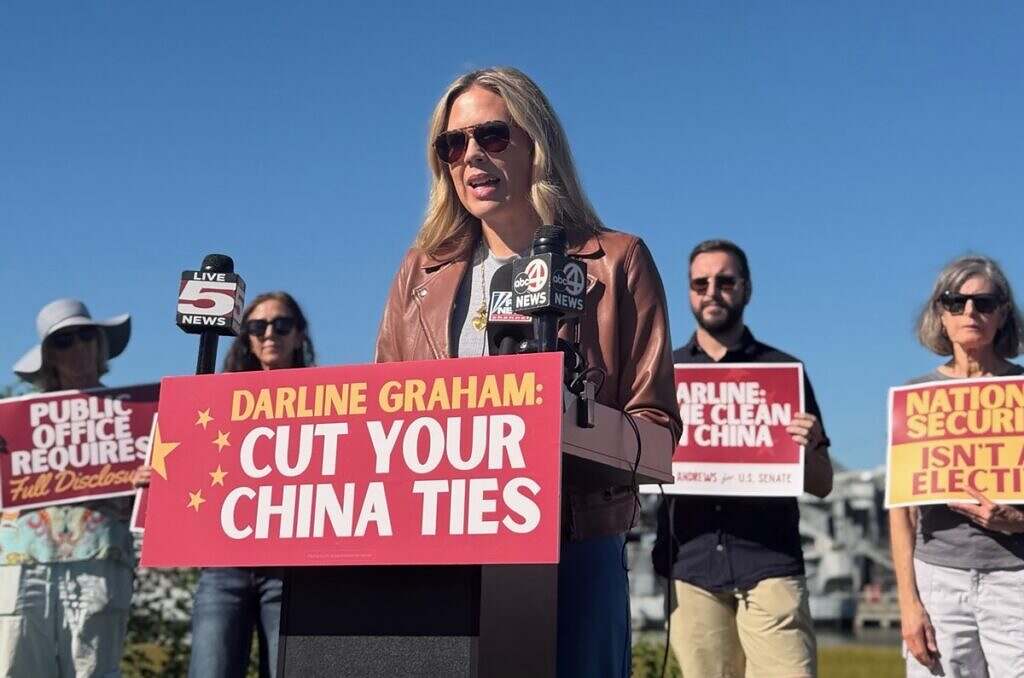
When questioned about her plan to bring down prices, Andrews’ opponent – interim U.S. senator Darline Graham Nordone – largely sidestepped specifics.
“I’ve lived paycheck to paycheck like a lot of South Carolinians,” she said. “So, I know how it feels. I know gas prices are high right now and they’re hurting at the pump. I feel the pain, too. I’m all for suspending any gas taxes. That’s a temporary solution… but the permanent solution, the long-term solution, is easing regulations on drilling and oil refineries.”
Andrews also sought to make a personal connection with voters on the issue – while at the same time reminding them she came out in support of suspending gas taxes long before her opponent did.
“I have three growing children,” she said. “I know how expensive things are. I went to Mount Pleasant and talked to the shrimpers who were being crushed by these record-high gas and diesel prices, which is why I, many, many weeks ago – long before our senator – proposed suspending the federal gas and diesel tax.”
Libertarian candidate Kasie Whitener also tackled the issue – seeming to be the only candidate running who actually understood the root cause of the problem.
***
RELATED | ANNIE ANDREWS BLASTS DARLINE GRAHAM NORDONE
***
“The problems that we’re facing in affordability, everybody wants to address the prices,” Whitener said. “Rising prices are a symptom; they’re not the illness. The illness is scarcity… all these prices are going up because the government owes money. We have a scarcity of money in our pockets because the government owes so much money. There’s just no evidence that either of these parties is going to do anything about the national debt, and the national debt is the problem. The Federal Reserve keeps hiking interest rates to try to cover for the fact that there’s reckless spending happening in Washington, but we cannot cover for it anymore. We’ve got to cut spending. We have to address the national debt. That will bring all the prices down.”
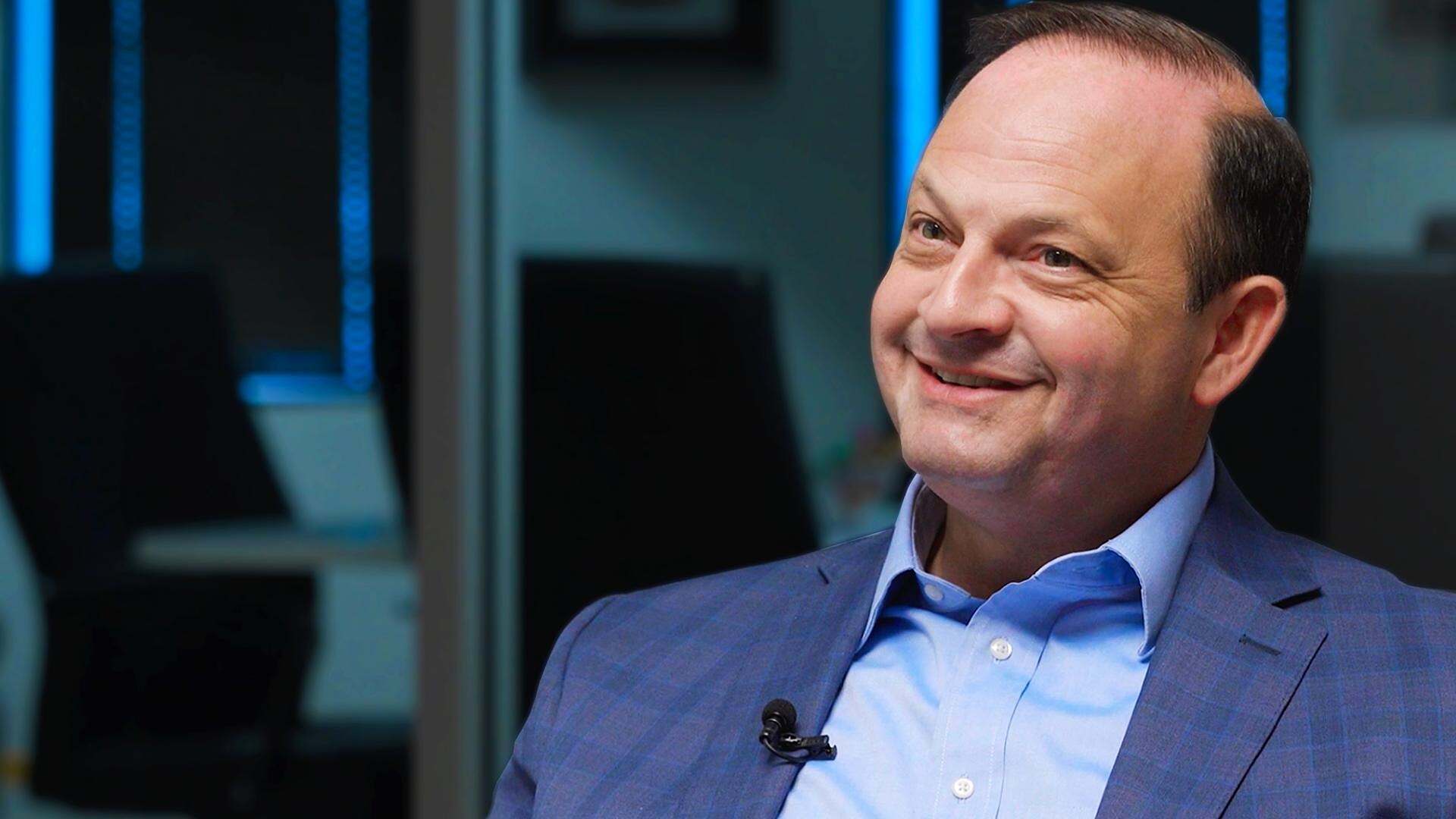
While the race for governor of South Carolina isn’t nearly as competitive as the race for Senate, affordability has been its driving issue as well. Unlike Nordone, Republican nominee Alan Wilson – the state’s attorney general – has demonstrated throughout this election cycle that he is one of the few GOP candidates willing to confront the problem head-on.
“As I travel the state, I’ve heard the same stories,” Wilson said during his debate with Democrat Jermaine Johnson earlier this month. “A single mom who saved, worked hard, bought a home, and couldn’t afford to stay in it. A young couple wondering if they’ll ever be able to buy their first house. A veteran on a fixed income trying to pay his rising utility bill. That’s not okay. Like so many of you watching tonight, they are struggling to make ends meet. As your next governor, I will bring in a new generation of leadership to upend the status quo.”
“At the end of the day, affordability is a priority to me, and letting you spend your money the way that you want to and not the way the government does, is something I will do as governor,” Wilson added later during the debate.
***
***
Johnson didn’t bring up retail prices during his debate with Wilson, but was passionate about another component of the problem: housing costs.
“I’ve introduced legislation that will allow us to use some funds that we get on a state level, as well as the federal level, to redevelop dilapidated buildings inside of some of our urban centers,” Johnson said. “I think we need to do that. One of the worst things that we have done in this state is allowing any single veteran to be homeless… we’ve got to do better about helping out with individuals. I remember when I was able to buy my first house here in South Carolina, and I remember what it felt like to be able to have a place that I could call home, to be able to lay my head on a pillow… y’all, we can do better for the people of South Carolina.”
While Republicans, Democrats and third party candidates are all seeking to address affordability as a campaign issue, it’s not a level playing field.
“Democrats have the advantage on this one by not being the party in power,” the strategist concluded. “They can howl and scream about how bad prices are, and instead of offering solutions, they get to point a finger of blame at Republicans and say, ‘They did it!’ Republicans, on the other hand, are in a tight spot. They can’t blame President Donald Trump and the GOP and then turn around and ask voters to keep them in control on Capitol Hill.”
While Democrats are projected to pick up significant ground nationally, most South Carolina statewide races – with the notable exception of Nordone’s battle with Andrews – seem to be well in hand for Republicans. With just over two weeks to go before voters head to the polls – and just two days before the start of early voting – expect a furious last-minute push as candidates make their final appeals to a shrinking pool of undecided voters.
You better believe “affordability” will be on the tips of their tongues as they do…
***
ABOUT THE AUTHOR…
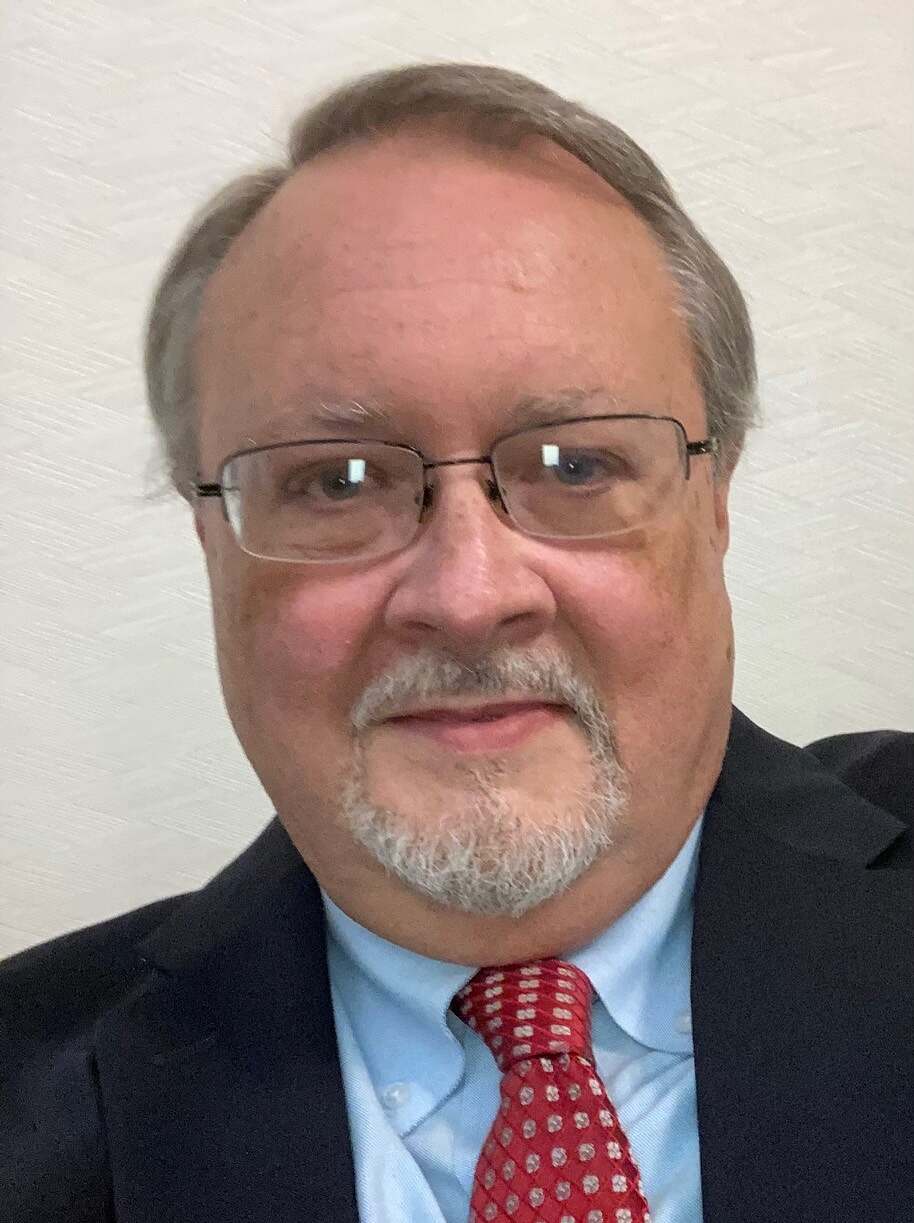
J. Mark Powell is an award-winning former TV journalist, government communications veteran, and a political consultant. He is also an author and an avid Civil War enthusiast. Got a tip or a story idea for Mark? Email him at mark@fitsnews.com.
***
SOUND OFF…
Got something you’d like to say in response to one of our articles? Or an issue you’d like to address proactively? We have an open microphone policy! Submit your letter to the editor (or guest column) via email HERE. Got a tip for a story? CLICK HERE. Got a technical question or a glitch to report? CLICK HERE.
