

by MARK POWELL
***
It may have slipped under your radar, but last Friday, while many South Carolinians were getting ready to watch Clemson go down in flames against Miami or the University of South Carolina fall to Kentucky by a whisker, something concerning was quietly happening 550 miles to the north.
The Trump administration’s top national security team was huddled in the tightly controlled confines of Camp David, Maryland, in what one news outlet called “a highly unusual meeting.”
Vice president JD Vance chaired the gathering that included secretary of state Marco Rubio, secretary of war Pete Hegseth, Treasury secretary Scott Bessent, CIA director John Ratcliffe, joint chiefs chairman general Dan Caine, and White House Middle East envoy Steve Witkoff.
Talk about a power lunch.
Here’s where things get interesting: the last time a similar confab happened was June 2025. And the devastating surprise attack on Iran’s nuclear facilities followed about six weeks later.
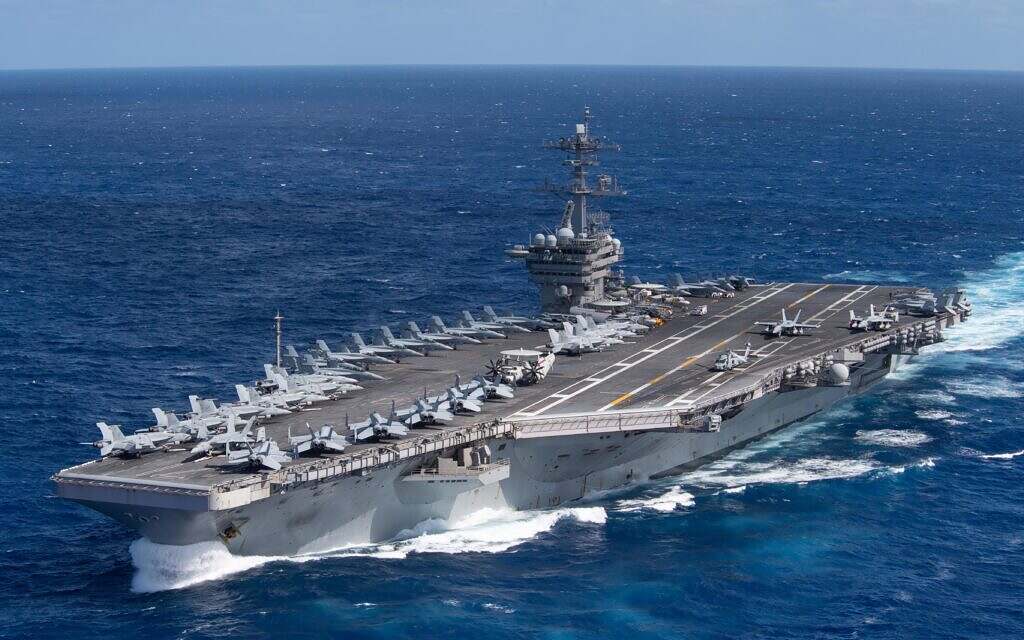
If this were simply a matter of the highest of high-level hobnobbing, that would be one thing. But it wasn’t. Because just 24 hours earlier, the White House announced the USS Theodore Roosevelt carrier group was being dispatched to join the substantial U.S. forces already assembled in the region — and it’s bringing more than 7,000 sailors and 2,000 Marines along with it.
***
***
“They’re not going there to sightsee,” a senior congressional staffer on Capitol Hill told us on condition of anonymity. “It’s costing a fortune to maintain our strong buildup already in the region. Adding this carrier group into the mix drives up the bill even higher. Evidence is mounting that suggests something big may be in the works.”
“Trump is caught between the proverbial rock and a hard place,” a national Republican strategist said, who likewise agreed to speak openly in exchange for confidentiality. “There’s no easy off-ramp. Iran is doing exactly what it’s done for the last 48 years: playing games, talking in circles, and running out the clock. Neither Trump nor the mullahs can afford to lose face by backing down now. Washington knows that, in order for things to change, a bold move is necessary. But that means serious military action, which in turn means casualties. And a political party that’s already unpopular can’t risk that heading into the midterms in four weeks.”
Which is where the calendar comes into play.
“My strong hunch is the White House has privately conceded that the House is very likely lost, and quite possibly the Senate along with it,” the strategist continued. “Democrats have done everything short of putting up billboards saying, ‘we’re going to impeach Trump a third time,’ and if they get control of one or both chambers, they’ll set that ball in motion on day one, which is January 3, 2027. (That means) if the administration is contemplating serious military action, there’s a 90-day window for it. Because if it acts after an impeachment process is set in motion, Democrats would scream their heads off that Trump was doing it to distract attention from their big show on Capitol Hill.”

***
Under that scenario, Trump would be wise to hold off ordering any attack until after November’s ballots are all counted. A quick look at history shows that military operations and the midterms are a politically explosive combination.
In peacetime, the midterms are almost always a rocky road for the party that controls the White House. In the nearly 90 years from 1934 through 2022, that party lost an average of roughly 27 House seats and three Senate seats.
Things get even worse when bombs begin falling.
1950: Communist soldiers from the North storm across the Korean peninsula’s 38th Parallel on June 25, rampaging through the democratic South. President Harry Truman responds by immediately rushing U.S. forces to the scene. Then the coffins begin arriving back home. In November, his Democrats lose 28 House seats, five Senate seats, and control of Congress for the first time since 1932.
1966: Fresh on the heels of his 1964 landslide election, Lyndon Johnson significantly increases U.S. military operations in the Vietnam War. Again, the body bags return home in growing numbers. In that November’s midterms, his Democrats are walloped, shedding roughly 47 seats in the House and four in the Senate.
***

RELATED | WEEK IN REVIEW
***
2006: With memories of World War II, Korea, and Vietnam fading, a younger generation coming to age is horrified as fighting in the Iraq War drags on. President George W. Bush’s Republicans are swamped by a Blue Wave that cost them 30 House seats, six (6) Senate seats, and control of both chambers.
“History may repeat itself, but the Trump administration seems disinclined to lend it a helping hand this time,” the strategist concluded.
However, history does provide a final cautionary tale from a president who got the timing right.
Throughout the first full year of the Civil War, president Abraham Lincoln divided his time between begging Union General George McClellan to move and putting up with his excuses for the lackluster results when he finally did. By the summer of 1862, Lincoln’s patience with the “Young Napoleon” (as the press loved calling him) had run out.
But Lincoln was also a realist. The Republican president realized McClellan was a personally popular, high-profile Democrat, and dumping him before the 1862 midterms was the last thing an administration that had failed to quash what it viewed as a rebellion of Southern states needed just then.
So, Lincoln cooled his heels and bided his time. On Election Day, the GOP sustained major losses in the House and Senate, but still controlled Congress.
Lincoln fired McClellan the very next day.
***
ABOUT THE AUTHOR…

J. Mark Powell is an award-winning former TV journalist, government communications veteran, and a political consultant. He is also an author and an avid Civil War enthusiast. Got a tip or a story idea for Mark? Email him at mark@fitsnews.com.
***
SOUND OFF…
Got something you’d like to say in response to one of our articles? Or an issue you’d like to address proactively? We have an open microphone policy! Submit your letter to the editor (or guest column) via email HERE. Got a tip for a story? CLICK HERE. Got a technical question or a glitch to report? CLICK HERE.
