|
Getting your Trinity Audio player ready...
|
by JENN WOOD
***
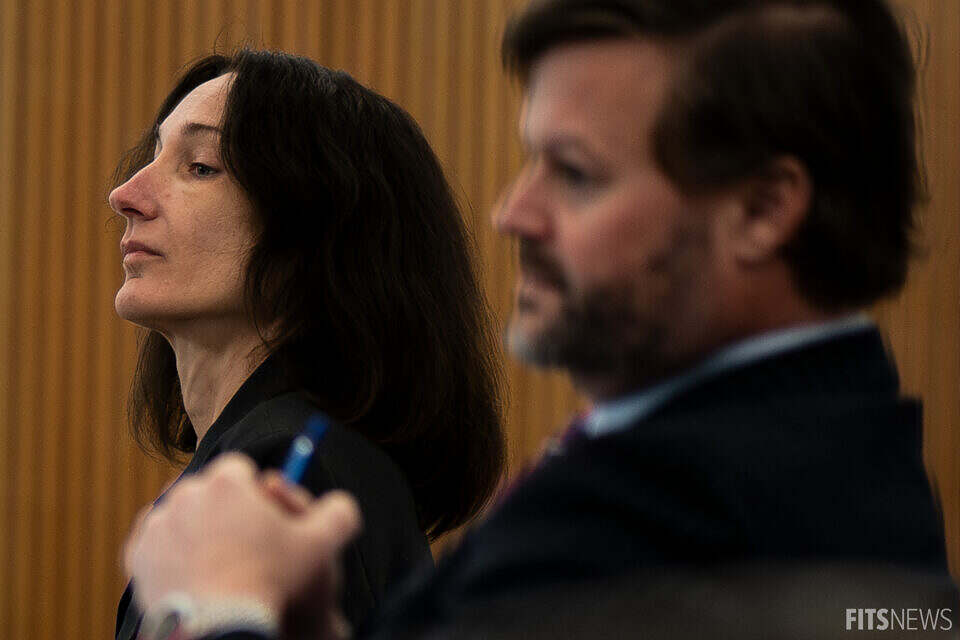
The second day of testimony in the trial of accused killer Amy Vilardi shifted sharply from forensics to motive, money and family tension – with jurors hearing from a landlord, a Verizon employee, relatives of the victims and a former employee who described unusual behavior in the hours before the bodies were discovered.
Vilardi – who is being tried separately from her husband (and co-accused), 38-year-old Ross Vilardi – faces four counts of murder in the November 2015 killings of her 60-year-old mother, Cathy Scott; her 58-year-old stepfather, Terry Michael Scott; her 80-year-old step-grandmother, Barbara Scott; and her 82-year-old grandmother, Violet Taylor.
All four victims were discovered inside of a double-wide trailer on Refuge Road near Pendleton, S.C. on November 2, 2015 – nearly ten years ago. Investigators believe the murders occurred on or about Halloween of that year.
The crime scene confronting responding officers inside the residence was exceedingly graphic. According to Anderson County Sheriff’s Office (ACSO) investigators, Barbara Scott, Taylor, and Terry Scott had their throats slit prior to being shot postmortem in the living room. Cathy Scott was shot twice in the head and then stabbed in a bedroom.
***

***
Video footage of the aftermath of the gruesome crime was played for jurors on the first day of Vilardi’s trial, which is being presided over by S.C. circuit court judge R. Scott Sprouse.
At the time of the murders, Amy and Ross Vilardi lived in a separate single-wide trailer on the same property as their relatives. The couple told investigators they did not discover their bodies for roughly three days.
It wasn’t until December 2023 — more than eight years after the crime — that both Vilardis were charged with four counts of murder.
The second day of the trial moved the case against Amy Vilardi beyond the brutality of the crime scene – and into what prosecutors appear to be framing as motive and opportunity. Meanwhile, defense attorneys Lori Murray and Josh Kendrick continued to effectively rebut the state’s theories on why the couple allegedly perpetrated these savage atrocities on their own flesh and blood.

***
EIGHT THOUSAND DOLLARS
Zuhair Namouz, an Upstate businessman, testified that Ross Vilardi leased commercial property from him for the couple’s dog grooming business. According to Namouz, the Vilardis provided an $8,000 check dated November 1, 2015 labeled “ending lease.”
Because November 1 fell on a Sunday that year, the check was not deposited. Namouz told jurors that on Monday — November 2, 2015 — he received a call from the Vilardis asking him not to deposit the check because they would bring cash instead. He testified $8,000 in cash was delivered the same day – and a receipt dated November 2, 2015 was introduced into evidence.
On cross-examination, Kendrick emphasized rent payments had generally been made – and suggested the Vilardis were not significantly behind at the time the lease ended.
Prosecutors also called a Verizon sales employee who testified that a smartphone and case had been purchased on November 1, 2015 — paid for in cash — at a store on Killian Road in the Blythewood area northeast of Columbia, S.C. A receipt reflecting the November 1 purchase date was admitted into evidence. On cross-examination, the defense noted the receipt did not indicate the time of day the transaction occurred — a fact likely to come into play as Murray and Kendrick continue poking holes in the state’s case.
***

***
FAMILY TESTIMONY
Two relatives of the victims — Jennifer Rigdon and Pamela Isbell — provided jurors with a window into the Scott household in the months leading up to the murders, describing both the security habits at the residence as well as a growing strain between Amy Vilardi and her family.
Rigdon — a niece of Mike Scott — testified that her uncle was protective of his home. The front door was routinely locked, and his bedroom door was kept locked at all times. If he needed to retrieve something, he would unlock the bedroom, go inside briefly, then lock it again. She also described a motion sensor at the end of the driveway that triggered an alert inside the home when vehicles entered or exited the property.
Rigdon told jurors that in the months before the killings, the Vilardis were not frequent dinner guests – and that Amy Vilardi’s relationship with her mother and stepfather had become “almost nonexistent.” When she arrived at the taped-off crime scene on November 2, 2015, she saw the Vilardis near the perimeter and testified they did not appear hysterical or emotional and did not speak with her.
Pamela Isbell, Mike Scott’s younger sister, offered emotional testimony about her brother and mother, Barbara Scott.
“He took care of everyone, but he took very good care of our mother,” she told jurors. “He was my everything.”
***

***
Isbell described her brother as a longtime employee of the S.C. Department of Transportation (SCDOT) who bought and sold gold and collectibles and kept significant amounts of cash in his bedroom. She testified that when she would take their mother to doctor’s appointments, Mike would retrieve cash from his locked bedroom and give it to her.
Isbell also described a turning point after July 4, 2015, when family members were no longer allowed to see Amy Vilardi’s children. Facebook messages from August 2015 between Isbell and Amy Vilardi were introduced, reflecting mounting tension and accusations within the family.
In one exchange, Amy Vilardi referenced conflict with her mother and stepfather and suggested the relationship had deteriorated.
Isbell testified that shortly before Halloween 2015, Mike Scott told her Amy Vilardi was going to allow the family to see the children again. When she spoke with him on October 31, he was excited about the upcoming visit.
On cross-examination, defense counsel pressed Rigdon on whether she knew with certainty that the back door was always locked; she acknowledged she did not. Murray also questioned Isbell about Mike Scott’s sobriety and asked if there were any improvements in the relationship between Vilardi and her mother between July and late October. Isbell recalled the only change occurred the week prior to the murder when Mike told her that they were going to be allowed to see the kids.
Together, the testimony painted a picture of a home that was routinely secured, where cash was kept in a locked bedroom, and where relationships — once close — had grown strained in the months before the killings.
***
RELATED | AMY VILARDI FINALLY FACES A JURY
***
‘WHEN IT WAS BAD, IT WAS TERRIBLE’
Roxie Vorhees, a former employee at Styles for Miles Pet Spa and a longtime acquaintance of Amy Vilardi, provided some of the most closely watched testimony of the day.
Vorhees testified she began working for Vilardi in 2014–2015 and described her and Ross Vilardi’s relationship as “great” at first. She characterized Amy Vilardi’s relationship with her mom as volatile.
“When it was good, it was good,” she said. “When it was bad, it was terrible.”
Vorhees testified the grooming business shut down shortly before the murders – and that employees were given only two days notice. On November 1, 2015, she exchanged texts with Amy Vilardi about picking up her final paycheck. She testified she went to the Vilardis’ single-wide trailer that day.
While there, Vorhees said she noticed a blue glow from a television inside the victims’ trailer. She described it as unusual because, in her experience, Mike and Cathy went to bed early. She also said she observed the bathroom light on.
Vorhees testified that while she was there picking up her check, Amy Vilardi gave her a cell phone. She later turned that phone over to the Anderson County Sheriff’s Office (ACSO) and said she did not erase any data from it.
She further testified that Ross Vilardi frequently wore red Asics tennis shoes, identifying a photograph of Ross wearing the shoes from surveillance footage. She said she did not recall seeing those shoes again after the murders.
***

***
The defense’s cross-examination of Vorhees was pointed. Murray asked Vorhees whether she believed Amy Vilardi had committed the murders. When she responded in the affirmative, Murray proceeded to question her about prior statements to investigators in which she reportedly indicated she did not believe either Amy and Ross Vilardi committed the murders.
Vorhees acknowledged her opinion on the case evolved over time.
Murray also questioned Vorhees about continuing to associate with the Vilardis after the killings – and assisting with the cleanup of the trailer where the murders occurred. Vorhees responded that the couple likely asked her to help because they knew she had expressed interest in crime scene cleanup as a career.
At one point, Murray refreshed Vorhees’ recollection with a video of a prior interview – and pressed her about prior statements regarding Cathy Scott’s temperament and alleged altercations. Vorhees agreed, stating that based on what she had heard, Scott was prone to altercations.
The exchange suggested the defense intends to challenge Vorhees’ credibility and consistency as the trial continues.
***
CIRCUMSTANTIAL — BUT ENOUGH?
As the second day of testimony concluded, jurors were no doubt mulling the information they received about cash payments, text messages, family tension and a home that was routinely locked and monitored.
As prosecutors continue to assemble what amounts to a circumstantial case built on timing, access and financial motive, defense attorneys are signaling their intention to challenge the credibility of key witnesses, question evolving statements, and cast doubt on whether the evidence truly proves who committed the murders.
Will it all come down to that circumstantial evidence? Or will there be a piece of physical evidence that pushes one theory across the threshold of reasonable doubt?
Nearly a decade after four lives were taken inside a Pendleton trailer, the jury is now tasked with sorting through those competing narratives — piece by piece, witness by witness.
Testimony in Amy Vilardi’s trial is set to resume tomorrow (Wednesday, February 25, 2026).
***
ABOUT THE AUTHOR …

As a private investigator turned journalist, Jenn Wood brings a unique skill set to FITSNews as its research director. Known for her meticulous sourcing and victim-centered approach, she helps shape the newsroom’s most complex investigative stories while producing the FITSFiles and Cheer Incorporated podcasts. Jenn lives in South Carolina with her family, where her work continues to spotlight truth, accountability, and justice.
***
WANNA SOUND OFF?
Got something you’d like to say in response to one of our articles? Or an issue you’d like to address proactively? We have an open microphone policy! Submit your letter to the editor (or guest column) via email HERE. Got a tip for a story? CLICK HERE. Got a technical question or a glitch to report? CLICK HERE.