
***
This spring the South Carolina legislature passed a law, H.4216, that sets the income tax on a path to zero. The law sets the goal, but not the schedule. The money to get there has already been flowing into the state’s main account, which took in $7 billion in 2015 and $14 billion in 2025. That is $7 billion more in 2025 than in 2015. In 2025 the income tax accounted for $6 billion of the $14 billion. The growth in the account is bigger than everything the income tax brings in.
It makes sense to end this tax as soon as possible, and the state’s own books say it can be reduced to zero and taken off the books without a new tax, or a higher one, taking its place.
Ending the tax means more money goes home with South Carolina workers every month. It means no state return to fill out in April, and no state tax taken out of a pension or a paycheck.
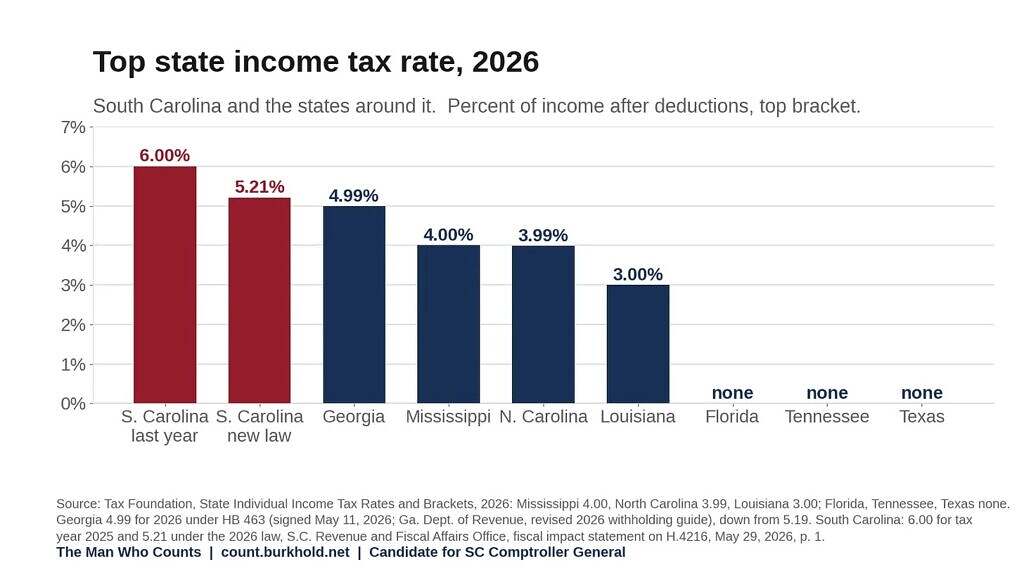
Eight states get by without an income tax, and three of them, Florida, Tennessee, and Texas, are Southern states like ours. Both of our neighbors charge less than South Carolina charges now. North Carolina is at 3.99% and Georgia at 4.99%.
***
***
South Carolina’s top rate is not just a rich man’s rate. Last year the top rate, 6%, started at about $18,000 of income after deductions, so three out of four returns that owed anything owed at the top rate. The new law moves that line to $30,000 and the rate to 5.21%, and about six in ten returns that owe anything will owe at the top rate under it.
South Carolina was the fastest-growing state in the country last year, and 66,622 more people moved in from other states than moved out. It grew that fast with the income tax in place, so nobody can say the tax slows growth. The case for ending the income tax is plainer than that: the money to end it is already here, and it belongs to the people who earned it.
North Carolina, Florida, Tennessee, and Texas all charge less income tax than we do. And our legislature can end the income tax without raising another one.
The new law’s rule cuts the tax only in those years the state’s forecasters predict the income tax will grow 5%. Problem is, that forecast has not been made since 2018. The first year’s $308.7 million did not wait on a forecast. The legislature wrote it straight into the rates.
So the question is where the money to finish the job will come from. A rate cut is permanent, and the money to replace the income tax has to come in every year. It comes from the sales tax, which grows on its own as the state’s population and economy grow, with no need to add any new items subject to it.
***
RELATED | N.C. LAWMAKERS APPROVE GAS TAX SUSPENSION
***
On the spending side, our main account doubled in ten years, and the state spent it as fast as it came in. Half of that growth was population plus inflation, what economists call “popflation.” The other half, about $3.4 billion a year by now, was the state choosing to spend more – and every dollar of it is a dollar the income tax could have come down instead.
We have a great opportunity now if South Carolina can hold its spending to popflation – about 4% a year. If it does, the sales tax and the rest of what it already collects grow past what it spends each year. The income tax comes down by the difference, year after year, on money that came in. Nobody has to find $6 billion. The state just has to stop spending every new dollar the minute it arrives. If the next ten years go like the last ten, holding spending to popflation would cut the income tax rate about in half by the end of them, a little more each year, and keep cutting after that.
The road to zero gets shorter every time the state finds spending it can stop, and there are three ways to shorten it. The state can run its agencies the way a business runs, and every dollar of waste it finds comes off the tax. It can freeze spending for a few years instead of holding it to 4% (one study of the tax found that a four-year freeze followed by six years at popflation would pay for the whole tax in ten). And it can put some of its considerable reserves toward the job: the main account closed 2025 with $6.6 billion unspent, and that money can buy the tax down while the growth catches up.
Each one has a price. A freeze means prices rise and the budget does not. Reserves pay once and have to be replaced. Savings have to be found before they count. But each one moves the day closer, and the legislature can choose any of them.

***
Ending the income tax can also change how South Carolina recruits business. One place to look first is what the state spends to bring businesses here. Commerce hands out grants and job development credits, which let a company keep part of the income tax withheld from its new workers’ paychecks to the companies it picks. The Legislative Audit Council (LAC) found that Commerce checks what those companies deliver mostly by reading what the companies report, and that it “has not found a credible way” to measure what the incentives return.
More than 530,000 of South Carolina’s businesses are small, 99 in 100 of them, and they added seven of every ten new jobs the state gained last year. The companies Commerce bargains with are the ones big enough to promise a plant or a headquarters; the plumber, the pharmacy, and the family restaurant never get to that table. A lower income tax reaches all 530,000 small business owners – and the big ones too – on the same terms, with no one in Columbia picking favorites.
Nobody can count how many businesses a lower income tax rate brings; the record does not say. But a state that costs less to do business in has less to make up with checks and incentives, and every check it does not have to write is a dollar closer to zero for South Carolina taxpayers.
The state took its share of your paycheck before you saw it, every year, and over the last ten years what it took in doubled. It could have let the income tax come down by the difference. It spent the difference instead. Hold the line on spending, count the money, and the tax can come down as fast as the money is there. The line is the legislature’s to hold. The count is the Comptroller General’s: what each agency is holding, what each dollar of it is for, identifying waste, and how much is left over from business that is finished, on one page anyone can read.
***
ABOUT THE AUTHOR…

Mike Burkhold is the Republican candidate for South Carolina Comptroller General. He is running on a platform of transparency and accountability. The sourced version of this piece, with every figure footnoted to its document and page, is at count.burkhold.net where he publishes information on South Carolina finances every Tuesday morning.
***
SOUND OFF…
Got something you’d like to say in response to one of our articles? Or an issue you’d like to address proactively? We have an open microphone policy! Submit your letter to the editor (or guest column) via email HERE. Got a tip for a story? CLICK HERE. Got a technical question or a glitch to report? CLICK HERE.
