

***
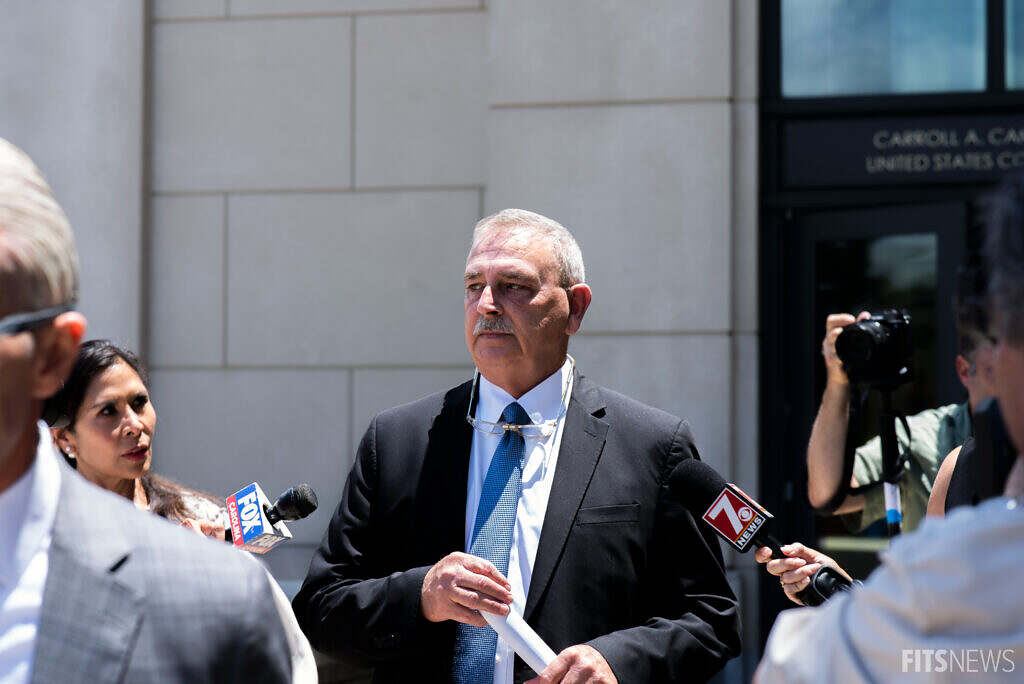
In what would prove to be the final months of Chuck Wright’s tumultuous reign as sheriff of Spartanburg County, South Carolina, the former administrative captain who oversaw the agency’s budget for nearly two decades found himself sitting across the table from state and federal agents.
As recordings from the case file now reveal, Mark Barry walked those agents through the rot that would precipitate the fall of a sitting sheriff whose flagrant abuse of taxpayer money had become an open secret — and whose loyalty to a code enforcement officer had become untenable.
“We had too many chief, not enough Indians,” Barry told agents with the South Carolina Law Enforcement Division (SLED) and the Federal Bureau of Investigation (FBI) during his February 14, 2025, interview, reflecting on his final years with the scandal-scarred department.
“It’s a shame we’re at this point,” he later added.
***
***
For all his lamenting, though, the same recording that captures Barry cataloging the sheriff’s failings also captures an administrative captain who saw the warning signs within the coffers and divisions he oversaw – yet ultimately chose to retire months early in January 2024.
In fact, much of Barry’s interview centered on what he said he learned in the twilight of his tenure, starting with the sheriff’s taxpayer-funded county credit card, which Wright later admitted to running up for years on frivolous purchases such as cigarettes and satellite radio.
***
“HEART OF GOLD…”
***
Any semblance of Wright’s county credit card abuse didn’t come to Barry’s attention until around mid-2022, he told agents, when his longtime assistant Lisa Estes and county budget director Kelly Newman flagged a series of irregular charges on the sheriff’s credit card.
Of the many charges for items taxpayers had no business paying for, the only ones Barry said stood out to him were purchases from Apple and Dollar General.
Concerned enough to raise the issue, Barry said he followed the chain of command and took the charges to chief deputy William “Billy” Parris, and the two of them brought the matter to Wright.
“Those are mine,” Barry recalled the sheriff telling them, adding that Wright promised he would “take care of that.”
There is little indication he ever did.
A month before Barry sat down with SLED and the FBI, Estes, who handled the sheriff’s credit card statements, told the same investigators the only reimbursement she ever got from Wright was $1,111 at the end of 2024, after his taxpayer-funded indulgences made headlines.
Whatever goodwill it was meant to buy, the reimbursement was a pittance next to the $11,883 in Apple charges billed to the sheriff’s county credit card.
Barry’s account also undercuts what Wright told the same agents three months earlier, when the sheriff claimed he thought the Apple purchases — many of them made to feed an insatiable Candy Crush habit on his county iPhone — were going on his personal credit card all along.
For all its absurdity, the sheriff’s Candy Crush habit pales in comparison to the opioid addiction he would later admit to in federal court, one that Parris, in his own interview with the same agents just days before Barry’s, said he had known about for years.
***

RELATED | WHEN STATE AND FEDERAL AGENTS APPROACHED CHUCK WRIGHT’S PILL DEALER
***
Barry, for his part, offered agents nothing beyond rumor when asked about the sheriff’s opioid use but readily diagnosed the root of the spending problem.
“He should have never had a credit card,” he said.
As for how the sheriff’s credit card bill was being paid, Barry told agents that Estes would simply “take money out of” any number of the agency’s “budgeted accounts.”
Gas, for instance, came out of the “training and travel account,” though Barry conceded he did not know how Estes covered the full balance each month.
“I don’t think there was an account in our budget that said ‘sheriff’s office credit card’ on it,” he said.
Of the accounts Barry could actually name, he mentioned a “special means account” and a “miscellaneous account,” though he noted that others, such as the “federal forfeiture” and “state forfeiture” accounts, were “very restricted.”
That was not the case, however, for the department’s “gambling account,” which Barry said had “no restrictions” and primarily covered buying back stolen property from pawn shops, along with the civil fees needed to get forfeiture cases into court.
“Nobody gambles anymore,” he added. “So there wasn’t a lot of money in there.”
It was a peculiar remark (exhibit one, exhibit two), considering that roughly two months after Barry’s interview, the same agents would approach Michael Thornton — the Upstate handyman who admitted to supplying Wright with prescription opioids and “information…” on illegal poker houses.
Back in February 2025, however, Barry painted a far gentler portrait of the opioid-addled lawman he had known since the 1980s.
“Chuck Wright has got a heart of gold,” he told agents. “But he’s so dang immature.”
***
“WELL, HE’S A CIVILIAN…”

***
Also under Barry’s purview was the sheriff’s office civil division, where Lawson “LB” Watson, a distant Wright relative and eventual co-defendant, had worked as a code enforcement officer since 2005 — the same year Barry was appointed to oversee it.
Few figures in the Wright saga have drawn more conflicting accounts from witnesses than Watson, 74, and Barry’s was among the… least charitable.
Needing little prompting, he gave agents an unflattering review of the sheriff’s cousin, claiming Watson owned multiple cars but kept only one tag, was the subject of civilian complaints over his conduct in Reidville and tried to intimidate the county clerk of court.
As for how Watson landed at the Spartanburg County Sheriff’s Office (SCSO), Barry told agents the hire stemmed from a misunderstanding, claiming Wright brought him on believing he was a state constable when he was in fact a magistrate’s constable.
It is a meaningful distinction in the Palmetto State, where state constables are commissioned through SLED with the authority to carry a firearm and make arrests, while a magistrate’s constable is largely limited to serving papers.
Barry further told agents it took the sheriff some time to grasp the difference, saying Wright would frequently ask why Watson couldn’t carry a badge and a gun, only for Barry to remind him, “well, he’s a civilian.”
***
***
Critical as he was, however, even Barry acknowledged Watson served civil papers and was “involved” in eviction proceedings, a notable concession considering Watson was later convicted in what prosecutors described as a “no-show job scheme.”
That’s an account retired Sgt. Danny Shields would echo months later, telling the same agents Watson had been a “good employee” for decades.
Watson was nonetheless a sore spot within SCSO, and Barry said he grew increasingly divisive in his later years, pointing to at least one incident involving a firearm and mounting office drama over a girlfriend-turned-ex whom Watson helped get hired.
“The sheriff was very defensive when it came to [Watson]” Barry said. “Very defensive… I don’t know if LB helped him out at one time or what.”
Just as he did with the sheriff’s credit card, Barry offered agents a blunt verdict on Wright’s cousin.
“That guy should have been let go a long time ago.”
Much has changed in the nearly two years since Barry sat down with state and federal agents, with Wright and Watson having both been charged, convicted and sentenced in an increasingly scrutinized federal public corruption case.
Whatever its shortcomings, the case has left Wright serving a 41-month federal prison sentence in Pennsylvania, while Watson is serving 16 months at a separate facility in West Virginia.
Write to Andrew Fancher at andy@fitsnews.com.
***
ABOUT THE AUTHOR…

Andrew Fancher is a Lone Star Emmy Award–winning journalist from Dallas, Texas. He joined FITSNews in 2023 after leaving an NBC affiliate, where he served as on-air talent. His reporting focuses on public corruption in South Carolina, with an emphasis on law enforcement misconduct and abuse of power.
***
SOUND OFF…
Got something you’d like to say in response to one of our articles? Or an issue you’d like to address proactively? We have an open microphone policy! Submit your letter to the editor (or guest column) via email HERE. Got a tip for a story? CLICK HERE. Got a technical question or a glitch to report? CLICK HERE.
