
by ERIN PARROTT
***
South Carolina law enforcement leaders are pushing for a major change in federal regulations that could allow state prisons and local jails to block illegal cell phone signals for the first time.
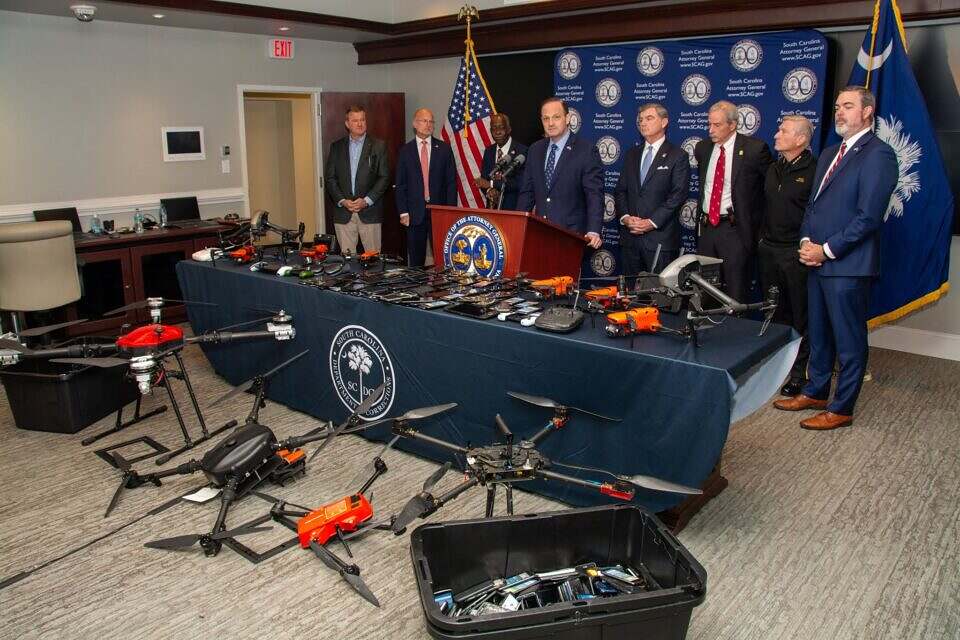
On Wednesday (November 18, 2026), Federal Communications Commission (FCC) chairman Brendan Carr joined S.C. attorney general and governor-elect Alan Wilson, S.C. Department of Corrections (SCDC) director Joel Anderson, attorney general-elect David Stumbo and other law enforcement officials in Columbia to announce an upcoming vote on the issue.
The FCC is scheduled to vote on Thursday (November 19, 2026) on proposed rules that would allow correctional facilities to jam signals from contraband cell phones – a measure South Carolina officials have been pushing for decades
“We’ve been working for decades to get the FCC to allow us to jam contraband cell phone signals inside state prisons,” Wilson said. “Prison inmates in South Carolina have been using cell phones to continue to commit more crimes from behind bars, and we need to shut that down to protect the public.”
According to law enforcement officials, inmates have used illegal cell phones to coordinate murders, operate drug trafficking organizations, orchestrate scams and commit other crimes while incarcerated.

***
Anderson described contraband cell phones as among the most dangerous weapons inside correctional facilities, arguing that blocking their signals would prevent inmates from continuing to victimize the public. Anderson was appointed SCDC director on an interim basis by governor Henry McMaster in April of 2025. He was confirmed by the S.C. Senate in March of this year.
One example highlighted during Wednesday’s announcement involved former SCDC captain Robert Johnson, who supervised contraband operations at Lee Correctional Institution.
In 2010, an inmate allegedly used an illegal cell phone to arrange Johnson’s murder. Johnson was subsequently shot six times inside his Sumter, S.C. home. Although he survived the assassination attempt, he has undergone 38 surgeries in the years since.
***
Contraband is a battle fought every day at SCDC. It was use of an illegal cellphone by an inmate in 2010 that nearly cost Captain Robert Johnson his life. @FCC @BrendanCarrFCC will be in Columbia Wednesday, ahead of the commission’s vote on Thursday to allow cellphone jamming inside our prisons. He will be speaking with Director Joel Anderson, @GovElectWilson and other officials ahead of a press conference at 12 p.m. Learn about some of the steps it has taken to get to this point. #WeAreCorrections
— S.C. Department of Corrections (@SCDCNews) November 17, 2026
***
S.C. Law Enforcement Division (SLED) chief Mark Keel also emphasized the dangers associated with contraband phones, pointing to their use in drug trafficking, gang activity and violence.
“If a cellphone can’t get a signal, an inmate can’t order a hit, conduct a scam, stalk their victim, orchestrate a riot, or continue acting as the kingpin of their money-making drug trafficking organization,” Keel said.
Carr raised concerns about inmates using contraband devices to target minors and produce child sexual abuse material. Although the FCC has previously authorized other technologies aimed at combating illegal cell phone use in correctional facilities, federal regulations have historically prohibited signal jamming due in part to concerns about interference with legitimate communications.
Stumbo said demonstrations of the proposed technology have shown that signals can be blocked inside correctional facilities without disrupting cell phone service outside prison walls.
Earlier this week, federal officials led by former SCDC director (and current U.S. attorney) Bryan Stirling announced charges in connection with a sprawling, multi-state fentanyl operation – one of many such enterprises allegedly coordinated via contraband prison cell phones.
Stirling has been one of the most vocal Palmetto State leaders in support of jamming prison cell phones, repeatedly arguing that criminals linked to violent organizations used them to “continue their criminal ways from behind bars.”
Thursday’s vote could mark a significant shift in federal policy, potentially giving South Carolina correctional officials another tool to combat criminal activity originating from behind bars. The proposed rules have not yet been approved, and their implementation would depend on the outcome of Thursday’s FCC vote.
***
ABOUT THE AUTHOR…

Erin Parrott is a Greenville, S.C. native who graduated from the University of South Carolina in 2025 with a bachelor degree in broadcast journalism. Got feedback or a tip for Erin? Email her here.
***
SOUND OFF…
Got something you’d like to say in response to one of our articles? Or an issue you’d like to address proactively? We have an open microphone policy! Submit your letter to the editor (or guest column) via email HERE. Got a tip for a story? CLICK HERE. Got a technical question or a glitch to report? CLICK HERE.
