

by WILL FOLKS
***
Earlier this month, online lending marketplace Lending Tree published an analysis of census data which revealed some significant geographic shifts among Generation Z (also known as “Gen Z” and “Zoomers”).
For those of you unhip to America’s prevailing demographic cohorts, Gen Z refers to individuals born between 1997 and 2012 – or citizens roughly between the ages of 15 and 29.
According to the Lending Tree analysis, nearly one in four Gen Z adults – an estimated 10.7 million of the 44.6 million Americans who fall within that demographic (or 23.9%) – moved across state lines in 2024, the most recent year for which census data is available.
“That’s a far higher share than for any other age group,” consumer finance analyst Matt Schulz wrote, noting that only 14% of Millennials, 7.2% of Gen Xers and 5.2% of Baby Boomers moved across state lines in 2024.
While a big chunk of the Gen Z migration (38.1%) was attributable to students attending college – an estimated 6.6 million Zoomers moved across state lines for reasons unrelated to higher education. Even after subtracting the college component, Gen Z still led all the other age cohorts in state-to-state migration.
Where are these young Americans headed?
***
***
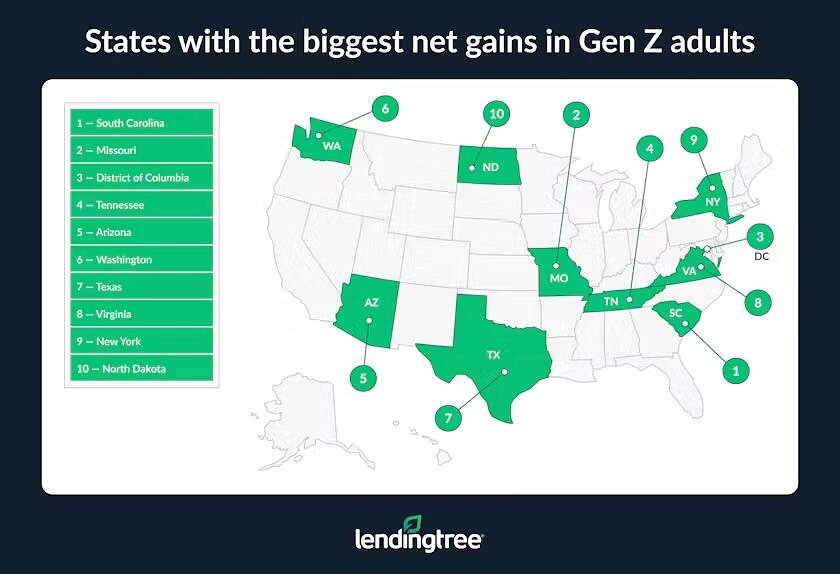
South Carolina led the nation with a net gain of 22,843 new Gen Z adults, while California led the nation with the net loss of 58,109 Gen Z adults. Surprisingly, the Palmetto State’s influx of Zoomers was nearly twice that of the No. 2 state on the list, Missouri – which saw a net gain of 14,063 Gen Z adults.
Young Americans aren’t the only ones flocking to South Carolina. Earlier this year, Hire a Helper – an online moving services marketplace – used proprietary 2025 data collected from PGM to track where Americans over the age of 65 were migrating.
According to that study, released in February, an estimated 2.1 million Americans over the age of 65 relocated last year. Once again, South Carolina led the nation with a net gain of 5,427 retirement-age movers – while California led the nation with a net loss of 12,963.
“This marked the strongest net growth among all states, positioning South Carolina as one of the fastest-rising retirement destinations (and destinations for older adults in general) in the country,” Hire a Helper’s senior editor Daniel Cobb noted.
A year ago, FITSNews reported on the Palmetto State’s incoming population surge – and the strain this influx would place on its outdated infrastructure and antiquated, dysfunctional state government.
***

RELATED | SOUTH CAROLINA CAN END ITS INCOME TAX
***
“Is South Carolina poised to handle its upcoming influx of new people?” this reporter rhetorically mused. “In a word, ‘no.’ Thanks to decades of corruption, cronyism and inefficiency at the municipal, county and state level, the Palmetto State has been stuck behind the eight ball in addressing core infrastructure challenges.”
Census estimates from last year show the explosive growth is already upon us. Multiple Metropolitan Statistical Areas (MSAs) in the Palmetto State have seen significant upticks in population since the 2020 census – with the Greenville/Anderson/Greer MSA adding an estimated 85,906 new citizens (a 9.26% increase) over the past five years. Greenville now anchors the nation’s 55th largest MSA with a total population of 1.01 million – up four spots from 2020.
The Charleston/North Charleston MSA saw even more newcomers, with an estimated 89,627 new citizens (an 11.21% increase) from the 2020 census. Charleston/North Charleston is now the nation’s 66th largest MSA with a total population of just under 890,000 – up seven spots from 2020.
As for the state capital of Columbia, its MSA added an estimated 50,448 new citizens over the past five years (a 6.08% uptick). It’s population now stands at just under 880,000 – making it the 71st largest MSA in the country. Columbia did not move on the list of largest MSAs over the past five years, although it was leapfrogged by Charleston – and fell further behind Greenville.
By far the most explosive growth in South Carolina over the past five years has occurred in the Myrtle Beach area – which has added 76,522 new citizens (a staggering 21.8% surge). With a total population of 427,758, the Grand Strand area is now the nation’s 131st largest MSA – up a stunning 24 spots in just half a decade.
Keep it tuned to FITSNews as we track these trends… and assess the ability of the state to absorb them.
***
ABOUT THE AUTHOR…

Will Folks is the founding editor of the news outlet you are currently reading. Prior to founding FITSNews, he served as press secretary to the governor of South Carolina. He lives in the Midlands region of the state with his wife and eight children.
***
SOUND OFF…
Got something you’d like to say in response to one of our articles? Or an issue you’d like to address proactively? We have an open microphone policy! Submit your letter to the editor (or guest column) via email HERE. Got a tip for a story? CLICK HERE. Got a technical question or a glitch to report? CLICK HERE.
